Department of Agricultural and Resource Economics, University of California, Davis, CA 95616.
Department of Environmental Science and Policy, University of California, Davis, CA 95616.
Proc Natl Acad Sci U S A. 2023 Jun 27;120(26):e2300688120. doi: 10.1073/pnas.2300688120. Epub 2023 Jun 20.
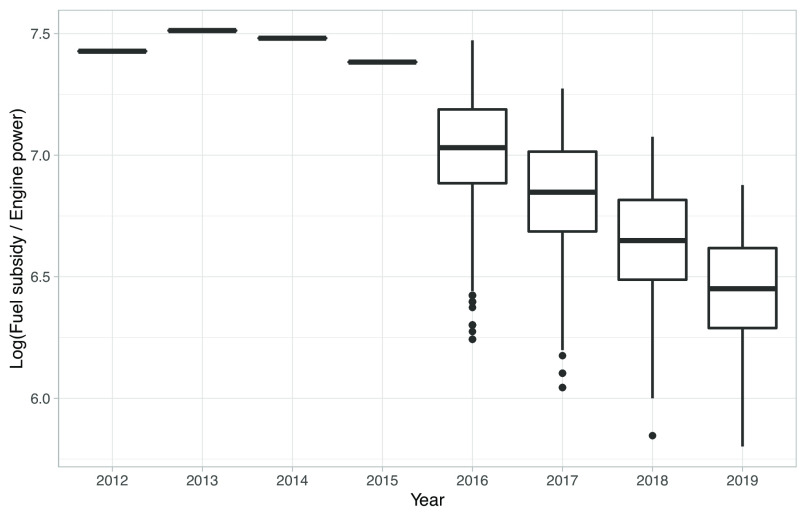
Subsidies are widely criticized in fisheries management for promoting global fishing capacity growth and overharvesting. Scientists worldwide have thus called for a ban on "harmful" subsidies that artificially increase fishing profits, resulting in the recent agreement among members of the World Trade Organization to eliminate such subsidies. The argument for banning harmful subsidies relies on the assumption that fishing will be unprofitable after eliminating subsidies, incentivizing some fishermen to exit and others to refrain from entering. These arguments follow from open-access governance regimes where entry has driven profits to zero. Yet many modern-day fisheries are conducted under limited-access regimes that limit capacity and maintain economic profits, even without subsidies. In these settings, subsidy removal will reduce profits but perhaps without any discernable effect on capacity. Importantly, until now, there have been no empirical studies of subsidy reductions to inform us about their likely quantitative impacts. In this paper, we evaluate a policy reform that reduced fisheries subsidies in China. We find that China's subsidy reductions accelerated the rate at which fishermen retired their vessels, resulting in reduced fleet capacity, particularly among older and smaller vessels. Notably, the reduction of harmful subsidies was only partly responsible for reducing fleet capacity; an increase in vessel retirement subsidies was also a necessary driver of capacity reduction. Our study demonstrates that the efficacy of removing harmful subsidies depends on the policy environment in which removals occur.
补贴在渔业管理中受到广泛批评,因为它们会促进全球捕捞能力的增长和过度捕捞。因此,世界各地的科学家呼吁禁止“有害”补贴,这些补贴人为地增加了渔业利润,导致世界贸易组织成员最近达成了消除此类补贴的协议。禁止有害补贴的论点基于这样一种假设,即取消补贴后,渔业将无利可图,从而促使一些渔民退出,另一些渔民则避免进入。这些论点源于进入导致利润为零的开放式管理体系。然而,许多现代渔业是在限制能力并维持经济利润的有限准入制度下进行的,即使没有补贴也是如此。在这些情况下,取消补贴将减少利润,但可能对产能没有任何明显影响。重要的是,到目前为止,还没有关于补贴减少的实证研究来告知我们其可能的定量影响。在本文中,我们评估了一项在中国减少渔业补贴的政策改革。我们发现,中国的补贴减少加速了渔民退役船只的速度,导致船队规模缩小,尤其是在老旧和小型船只中。值得注意的是,有害补贴的减少仅部分导致了船队规模的缩小;退役补贴的增加也是减少船队规模的必要驱动因素。我们的研究表明,取消有害补贴的效果取决于取消补贴所发生的政策环境。