Wellcome-MRC Institute of Metabolic Science, Box 289, Level 4, Addenbrooke's Hospital, Cambridge CB2 0QQ, UK.
MRC Integrative Epidemiology Unit, University of Bristol, Oakfield House, Oakfield Grove, Bristol BS8 2BN, UK.
J Clin Endocrinol Metab. 2023 Nov 17;108(12):e1580-e1587. doi: 10.1210/clinem/dgad373.
The melanocortin 3 receptor (MC3R) has recently emerged as a critical regulator of pubertal timing, linear growth, and the acquisition of lean mass in humans and mice. In population-based studies, heterozygous carriers of deleterious variants in MC3R report a later onset of puberty than noncarriers. However, the frequency of such variants in patients who present with clinical disorders of pubertal development is currently unknown.
This work aimed to determine whether deleterious MC3R variants are more frequently found in patients clinically presenting with constitutional delay of growth and puberty (CDGP) or normosmic idiopathic hypogonadotropic hypogonadism (nIHH).
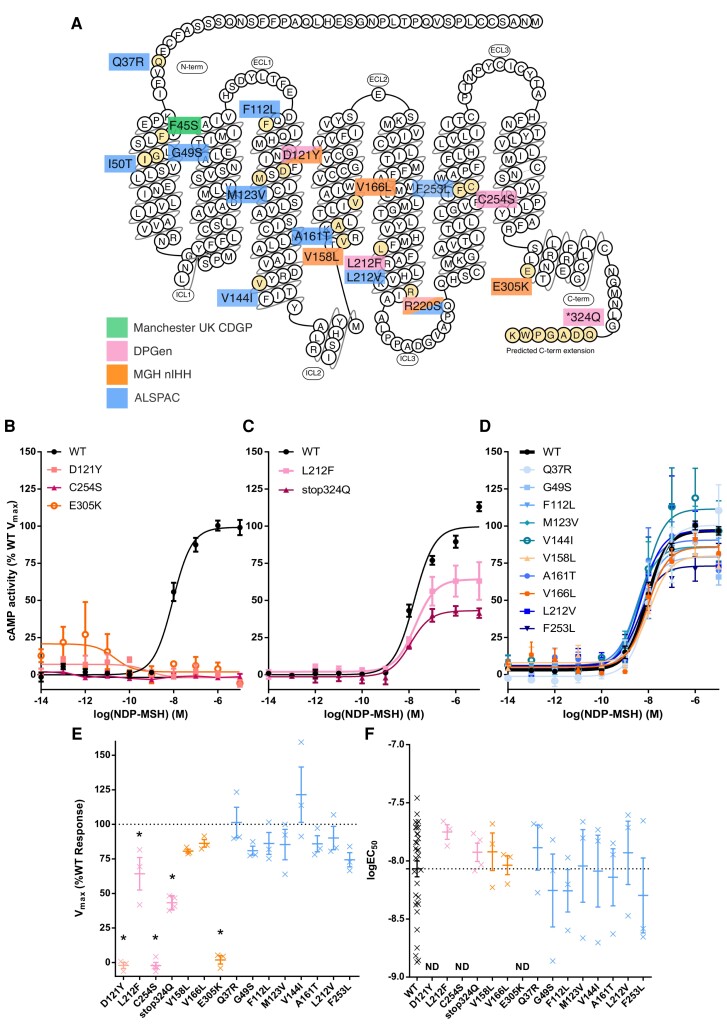
We examined the sequence of MC3R in 362 adolescents with a clinical diagnosis of CDGP and 657 patients with nIHH, experimentally characterized the signaling properties of all nonsynonymous variants found and compared their frequency to that in 5774 controls from a population-based cohort. Additionally, we established the relative frequency of predicted deleterious variants in individuals with self-reported delayed vs normally timed menarche/voice-breaking in the UK Biobank cohort.
MC3R loss-of-function variants were infrequent but overrepresented in patients with CDGP (8/362 [2.2%]; OR = 4.17; P = .001). There was no strong evidence of overrepresentation in patients with nIHH (4/657 [0.6%]; OR = 1.15; P = .779). In 246 328 women from the UK Biobank, predicted deleterious variants were more frequently found in those self-reporting delayed (aged ≥16 years) vs normal age at menarche (OR = 1.66; P = 3.90E-07).
We have found evidence that functionally damaging variants in MC3R are overrepresented in individuals with CDGP but are not a common cause of this phenotype.
黑皮质素 3 受体 (MC3R) 最近被认为是调节人类和小鼠青春期开始、线性生长和获得瘦体重的关键调节因子。在基于人群的研究中,MC3R 有害变异的杂合携带者报告青春期开始晚于非携带者。然而,目前尚不清楚这种变体在出现青春期发育障碍的患者中的频率。
本研究旨在确定 MC3R 中的有害变异是否更频繁地出现在临床上表现为生长和青春期延迟的患者 (CDGP) 或正常嗅觉特发性低促性腺激素性性腺功能减退症 (nIHH) 患者中。
我们检查了 362 名临床诊断为 CDGP 的青少年和 657 名 nIHH 患者的 MC3R 序列,实验表征了所有非同义变异的信号特性,并将其频率与来自基于人群队列的 5774 名对照进行了比较。此外,我们在英国生物银行队列中建立了自我报告青春期/变声延迟与正常时间的个体中预测有害变异的相对频率。
MC3R 失活变异很少见,但在 CDGP 患者中过度表达(362 例中有 8 例 [2.2%];OR = 4.17;P =.001)。在 nIHH 患者中没有过度表达的强烈证据(657 例中有 4 例 [0.6%];OR = 1.15;P =.779)。在英国生物银行的 246328 名女性中,预测有害变异在自我报告青春期延迟(年龄≥16 岁)的女性中比正常年龄初潮的女性更常见(OR = 1.66;P = 3.90E-07)。
我们有证据表明,MC3R 中的功能损害变异在 CDGP 患者中过度表达,但不是这种表型的常见原因。