Department of Anesthesiology and Resuscitology, Okayama University Hospital, 2-5-1, Shikata-Cho, Kita-Ku, Okayama, 700-8558, Japan.
BMC Anesthesiol. 2023 Jun 20;23(1):216. doi: 10.1186/s12871-023-02182-1.
Body temperature (BT) is thought to have associations with oxygen consumption (VO). However, there have been few studies in which the association between systemic VO and BT in humans was investigated in a wide range of BTs. The aims of this study were 1) to determine the association between VO and age and 2) to determine the association between VO and BT.
This study was a retrospective study of patients who underwent surgery under general anesthesia at a tertiary teaching hospital. VO was measured by the Dräger Perseus A500 anesthesia workstation (Dräger Medical, Lubeck, Germany). The associations of VO with age and BT were examined using spline regression and multivariable regression analysis with a random effect.
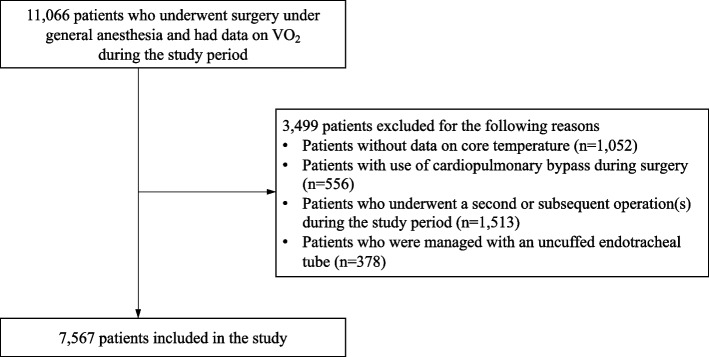
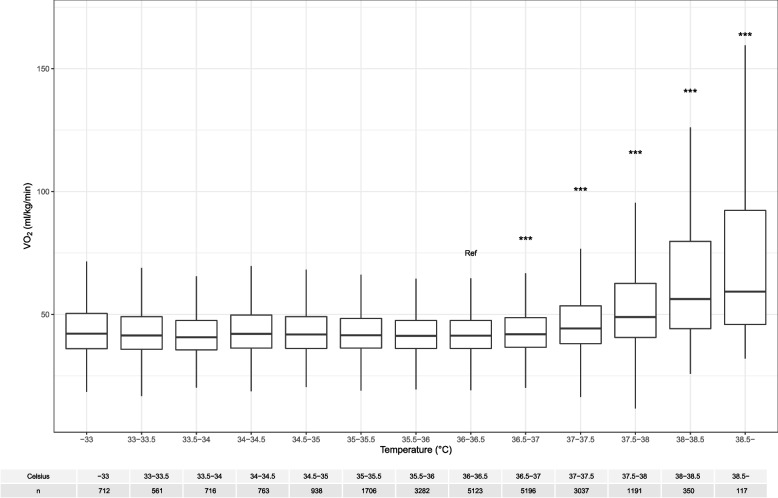
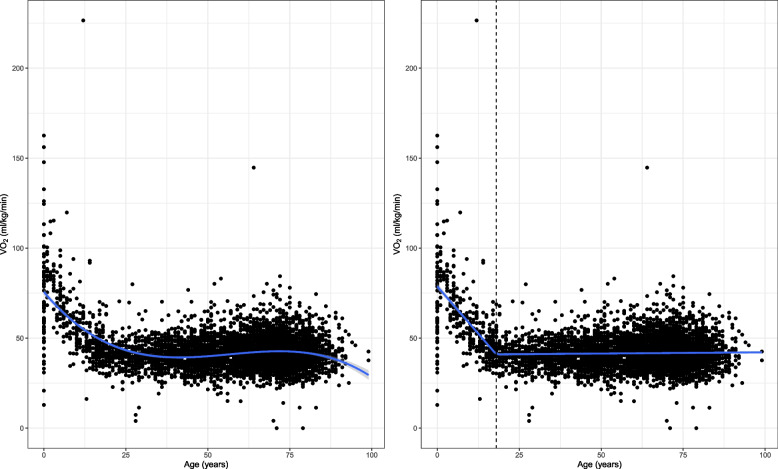
A total of 7,567 cases were included in this study. A linear spline with one knot shows that VO was reduced by 2.1 ml/kg/min with one year of age (p < 0.001) among patients less than 18 years of age and that there was no significant change in VO among patients 18 years of age or older (estimate: 0.014 ml/kg/min, p = 0.08). VO in all bands of BT < 36.0 °C was not significantly different from VO in BT > = 36 °C and < 36.5 °C. Multivariable linear regression analysis showed that compared with VO in BT > = 36 °C and < 36.5 °C as a reference, VO levels were significantly higher by 0.57 ml/kg/min in BT > = 36.5 °C and < 37 °C (p < 0.001), by 1.8 ml/kg/min in BT > = 37 °C and < 37.5 °C (p < 0.001), by 3.6 ml/kg/min in BT > = 37.5 °C and < 38 °C (p < 0.001), by 4.9 ml/kg/min in BT > = 38 °C and < 38.5 °C (p < 0.001), and by 5.7 ml/kg/min in BT > = 38.5 °C (p < 0.001). The associations between VO and BT were significantly different among categorized age groups (p = 0.03).
VO increases in parallel with increase in body temperature in a hyperthermic state but remains constant in a hypothermic state. Neonates and infants, who have high VO, may have a large systemic organ response in VO to change in BT.
人们认为体温(BT)与耗氧量(VO)有关。然而,在广泛的 BT 范围内研究人体 VO 与 BT 之间的关联的研究较少。本研究的目的是 1)确定 VO 与年龄之间的关系,2)确定 VO 与 BT 之间的关系。
这是一项在三级教学医院接受全身麻醉下手术的患者的回顾性研究。VO 通过 Dräger Perseus A500 麻醉工作站(Dräger Medical,吕贝克,德国)进行测量。使用样条回归和具有随机效应的多变量回归分析检查 VO 与年龄和 BT 的关系。
本研究共纳入 7567 例患者。在年龄小于 18 岁的患者中,与一年龄相关的线性样条显示 VO 每减少 2.1 ml/kg/min(p < 0.001),而 18 岁或以上患者的 VO 无明显变化(估计值:0.014 ml/kg/min,p = 0.08)。BT <36.0°C 的所有 BT 带中的 VO 与 BT > = 36°C 和 <36.5°C 中的 VO 无显著差异。多变量线性回归分析显示,与 BT > = 36°C 和 <36.5°C 作为参考相比,BT > = 36.5°C 和 <37°C 时 VO 水平显著升高 0.57 ml/kg/min(p < 0.001),BT > = 37°C 和 <37.5°C 时升高 1.8 ml/kg/min(p < 0.001),BT > = 37.5°C 和 <38°C 时升高 3.6 ml/kg/min(p < 0.001),BT > = 38°C 和 <38.5°C 时升高 4.9 ml/kg/min(p < 0.001),BT > = 38.5°C 时升高 5.7 ml/kg/min(p < 0.001)。VO 和 BT 之间的关系在分类年龄组之间差异有统计学意义(p = 0.03)。
在高热状态下,VO 随体温升高而平行增加,但在低温状态下保持不变。具有高 VO 的新生儿和婴儿可能会对 BT 变化导致的全身器官 VO 有较大反应。