Department of Internal Clinical Sciences, Anesthesiology and Cardiovascular Sciences, Sapienza University of Rome, Rome, Italy.
Department Maternal Infantile and Urological Sciences, Sapienza University of Rome, Rome, Italy.
Pediatr Res. 2023 Nov;94(5):1789-1796. doi: 10.1038/s41390-023-02658-3. Epub 2023 Jun 21.
Despite multifactorial pathogenesis, dysregulation of inflammatory immune response may play a crucial role in necrotizing enterocolitis (NEC). Regulatory T cells (Tregs) are involved in immune tolerance early in life. We aimed to investigate the predicting role of Tregs in developing NEC in neonates at high risk.
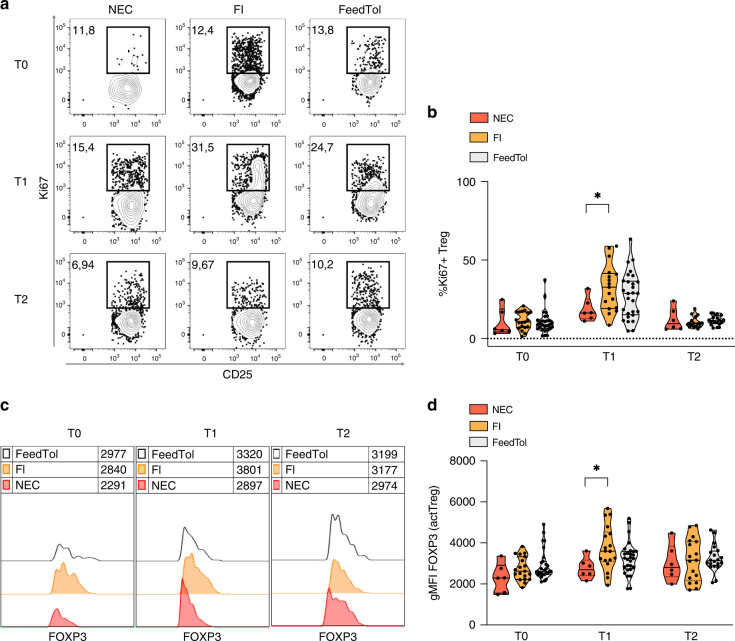
We studied six newborns with a diagnosis of NEC (cases) in comparison with 52 controls (without NEC). We further classified controls as neonates with feeding intolerance (FI) and neonates without it (FeedTol). The rate of female and male neonates (sex defined as a biological attribute) was similar. We analyzed the blood frequency of Tregs (not overall numbers) at three time points: 0-3 (T0), 7-10 (T1), and 27-30 (T2) days after birth by flow cytometry. Neonates' sex was defined based on the inspection of external genitalia at birth.
We observed, at T0, a significantly lower frequency of Tregs in NEC cases (p < 0.001) compared with both FI (p < 0.01) and FeedTol controls (p < 0.01). Multivariate analysis reported that the occurrence of NEC was independently influenced by Treg frequency at birth (ß 2.98; p = 0.039).
Tregs frequency and features in the peripheral blood of preterm neonates, early in life, may contribute to identifying neonates at high risk of developing NEC.
Regulatory T cells may play a pivotal role in regulating the immune response in early life. Reduction of Tregs in early life could predispose preterm newborns to necrotizing enterocolitis. Early markers of necrotizing enterocolitis are still lacking. We demonstrated a predicting role of assessment of regulatory T cells in the diagnosis of this gastrointestinal emergency. Early identification of newborns at high risk of necrotizing enterocolitis through measurement of regulatory T cells may guide clinicians in the management of preterm newborns in order to reduce the development of this severe condition.
尽管发病机制复杂,但炎症免疫反应失调可能在坏死性小肠结肠炎(NEC)中起着关键作用。调节性 T 细胞(Tregs)在生命早期参与免疫耐受。我们旨在研究 Tregs 在高危新生儿中发生 NEC 的预测作用。
我们研究了 6 例诊断为 NEC 的新生儿(病例),并与 52 例对照(无 NEC)进行比较。我们进一步将对照组分为喂养不耐受(FI)新生儿和喂养耐受(FeedTol)新生儿。男女新生儿的比例相似。我们通过流式细胞术在出生后 0-3(T0)、7-10(T1)和 27-30(T2)天三个时间点分析 Tregs 的血液频率(不是总数)。新生儿的性别根据出生时外生殖器检查确定。
我们观察到,在 T0 时,与 FI(p<0.01)和 FeedTol 对照组(p<0.01)相比,NEC 病例的 Tregs 频率明显较低(p<0.001)。多变量分析报告,NEC 的发生独立受出生时 Treg 频率的影响(β2.98;p=0.039)。
早产儿生命早期外周血 Tregs 的频率和特征可能有助于识别发生 NEC 的高危新生儿。
调节性 T 细胞可能在生命早期调节免疫反应中发挥关键作用。生命早期 Tregs 的减少可能使早产儿易患坏死性小肠结肠炎。坏死性小肠结肠炎的早期标志物仍然缺乏。我们证明了评估调节性 T 细胞在诊断这种胃肠道急症中的预测作用。通过测量调节性 T 细胞,早期识别发生坏死性小肠结肠炎风险较高的新生儿,可能有助于指导临床医生管理早产儿,以减少这种严重情况的发生。