Center for Genomic Medicine Massachusetts General Hospital Boston MA USA.
The Broad Institute of Harvard and MIT Cambridge MA USA.
J Am Heart Assoc. 2023 Jul 4;12(13):e029862. doi: 10.1161/JAHA.123.029862. Epub 2023 Jun 22.
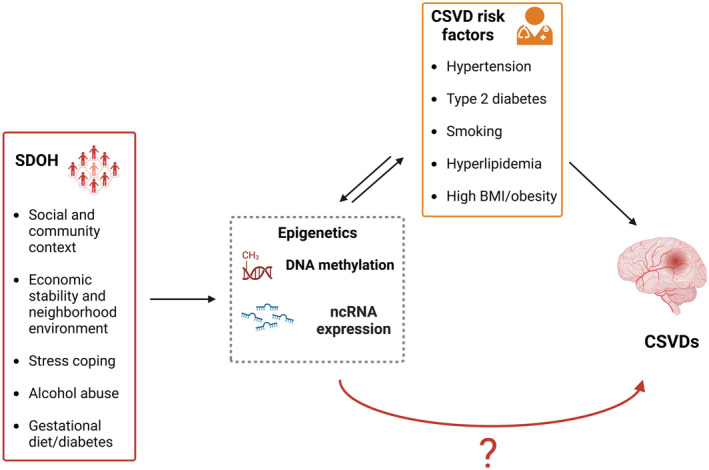
Cerebral small vessel disease is highly prevalent, particularly in marginalized communities, and its incidence is expected to increase given the aging global population. Cerebral small vessel disease contributes to risk for stroke, vascular cognitive impairment and dementia, late-life depression, and gait disorders. A growing body of evidence suggests that adverse outcomes, including cerebral small vessel disease, caused by traditional cardiovascular risk factors are at least partly mediated by epigenetic changes, some of them already beginning during fetal development. Societal and health care access inequities, summarized under the umbrella term social determinants of health, put a higher burden of cardiovascular risk factors on marginalized populations and expose them to an increased risk for adverse outcomes. Social epigenetics has begun to deliver solid evidence that social determinants of health lead to distinct epigenetic signatures that potentially mediate the biological effect of environmental exposures on cardiovascular risk factors. Here, we provide a review of the most recent advances in the epigenetics of cerebral small vessel disease risk factors and social determinants of health and call for research efforts combining insights from both fields to reach a deeper understanding of the causal pathways, ultimately facilitating discovery of new treatment targets for a disease whose burden is magnified by existing health disparities.
脑小血管病患病率极高,尤其是在边缘化社区,且考虑到全球人口老龄化,其发病率预计将会增加。脑小血管病可导致中风、血管性认知障碍和痴呆、老年期抑郁症以及步态障碍。越来越多的证据表明,包括脑小血管病在内的由传统心血管危险因素导致的不良结局至少部分是由表观遗传变化介导的,其中一些变化在胎儿发育过程中就已经开始。社会和医疗保健机会的不平等,统称健康的社会决定因素,使边缘化人群承受着更高的心血管危险因素负担,并使他们面临更高的不良结局风险。社会表观遗传学已经开始提供确凿的证据,表明健康的社会决定因素会导致独特的表观遗传特征,这些特征可能介导环境暴露对心血管危险因素的生物学影响。在这里,我们回顾了脑小血管病危险因素和健康的社会决定因素的表观遗传学方面的最新进展,并呼吁开展将这两个领域的见解结合起来的研究工作,以深入了解因果途径,最终为这一疾病找到新的治疗靶点,因为现有的健康差异使该疾病的负担更加严重。