Department of General Internal Medicine and Psychosomatics, Medical University Hospital, Heidelberg, Germany.
Department of Medicine Controlling, Medical University Hospital, Heidelberg, Germany.
PLoS One. 2023 Jun 22;18(6):e0287234. doi: 10.1371/journal.pone.0287234. eCollection 2023.
Mental comorbidities of physically ill patients lead to higher morbidity, mortality, health-care utilization and costs.
The aim of the study was to investigate the impact of mental comorbidity and physical multimorbidity on the length-of-stay in medical inpatients at a maximum-care university hospital.
The study follows a retrospective, quantitative cross-sectional analysis approach to investigate mental comorbidity and physical multimorbidity in internal medicine patients.
The study comprised a total of n = 28.553 inpatients treated in 2017, 2018 and 2019 at a German Medical University Hospital.
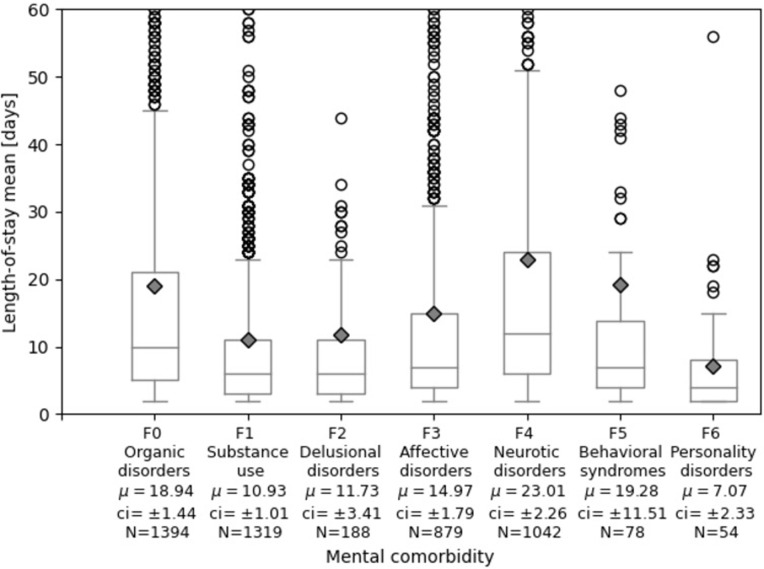
Inpatients with a mental comorbidity showed a median length-of-stay of eight days that was two days longer compared to inpatients without a mental comorbidity. Neurotic and somatoform disorders (ICD-10 F4), behavioral syndromes (F5) and organic disorders (F0) were leading with respect to length-of-stay, followed by affective disorders (F3), schizophrenia and delusional disorders (F2), and substance use (F1), all above the sample mean length-of-stay. The impact of mental comorbidity on length-of-stay was greatest for middle-aged patients. Mental comorbidity and Elixhauser score as a measure for physical multimorbidity showed a significant interaction effect indicating that the impact of mental comorbidity on length-of-stay was greater in patients with higher Elixhauser scores.
The findings provide new insights in medical inpatients how mental comorbidity and physical multimorbidity interact with respect to length-of-stay. Mental comorbidity had a large effect on length-of-stay, especially in patients with high levels of physical multimorbidity. Thus, there is an urgent need for new service models to especially care for multimorbid inpatients with mental comorbidity.
身体疾病患者的精神合并症会导致更高的发病率、死亡率、医疗保健利用率和成本。
本研究旨在调查精神合并症和身体多病对一家顶级大学医院内科住院患者住院时间的影响。
本研究采用回顾性、定量的横断面分析方法,调查内科患者的精神合并症和身体多病。
本研究共纳入 2017 年、2018 年和 2019 年在一家德国医科大学医院接受治疗的 28553 名住院患者。
患有精神合并症的住院患者的中位住院时间为 8 天,比没有精神合并症的住院患者长 2 天。神经症和躯体形式障碍(ICD-10 F4)、行为综合征(F5)和器质性障碍(F0)在住院时间方面处于领先地位,其次是情感障碍(F3)、精神分裂症和妄想障碍(F2)以及物质使用障碍(F1),均高于样本平均住院时间。精神合并症对中年患者住院时间的影响最大。精神合并症和 Elixhauser 评分作为身体多病的衡量标准,表现出显著的交互作用,表明精神合并症对住院时间的影响在 Elixhauser 评分较高的患者中更大。
这些发现为内科住院患者提供了新的见解,了解精神合并症和身体多病如何在住院时间方面相互作用。精神合并症对住院时间有很大影响,特别是在身体多病程度较高的患者中。因此,迫切需要新的服务模式,特别关注患有精神合并症的多病住院患者。