Department of Cardiovascular Medicine, Graduate School of Medicine, Kyoto University, Kyoto, Japan.
Department of Cardiovascular Medicine, Kanazawa University Graduate School of Medical Sciences, Kanazawa, Japan.
Cardiovasc Interv Ther. 2024 Jan;39(1):65-73. doi: 10.1007/s12928-023-00942-x. Epub 2023 Jun 22.
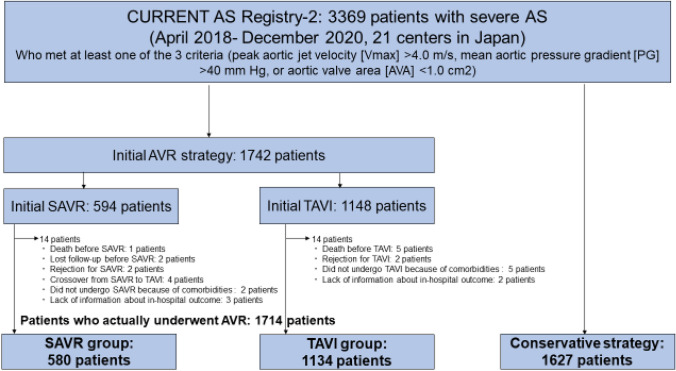
There were no data comparing the in-hospital outcomes after transcatheter aortic valve implantation (TAVI) with those after surgical aortic valve replacement (SAVR) in Japan. Among consecutive patients with severe AS between April 2018 and December 2020 in the CURRENT AS Registry-2, we identified 1714 patients who underwent aortic valve replacement (TAVI group: 1134 patients, and SAVR group: 580 patients). Patients in the TAVI group were much older (84.4 versus 73.6 years, P < 0.001) and more often had comorbidities than those in the SAVR group. In-hospital death rate was numerically lower in the TAVI group than in the SAVR group (0.6% versus 2.2%). After excluding patients with dialysis, in-hospital death rate was very low and comparable in the TAVI and SAVR groups (0.6% versus 0.8%). The rates of major bleeding and new-onset atrial fibrillation during index hospitalization were higher after SAVR than after TAVI (72% versus 20%, and 26% versus 4.6%, respectively), while the rate of pacemaker implantation was higher after TAVI than after SAVR (8.1% versus 2.4%). Regarding the echocardiographic data at discharge, the prevalence of patient-prosthesis mismatch was lower in the TAVI group than in the SAVR group (moderate: 9.0% versus 26%, and severe: 2.6% versus 4.8%). In this real-world data in Japan, TAVI compared with SAVR was chosen in much older patients with more comorbidities with severe AS. In-hospital death rate was numerically lower in the TAVI group than in the SAVR group.
在日本,比较经导管主动脉瓣置换术(TAVI)与外科主动脉瓣置换术(SAVR)的住院结局的数据尚不存在。在 CURRENT AS 注册研究-2 中,我们连续纳入了 2018 年 4 月至 2020 年 12 月期间患有严重主动脉瓣狭窄的患者,共 1714 例,其中行主动脉瓣置换术(TAVI 组:1134 例,SAVR 组:580 例)。TAVI 组患者年龄明显更大(84.4 岁比 73.6 岁,P<0.001),合并症更多。TAVI 组患者住院期间死亡率低于 SAVR 组(0.6%比 2.2%)。排除透析患者后,TAVI 组和 SAVR 组患者住院期间死亡率非常低且相似(0.6%比 0.8%)。SAVR 组患者主要出血和新发心房颤动发生率高于 TAVI 组(72%比 20%,26%比 4.6%),而 TAVI 组患者起搏器植入率高于 SAVR 组(8.1%比 2.4%)。出院时的超声心动图数据显示,TAVI 组患者中患者-假体不匹配的发生率低于 SAVR 组(中度:9.0%比 26%,重度:2.6%比 4.8%)。在日本的真实世界数据中,TAVI 与 SAVR 相比,用于治疗严重主动脉瓣狭窄的年龄更大、合并症更多的患者。TAVI 组患者住院期间死亡率低于 SAVR 组。