Chacón-Diaz Manuel, Hernández-Vásquez Akram, Custodio-Sánchez Piero
Universidad Científica del Sur. Lima, Perú. Universidad Científica del Sur Universidad Científica del Sur Lima Peru.
Instituto Nacional Cardiovascular INCOR. Lima, Perú. Instituto Nacional Cardiovascular INCOR Lima Perú.
Arch Peru Cardiol Cir Cardiovasc. 2022 Jun 27;3(2):53-59. doi: 10.47487/apcyccv.v3i2.218. eCollection 2022 Apr-Jun.
To determine one-year survival and factors associated with mortality in patients with ST-segment elevation myocardial infarction in Peru.
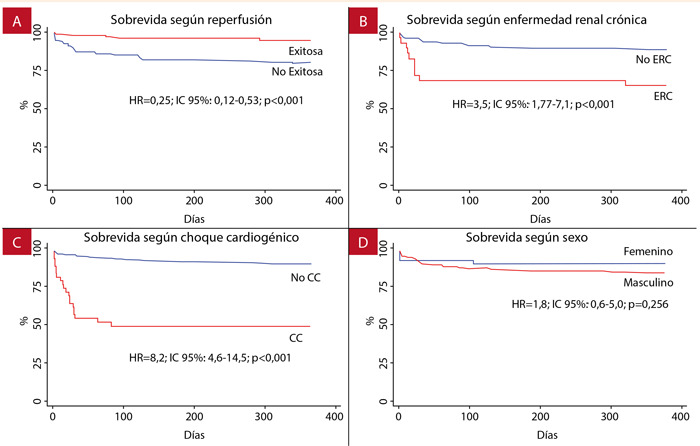
An analysis was made of the cohort of patients included in the PERSTEMI-II registry during the year 2020, in whom survival at one year after the event and its risk factors were evaluated using Kaplan-Meier survival analysis and Cox regression.
Of 374 patients in the PERSTEMI-II study, 366 (97.9%) completed follow-up up to one year after the event with a survival rate of 85%. Successful reperfusion was related to better survival at 1 year (hazard ratio [HR]=0.30, 95% CI: 0.14-0.62, p=0.001). Age (HR=1.04, 95% CI: 1.01-1.07, p=0.003), chronic kidney disease (HR=2.15, 95% CI: 1.04-4.39, p=0.037) and cardiogenic shock (HR=6.67, 95% CI: 3.72-11.97, p<0.001) were factors of higher mortality at 1-year follow-up.
The PERSTEMI-II registry is the first Peruvian registry that provides data on survival after ST-segment elevation myocardial infarction, which is 85% at one year. Successful reperfusion improves survival at one-year post infarction.
确定秘鲁ST段抬高型心肌梗死患者的一年生存率及与死亡率相关的因素。
对2020年纳入PERSTEMI-II注册研究的患者队列进行分析,采用Kaplan-Meier生存分析和Cox回归评估事件发生后一年的生存率及其危险因素。
在PERSTEMI-II研究的374例患者中,366例(97.9%)完成了事件发生后长达一年的随访,生存率为85%。成功再灌注与1年时更好的生存率相关(风险比[HR]=0.30,95%置信区间:0.14-0.62,p=0.001)。年龄(HR=1.04,95%置信区间:1.01-1.07,p=0.003)、慢性肾脏病(HR=2.15,95%置信区间:1.04-4.39,p=0.037)和心源性休克(HR=6.67,95%置信区间:3.72-11.97,p<0.001)是1年随访时死亡率较高的因素。
PERSTEMI-II注册研究是首个提供ST段抬高型心肌梗死后生存数据的秘鲁注册研究,一年生存率为85%。成功再灌注可提高梗死后一年的生存率。