• 文献检索
  • 文档翻译
  • 深度研究
  • 学术资讯
  • Suppr Zotero 插件Zotero 插件
  • 邀请有礼
  • 套餐&价格
  • 历史记录
应用&插件
Suppr Zotero 插件Zotero 插件浏览器插件Mac 客户端Windows 客户端微信小程序
定价
高级版会员购买积分包购买API积分包
服务
文献检索文档翻译深度研究API 文档MCP 服务
关于我们
关于 Suppr公司介绍联系我们用户协议隐私条款
关注我们

Suppr 超能文献

核心技术专利:CN118964589B侵权必究
粤ICP备2023148730 号-1Suppr @ 2026

文献检索

告别复杂PubMed语法,用中文像聊天一样搜索,搜遍4000万医学文献。AI智能推荐,让科研检索更轻松。

立即免费搜索

文件翻译

保留排版,准确专业,支持PDF/Word/PPT等文件格式,支持 12+语言互译。

免费翻译文档

深度研究

AI帮你快速写综述,25分钟生成高质量综述,智能提取关键信息,辅助科研写作。

立即免费体验

呼吸机相关性事件与急性呼吸窘迫综合征(ARDS)呼吸机撤机方案实施之间的关系。

Association between ventilator-associated events and implementation of acute respiratory distress syndrome (ARDS) ventilator weaning protocol.

机构信息

Sunrise Hospital and Medical Center, Las Vegas, NV, USA.

Sunrise Hospital and Medical Center, Las Vegas, NV, USA.

出版信息

Am J Infect Control. 2023 Dec;51(12):1321-1323. doi: 10.1016/j.ajic.2023.06.013. Epub 2023 Jun 22.

DOI:10.1016/j.ajic.2023.06.013
PMID:37355095
原文链接:https://pmc.ncbi.nlm.nih.gov/articles/PMC10286560/
Abstract

BACKGROUND

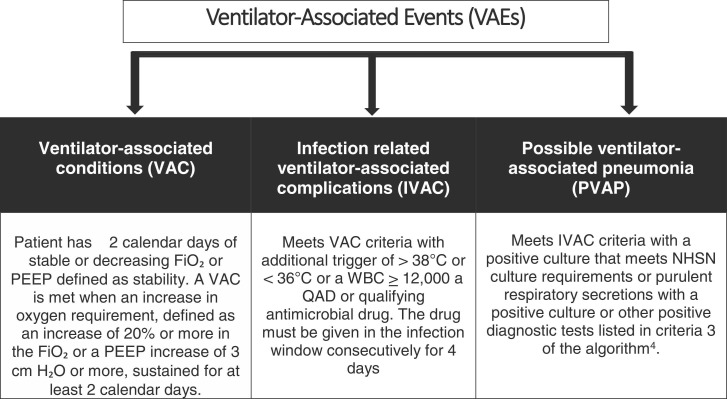
Acute respiratory distress syndrome (ARDS) is a severe and life-threatening condition that can occur in critically ill patients. Mechanical ventilation is a commonly used intervention with ARDS patients, but weaning patients off the ventilator can be challenging. An ARDSnet-like ventilator weaning protocol was implemented with the goal of reducing triggers for ventilator-associated events (VAEs).

METHODS

The implementation of the new protocol was used to complete a retrospective investigation of patient outcomes for 1,233 ventilator periods. Periods were included between April and December 2022 for any ventilated patient lasting at least 4 days. National Health Care Safety Network VAE criteria were used to surveille the patient data. Triggers were based on the positive end-expiratory pressure increases or fraction of inspired oxygen (FiO₂) increases. The preset weaning criteria was a reduction by 2 cmHO per 24 hours.

RESULTS

Of the total 1,233 individual ventilator periods, VAE criteria were met in 10%. Of the total 126 periods with VAE, 39.2% met the criteria for appropriate protocol implementation. There was a statistically significant relationship between VAE identification and implementation of the protocol.

CONCLUSIONS

The implementation of a protocol for ventilator weaning affects the outcome of developing a VAE. The findings emphasize the importance of implementing the ARDS weaning protocol as a template to reduce the triggers for VAEs and improve overall patient outcomes.

摘要

背景

急性呼吸窘迫综合征(ARDS)是一种严重且危及生命的疾病,可发生于重症患者。机械通气是 ARDS 患者常用的干预措施,但患者脱机率具挑战性。ARDSnet 样通气机脱机方案的实施旨在减少与通气相关事件(VAEs)相关的触发因素。

方法

新方案的实施用于对 1233 个通气期的患者结局进行回顾性调查。2022 年 4 月至 12 月期间,任何持续至少 4 天的通气患者均纳入该研究。使用国家医疗保健安全网络(National Health Care Safety Network,NHSN)VAEs 标准监测患者数据。触发因素基于呼气末正压(positive end-expiratory pressure,PEEP)或吸入氧分数(fraction of inspired oxygen,FiO₂)的增加。预设的脱机标准是每 24 小时降低 2 cmHO。

结果

在总共 1233 个单独的通气期中,有 10%符合 VAE 标准。在总共 126 个出现 VAE 的期中,有 39.2%符合方案实施的适当标准。VAEs 的识别与方案的实施之间存在统计学显著关系。

结论

通气机脱机方案的实施会影响 VAE 的发生。研究结果强调了实施 ARDS 脱机方案作为模板来减少 VAEs 触发因素和改善整体患者结局的重要性。
https://cdn.ncbi.nlm.nih.gov/pmc/blobs/9709/10286560/7f5494946633/gr1_lrg.jpg

相似文献

1
Association between ventilator-associated events and implementation of acute respiratory distress syndrome (ARDS) ventilator weaning protocol.呼吸机相关性事件与急性呼吸窘迫综合征(ARDS)呼吸机撤机方案实施之间的关系。
Am J Infect Control. 2023 Dec;51(12):1321-1323. doi: 10.1016/j.ajic.2023.06.013. Epub 2023 Jun 22.
2
The epidemiology and clinical outcomes of ventilator-associated events among 20,769 mechanically ventilated patients at intensive care units: an observational study.20769 例重症监护病房机械通气患者呼吸机相关性事件的流行病学和临床结局:一项观察性研究。
Crit Care. 2021 Feb 2;25(1):44. doi: 10.1186/s13054-021-03484-x.
3
Prevalence, Clinical Characteristics, and Outcomes Related to Ventilator-Associated Events in Neurocritically Ill Patients.神经危重症患者呼吸机相关事件的流行情况、临床特征及结局。
Neurocrit Care. 2020 Oct;33(2):499-507. doi: 10.1007/s12028-019-00910-5.
4
Incidence, Characteristics, and Outcomes of Ventilator-associated Events during the COVID-19 Pandemic.COVID-19 大流行期间呼吸机相关性事件的发生率、特征和结局。
Ann Am Thorac Soc. 2022 Jan;19(1):82-89. doi: 10.1513/AnnalsATS.202103-364OC.
5
The Impact of Ventilator-Associated Events in Critically Ill Subjects With Prolonged Mechanical Ventilation.呼吸机相关事件对长期机械通气的重症患者的影响。
Respir Care. 2017 Nov;62(11):1379-1386. doi: 10.4187/respcare.05073. Epub 2017 Jul 18.
6
Applicability of the National Healthcare Safety Network's surveillance definition of ventilator-associated events in the surgical intensive care unit: a 1-year review.国家医疗安全网络关于外科重症监护病房呼吸机相关事件的监测定义的适用性:一项为期1年的回顾
J Trauma Acute Care Surg. 2014 Dec;77(6):934-7. doi: 10.1097/TA.0000000000000425.
7
Does ventilator-associated event surveillance detect ventilator-associated pneumonia in intensive care units? A systematic review and meta-analysis.呼吸机相关事件监测能否检测出重症监护病房中的呼吸机相关性肺炎?一项系统评价和荟萃分析。
Crit Care. 2016 Oct 24;20(1):338. doi: 10.1186/s13054-016-1506-z.
8
Evaluation of the New Centers for Disease Control and Prevention Ventilator-Associated Event Module and Criteria in Critically Ill Children in Greece.希腊危重症儿童中疾病控制与预防中心新的呼吸机相关事件模块及标准的评估
Infect Control Hosp Epidemiol. 2016 Oct;37(10):1162-6. doi: 10.1017/ice.2016.135. Epub 2016 Jul 11.
9
Epidemiology and outcomes of ventilator-associated events in critically ill children: Evaluation of three different definitions.危重症患儿呼吸机相关性事件的流行病学和结局:三种不同定义的评估。
Infect Control Hosp Epidemiol. 2023 Feb;44(2):216-221. doi: 10.1017/ice.2022.97. Epub 2022 May 4.
10
Ventilator Bundles in Transition: From Prevention of Ventilator-Associated Pneumonia to Prevention of Ventilator-Associated Events.呼吸机相关 bundle 转变:从预防呼吸机相关性肺炎到预防呼吸机相关性事件。
Respir Care. 2019 Aug;64(8):994-1006. doi: 10.4187/respcare.06966.

引用本文的文献

1
Using Artificial Intelligence to Predict Mechanical Ventilation Weaning Success in Patients with Respiratory Failure, Including Those with Acute Respiratory Distress Syndrome.利用人工智能预测呼吸衰竭患者(包括急性呼吸窘迫综合征患者)机械通气撤机成功率
J Clin Med. 2024 Mar 5;13(5):1505. doi: 10.3390/jcm13051505.

本文引用的文献

1
Formal guidelines: management of acute respiratory distress syndrome.正式指南:急性呼吸窘迫综合征的管理
Ann Intensive Care. 2019 Jun 13;9(1):69. doi: 10.1186/s13613-019-0540-9.
2
Weaning from Mechanical Ventilation in ARDS: Aspects to Think about for Better Understanding, Evaluation, and Management.ARDS 患者机械通气撤机:更好理解、评估和管理所需考虑的方面。
Biomed Res Int. 2018 Oct 9;2018:5423639. doi: 10.1155/2018/5423639. eCollection 2018.
3
Clinical significance of ventilator-associated event.呼吸机相关事件的临床意义。
J Crit Care. 2016 Oct;35:19-23. doi: 10.1016/j.jcrc.2016.04.021. Epub 2016 May 2.
4
Improving ventilator-associated event surveillance in the National Healthcare Safety Network and addressing knowledge gaps: update and review.改进国家医疗安全网络中的呼吸机相关事件监测并填补知识空白:更新与综述
Curr Opin Infect Dis. 2014 Aug;27(4):394-400. doi: 10.1097/QCO.0000000000000083.
5
Developing a new, national approach to surveillance for ventilator-associated events: executive summary.制定一种新的全国性呼吸机相关事件监测方法:执行摘要。
Clin Infect Dis. 2013 Dec;57(12):1742-6. doi: 10.1093/cid/cit577.
6
Individualized PEEP setting in subjects with ARDS: a randomized controlled pilot study.ARDS 患者个体化 PEEP 设置:一项随机对照初步研究。
Respir Care. 2013 Sep;58(9):1416-23. doi: 10.4187/respcare.02068. Epub 2013 Jan 29.
7
Ventilator-associated pneumonia rates at major trauma centers compared with a national benchmark: a multi-institutional study of the AAST.主要创伤中心与国家基准相比的呼吸机相关性肺炎发生率:AAST 的多机构研究。
J Trauma Acute Care Surg. 2012 May;72(5):1165-73. doi: 10.1097/TA.0b013e31824d10fa.
8
Acute respiratory distress syndrome: diagnosis and management.急性呼吸窘迫综合征:诊断与管理。
Am Fam Physician. 2012 Feb 15;85(4):352-8.
9
Ventilator-associated pneumonia is more common and of less consequence in trauma patients compared with other critically ill patients.与其他重症患者相比,创伤患者发生呼吸机相关性肺炎更为常见,但后果较轻。
J Trauma. 2010 Nov;69(5):1083-91. doi: 10.1097/TA.0b013e3181f9fb51.
10
The use of positive end-expiratory pressure in the management of the acute respiratory distress syndrome.呼气末正压在急性呼吸窘迫综合征管理中的应用。
Minerva Anestesiol. 2005 Jun;71(6):265-72.