Department of Obstetrics and Fetal Medicine, Laboratory for Experimental Feto-Maternal Medicine, University Medical Centre of Hamburg-Eppendorf, Germany; Institute of Immunology, University Medical Centre of Hamburg-Eppendorf, Germany.
Department of Obstetrics and Fetal Medicine, Laboratory for Experimental Feto-Maternal Medicine, University Medical Centre of Hamburg-Eppendorf, Germany.
EBioMedicine. 2023 Jul;93:104651. doi: 10.1016/j.ebiom.2023.104651. Epub 2023 Jun 22.
Climate change, in particular the exposure to heat, impacts on human health and can trigger diseases. Pregnant people are considered a vulnerable group given the physiological changes during pregnancy and the potentially long-lasting consequences for the offspring. Evidence published to date on higher risk of pregnancy complications upon heat stress exposure are from geographical areas with high ambient temperatures. Studies from geographic regions with temperate climates are sparse; however, these areas are critical since individuals may be less equipped to adapt to heat stress. This study addresses a significant gap in knowledge due to the temperature increase documented globally.
Birth data of singleton pregnancies (n = 42,905) from a tertiary care centre in Hamburg, Germany, between 1999 and 2021 were retrospectively obtained and matched with climate data from the warmer season (March to September) provided by the adjacent federal meteorological station of the German National Meteorological Service to calculate the relative risk of heat-associated preterm birth. Heat events were defined by ascending temperature percentiles in combination with humidity over exposure periods of up to 5 days. Further, ultrasound data documented in a longitudinal prospective pregnancy cohort study (n = 612) since 2012 were used to identify pathophysiological causes of heat-induced preterm birth.
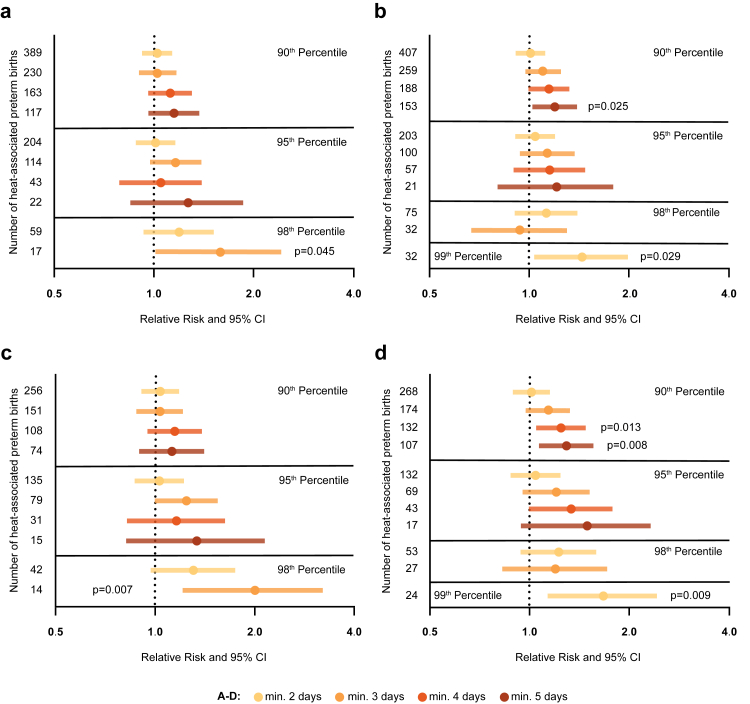
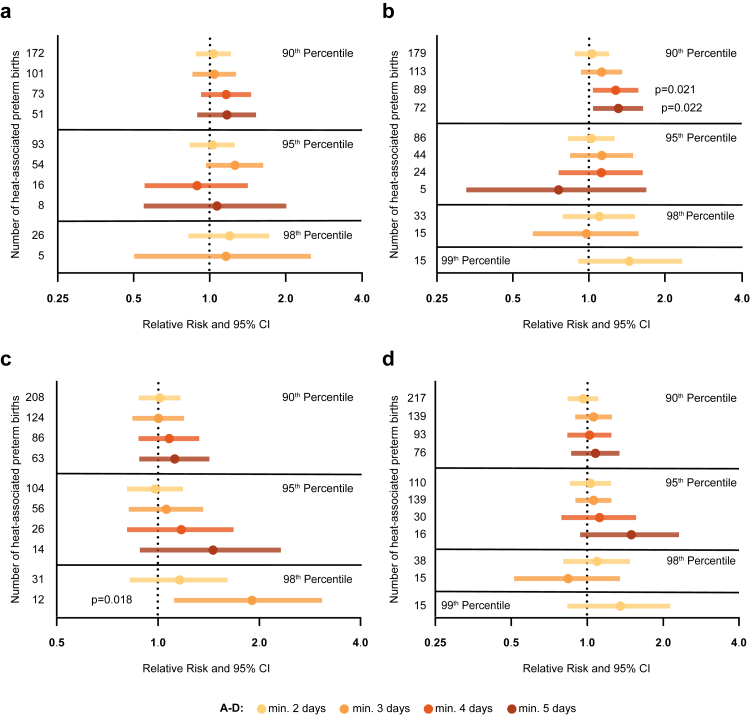
Both extreme heat and prolonged periods of heat exposure increased the relative risk of preterm birth (RR: 1.59; 95% CI: 1.01-2.43; p = 0.045; RR: 1.20; 95% CI: 1.02-1.40; p = 0.025). We identified a critical period of heat exposure during gestational ages 34-37 weeks that resulted in increased risk of late preterm birth (RR: 1.67; 95% CI: 1.14-1.43; p = 0.009). Pregnancies with a female fetus were more prone to heat stress-associated preterm birth. We found heat exposure was associated with altered vascular resistance within the uterine artery.
Heat stress caused by high ambient temperatures increases the risk of preterm birth in a geographical region with temperate climate. Prenatal routine care should be revised in such regions to provide active surveillance for women at risk.
Found in acknowledgements.
气候变化,尤其是暴露于高温,会对人类健康产生影响,并可能引发疾病。考虑到怀孕期间的生理变化以及对后代可能产生的长期影响,孕妇被认为是一个脆弱群体。迄今为止,关于热应激暴露导致妊娠并发症风险增加的证据来自高温地区。来自温带气候地区的研究很少,但这些地区至关重要,因为个体可能不太适应热应激。由于全球记录的气温升高,本研究填补了这一知识空白。
本研究回顾性获取了 1999 年至 2021 年期间德国汉堡一家三级保健中心的单胎妊娠分娩数据(n=42905),并与德国国家气象局毗邻联邦气象站提供的暖季(3 月至 9 月)气候数据相匹配,以计算与热相关的早产的相对风险。热事件通过温度百分位上升与暴露期内湿度相结合来定义,暴露期长达 5 天。此外,自 2012 年以来,在一项纵向前瞻性妊娠队列研究(n=612)中记录了超声数据,用于确定热诱导早产的病理生理原因。
极端高温和长时间暴露于高温都会增加早产的相对风险(RR:1.59;95%CI:1.01-2.43;p=0.045;RR:1.20;95%CI:1.02-1.40;p=0.025)。我们发现妊娠 34-37 周期间存在一个关键的热暴露期,导致晚期早产风险增加(RR:1.67;95%CI:1.14-1.43;p=0.009)。怀有女胎的孕妇更容易受到热应激相关的早产。我们发现热暴露与子宫动脉血管阻力改变有关。
高温引起的热应激增加了温带气候地区早产的风险。在这些地区,产前常规护理应进行修订,为高危妇女提供主动监测。
在致谢中找到。