
APP-BACE1 相互作用和细胞内定位调节 iPSC 衍生皮质神经元中的 Aβ 产生。
APP-BACE1 Interaction and Intracellular Localization Regulate Aβ Production in iPSC-Derived Cortical Neurons.
机构信息
Institute of Neuroscience and Physiology, Department of Psychiatry and Neurochemistry, The Sahlgrenska Academy at the University of Gothenburg, Blå Stråket 15, Sahlgrenska Hospital, 405 30, Gothenburg, Sweden.
Centre for Cellular Imaging, Core Facilities, The Sahlgrenska Academy, University of Gothenburg, Medicinaregatan 7A, 405 30, Gothenburg, Sweden.
出版信息
Cell Mol Neurobiol. 2023 Oct;43(7):3653-3668. doi: 10.1007/s10571-023-01374-0. Epub 2023 Jun 24.
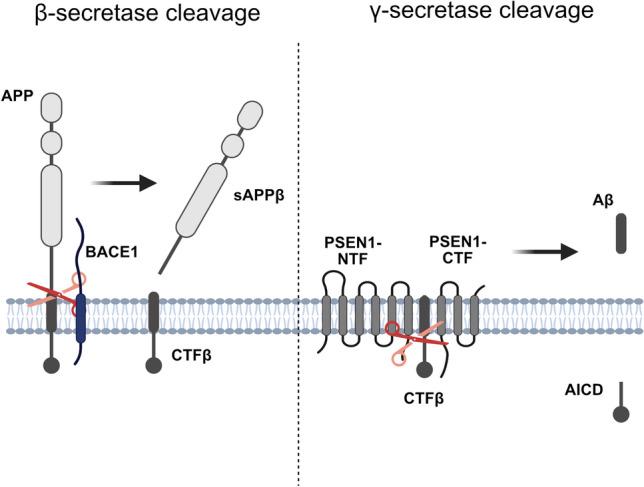
Alzheimer's disease (AD) is characterized pathologically by amyloid β (Aβ)-containing plaques. Generation of Aβ from amyloid precursor protein (APP) by two enzymes, β- and γ-secretase, has therefore been in the AD research spotlight for decades. Despite this, how the physical interaction of APP with the secretases influences APP processing is not fully understood. Herein, we compared two genetically identical human iPSC-derived neuronal cell types: low Aβ-secreting neuroprogenitor cells (NPCs) and high Aβ-secreting mature neurons, as models of low versus high Aβ production. We investigated levels of substrate, enzymes and products of APP amyloidogenic processing and correlated them with the proximity of APP to β- and γ-secretase in endo-lysosomal organelles. In mature neurons, increased colocalization of full-length APP with the β-secretase BACE1 correlated with increased β-cleavage product sAPPβ. Increased flAPP/BACE1 colocalization was mainly found in early endosomes. In the same way, increased colocalization of APP-derived C-terminal fragment (CTF) with presenilin-1 (PSEN1), the catalytic subunit of γ-secretase, was seen in neurons as compared to NPCs. Furthermore, most of the interaction of APP with BACE1 in low Aβ-secreting NPCs seemed to derive from CTF, the remaining APP part after BACE1 cleavage, indicating a possible novel product-enzyme inhibition. In conclusion, our results suggest that interaction of APP and APP cleavage products with their secretases can regulate Aβ production both positively and negatively. β- and γ-Secretases are difficult targets for AD treatment due to their ubiquitous nature and wide range of substrates. Therefore, targeting APP-secretase interactions could be a novel treatment strategy for AD. Colocalization of APP species with BACE1 in a novel model of low- versus high-Aβ secretion-Two genetically identical human iPSC-derived neuronal cell types: low Aβ-secreting neuroprogenitor cells (NPCs) and high Aβ secreting mature neurons, were compared. Increased full-length APP (flAPP)/BACE1 colocalization in early endosomes was seen in neurons, while APP-CTF/BACE1 colocalization was much higher than flAPP/BACE1 colocalization in NPCs, although the cellular location was not determined.
阿尔茨海默病(AD)的病理学特征是含有淀粉样β(Aβ)的斑块。因此,几十年来,淀粉样前体蛋白(APP)通过两种酶β-和γ-分泌酶生成 Aβ 一直是 AD 研究的焦点。尽管如此,APP 与分泌酶的物理相互作用如何影响 APP 的加工仍不完全清楚。在此,我们比较了两种遗传上相同的人诱导多能干细胞衍生的神经元细胞类型:低 Aβ 分泌的神经祖细胞(NPC)和高 Aβ 分泌的成熟神经元,作为低 Aβ 产生和高 Aβ 产生的模型。我们研究了 APP 淀粉样生成加工的底物、酶和产物的水平,并将其与 APP 在内体溶酶体细胞器中与β-和γ-分泌酶的接近程度相关联。在成熟神经元中,全长 APP 与β-分泌酶 BACE1 的共定位增加与β-切割产物 sAPPβ 的增加相关。增加的 flAPP/BACE1 共定位主要存在于早期内体中。同样,与 NPC 相比,APP 衍生的 C 端片段(CTF)与 γ-分泌酶的催化亚基早老素-1(PSEN1)的共定位增加也见于神经元中。此外,在低 Aβ 分泌的 NPC 中,大多数 APP 与 BACE1 的相互作用似乎源于 CTF,即 BACE1 切割后剩余的 APP 部分,表明可能存在新的产物-酶抑制。总之,我们的结果表明,APP 及其切割产物与分泌酶的相互作用可以正向和负向调节 Aβ 的产生。由于β-和γ-分泌酶的广泛存在和广泛的底物范围,它们是 AD 治疗的困难靶点。因此,靶向 APP-分泌酶相互作用可能是 AD 的一种新的治疗策略。APP 物种与 BACE1 在低-与高-Aβ 分泌的新型模型中的共定位-比较了两种遗传上相同的人诱导多能干细胞衍生的神经元细胞类型:低 Aβ 分泌的神经祖细胞(NPC)和高 Aβ 分泌的成熟神经元。在神经元中观察到全长 APP(flAPP)/BACE1 共定位增加存在于早期内体中,而 NPC 中 APP-CTF/BACE1 共定位明显高于 flAPP/BACE1 共定位,尽管细胞位置尚未确定。



 Zotero 插件