Department of Cell & Molecular Biology, Northwestern University Feinberg School of Medicine, Chicago, Illinois 60611, USA.
J Neuroinflammation. 2011 Nov 2;8:150. doi: 10.1186/1742-2094-8-150.
β-Amyloid (Aβ) plays a central role in Alzheimer's disease (AD) pathogenesis. Neurons are major sources of Aβ in the brain. However, astrocytes outnumber neurons by at least five-fold. Thus, even a small level of astrocytic Aβ production could make a significant contribution to Aβ burden in AD. Moreover, activated astrocytes may increase Aβ generation. β-Site APP cleaving enzyme 1 (BACE1) cleavage of amyloid precursor protein (APP) initiates Aβ production. Here, we explored whether pro-inflammatory cytokines or Aβ42 would increase astrocytic levels of BACE1, APP, and β-secretase processing, implying a feed-forward mechanism of astrocytic Aβ production.
Mouse primary astrocytes were treated with combinations of LPS, TNF-α, IFN-γ, and IL-1β and analyzed by immunoblot and ELISA for endogenous BACE1, APP, and secreted Aβ40 levels. Inhibition of JAK and iNOS signaling in TNF-α+IFN-γ-stimulated astrocytes was also analyzed. In addition, C57BL/6J or Tg2576 mouse astrocytes were treated with oligomeric or fibrillar Aβ42 and analyzed by immunoblot for levels of BACE1, APP, and APPsβsw. Astrocytic BACE1 and APP mRNA levels were measured by TaqMan RT-PCR.
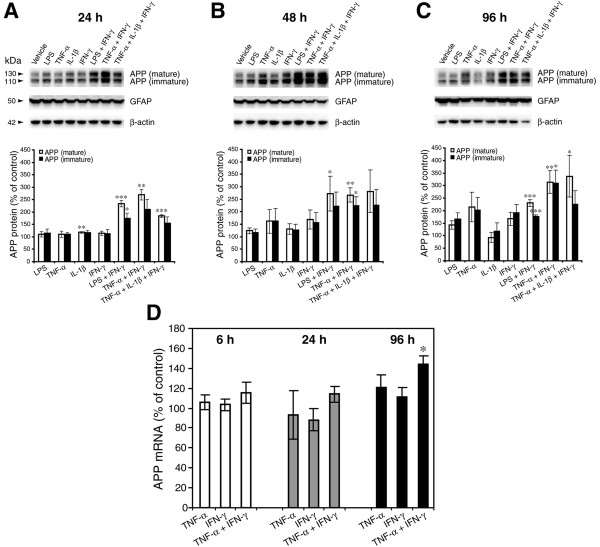
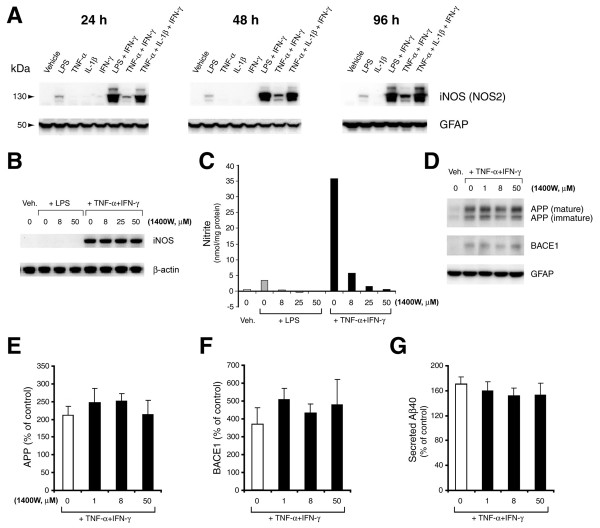
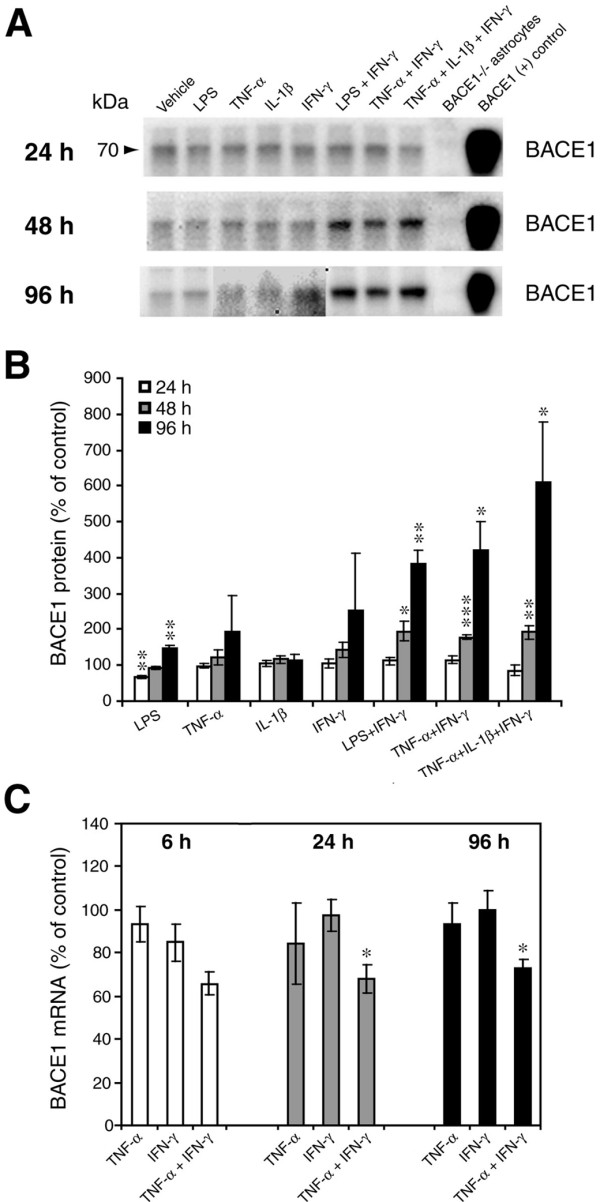
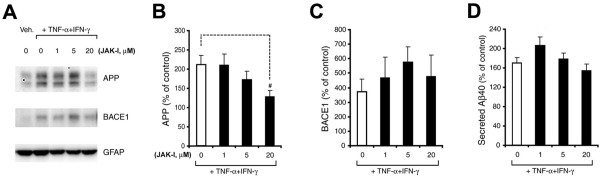
TNF-α+IFN-γ stimulation significantly increased levels of astrocytic BACE1, APP, and secreted Aβ40. BACE1 and APP elevations were post-transcriptional at early time-points, but became transcriptional with longer TNF-α+IFN-γ treatment. Despite a ~4-fold increase in astrocytic BACE1 protein level following TNF-α+IFN-γ stimulation, BACE1 mRNA level was significantly decreased suggesting a post-transcriptional mechanism. Inhibition of iNOS and JAK did not reduce TNF-α+IFN-γ-stimulated elevation of astrocytic BACE1, APP, and Aβ40, except that JAK inhibition blocked the APP increase. Finally, oligomeric and fibrillar Aβ42 dramatically increased levels of astrocytic BACE1, APP, and APPsβsw through transcriptional mechanisms, at least in part.
Cytokines including TNF-α+IFN-γ increase levels of endogenous BACE1, APP, and Aβ and stimulate amyloidogenic APP processing in astrocytes. Oligomeric and fibrillar Aβ42 also increase levels of astrocytic BACE1, APP, and β-secretase processing. Together, our results suggest a cytokine- and Aβ42-driven feed-forward mechanism that promotes astrocytic Aβ production. Given that astrocytes greatly outnumber neurons, activated astrocytes may represent significant sources of Aβ during neuroinflammation in AD.
β-淀粉样蛋白(Aβ)在阿尔茨海默病(AD)发病机制中起核心作用。神经元是大脑中 Aβ的主要来源。然而,星形胶质细胞的数量至少是神经元的五倍。因此,即使星形胶质细胞中 Aβ 的产生水平略有增加,也可能对 AD 中的 Aβ 负担产生重大影响。此外,活化的星形胶质细胞可能会增加 Aβ 的生成。β-位点 APP 裂解酶 1(BACE1)切割淀粉样前体蛋白(APP)启动 Aβ 的产生。在这里,我们探讨了促炎细胞因子或 Aβ42 是否会增加星形胶质细胞中 BACE1、APP 和 β-分泌酶处理的水平,这意味着星形胶质细胞 Aβ 产生的前馈机制。
用 LPS、TNF-α、IFN-γ 和 IL-1β 处理原代小鼠星形胶质细胞,并通过免疫印迹和 ELISA 分析内源性 BACE1、APP 和分泌的 Aβ40 水平。还分析了 TNF-α+IFN-γ 刺激的星形胶质细胞中 JAK 和 iNOS 信号的抑制作用。此外,用寡聚体或纤维状 Aβ42 处理 C57BL/6J 或 Tg2576 小鼠星形胶质细胞,并通过免疫印迹分析 BACE1、APP 和 APPsβsw 的水平。用 TaqMan RT-PCR 测量星形胶质细胞 BACE1 和 APP mRNA 水平。
TNF-α+IFN-γ 刺激显著增加了星形胶质细胞 BACE1、APP 和分泌的 Aβ40 水平。BACE1 和 APP 的升高在早期是转录后,但随着 TNF-α+IFN-γ 处理时间的延长,成为转录。尽管 TNF-α+IFN-γ 刺激后星形胶质细胞 BACE1 蛋白水平增加了约 4 倍,但 BACE1 mRNA 水平显著降低,表明存在转录后机制。尽管 iNOS 和 JAK 的抑制作用并没有降低 TNF-α+IFN-γ 刺激引起的星形胶质细胞 BACE1、APP 和 Aβ40 的升高,但 JAK 的抑制作用阻止了 APP 的增加。最后,寡聚体和纤维状 Aβ42 通过转录机制显著增加了星形胶质细胞 BACE1、APP 和 APPsβsw 的水平,至少部分是这样。
包括 TNF-α+IFN-γ 在内的细胞因子增加了内源性 BACE1、APP 和 Aβ 的水平,并刺激了星形胶质细胞中淀粉样前体蛋白的淀粉样加工。寡聚体和纤维状 Aβ42 也增加了星形胶质细胞 BACE1、APP 和 β-分泌酶处理的水平。总之,我们的研究结果表明,细胞因子和 Aβ42 驱动的前馈机制促进了星形胶质细胞的 Aβ 产生。鉴于星形胶质细胞的数量远远超过神经元,活化的星形胶质细胞在 AD 中的神经炎症期间可能是 Aβ 的重要来源。