Student Research Committee, School of Nursing & Midwifery, Shahroud University of Medical Sciences, Shahroud, Iran.
Department of Epidemiology, School of Public Health, Shahroud University of Medical Sciences, Shahroud, Iran.
BMC Cardiovasc Disord. 2023 Jun 24;23(1):318. doi: 10.1186/s12872-023-03357-x.
By the lengthening of life span, the incidence of chronic diseases such as hypertension and uncontrolled hypertension has increased. This study aims to determine the prevalence of uncontrolled hypertension and its related factors in the age group of 50-74 years in Shahroud, northeast Iran.
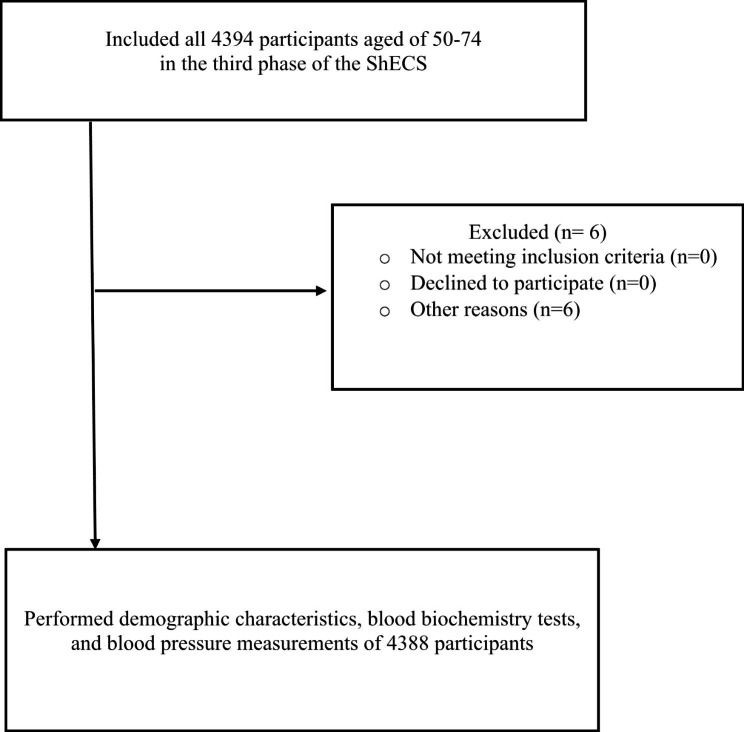
The data of the third phase of the Shahroud Eye Cohort Study were used in this study. This phase of the cohort study included 4394 participants aged 50 to 74 years from the previous phases. In addition to ophthalmological and optometric examinations, demographic characteristics, blood biochemistry tests, and blood pressure measurements were performed in this phase. Individuals with a blood pressure ≥ 140/90 mm/Hg (being treated or not treated with antihypertensive medicines) were defined as uncontrolled hypertension. In patients with diabetes and chronic kidney disease, blood pressure equal to or higher than 130/80 mm/Hg was considered uncontrolled hypertension. Descriptive statistics and multiple logistic regression were used to analyze the data.
Overall, the prevalence of uncontrolled hypertension out of all the participants was 61.7% (95% CI: 60.3-63.2). Multiple regression results showed that the male gender (OR: 2.1, 95% CI: 1.5-2.9), patients with diabetes (OR:3.2, 95% CI: 2.4-4.3), and patients with chronic kidney disease (CKD) (OR: 3.2, 95% CI: 2.5-4.1) increased the risk of uncontrolled hypertension while in patients with cardiovascular disease (OR: 0.6, 95% CI: 0.4-0.8) and polypharmacy (OR: 0.2, 95% CI: 0.1-0.2) reduced the risk of uncontrolled hypertension.
The present study showed that uncontrolled hypertension has a high prevalence, and factors such as male gender, diabetes, and CKD are associated with this disorder. So, it is recommended to take the necessary measures to formulate and implement immediate actions to prevent or control hypertension.
随着寿命的延长,高血压和未控制高血压等慢性病的发病率有所增加。本研究旨在确定伊朗东北部沙赫鲁德 50-74 岁人群中未控制高血压的患病率及其相关因素。
本研究使用了沙赫鲁德眼队列研究第三阶段的数据。该队列研究的这一阶段包括来自前几阶段的 4394 名 50 至 74 岁的参与者。除了眼科和视光学检查外,还在这一阶段进行了人口统计学特征、血液生化检查和血压测量。血压≥140/90mmHg 的个体(无论是否服用降压药物治疗)被定义为未控制高血压。在患有糖尿病和慢性肾脏病的患者中,血压等于或高于 130/80mmHg 被认为是未控制高血压。采用描述性统计和多因素 logistic 回归分析数据。
总体而言,所有参与者中未控制高血压的患病率为 61.7%(95%CI:60.3-63.2)。多因素回归结果显示,男性(OR:2.1,95%CI:1.5-2.9)、糖尿病患者(OR:3.2,95%CI:2.4-4.3)和慢性肾脏病患者(OR:3.2,95%CI:2.5-4.1)会增加未控制高血压的风险,而心血管疾病患者(OR:0.6,95%CI:0.4-0.8)和使用多种药物(OR:0.2,95%CI:0.1-0.2)则会降低未控制高血压的风险。
本研究表明,未控制高血压的患病率较高,男性、糖尿病和慢性肾脏病等因素与该疾病有关。因此,建议采取必要措施制定和实施立即行动,以预防或控制高血压。