Green Zane Asher, Rizwan Sophie
Faculty of Business Administration, Preston University, No. 85, Street 3, H-8/1, Islamabad, Pakistan.
Contemporary Research Initiative, Preston University, Islamabad, Pakistan.
J Happiness Stud. 2023 Jun 8:1-32. doi: 10.1007/s10902-023-00664-0.
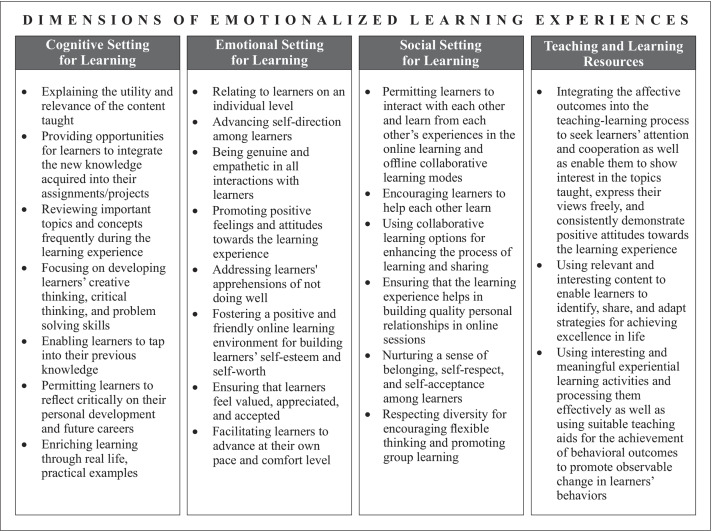
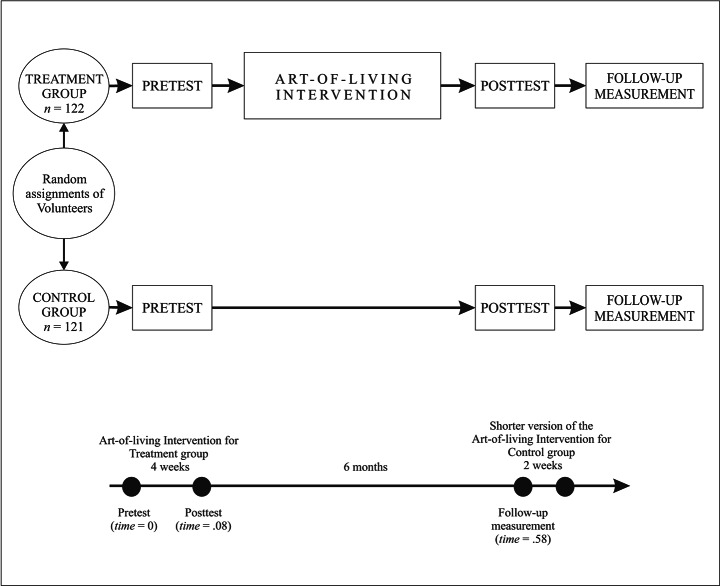
Art-of-living allows individuals to live a contemplative, mindful, and active life to attain well-being. This study demonstrates the development and implementation of an art-of-living training intervention to nurture positivity among Pakistan's university students during COVID-19. To ensure the efficacy of teaching and learning during the second wave of the pandemic, the intervention was imparted through a blended learning approach comprising two modes: (1) online learning and (2) offline personal and collaborative learning. This approach was based on the emotionalized learning experiences (ELE) format to make learning more engaging, permanent, and gratifying. The study comprised 243 students randomly assigned to an experimental group ( = 122) and a wait-list control group ( = 121). Growth curve analysis indicated that positivity together with the components of art-of-living-self-efficacy, savoring, social contacts, physical care, and meaning-and overall art-of-living increased at a greater rate in the experimental group than in the control group from pretest to posttest and from posttest to follow-up measurement. The analysis provided an all-encompassing view of how positivity developed in the two groups over time. There were significant variations in participants' initial status (intercepts) and growth trajectories (slopes). The influence of participants' initial positivity scores suggested that students with high initial positivity scores had a slower increase in linear growth, whereas those with low initial positivity scores had a faster increase in linear growth over time. The success of the intervention may be attributed to the dimensions of ELE-embodied in the two modes-and fidelity to intervention for effectively implementing the blended learning approach.
The online version contains supplementary material available at 10.1007/s10902-023-00664-0.
生活艺术使个人能够过上沉思、正念和积极的生活以实现幸福。本研究展示了一种生活艺术培训干预措施的开发与实施,以在新冠疫情期间培养巴基斯坦大学生的积极心态。为确保在疫情第二波期间教学的有效性,该干预通过混合学习方法进行,包括两种模式:(1)在线学习和(2)线下个人及协作学习。这种方法基于情感化学习体验(ELE)形式,以使学习更具吸引力、更持久且更令人满足。该研究包括243名学生,他们被随机分配到实验组(n = 122)和候补对照组(n = 121)。增长曲线分析表明,从预测试到后测试以及从后测试到随访测量,实验组中积极心态以及生活艺术的组成部分——自我效能感、品味、社交联系、身体护理、意义——和整体生活艺术的增长速度比对照组更快。该分析全面呈现了两组中积极心态随时间的发展情况。参与者的初始状态(截距)和增长轨迹(斜率)存在显著差异。参与者初始积极心态得分的影响表明,初始积极心态得分高的学生线性增长较慢,而初始积极心态得分低的学生随时间线性增长较快。干预的成功可能归因于两种模式中体现的ELE维度以及对有效实施混合学习方法的干预忠诚度。
在线版本包含可在10.1007/s10902-023-00664-0获取的补充材料。