Wen Yun, Wu Longkai, He Sujin, Ng Nathanael Hsien-Ern, Teo Beng Chong, Looi Chee Kit, Cai Yiyu
National Institute of Education, Nanyang Technological University, Singapore, Singapore.
Central China Normal University, Wuhan, China.
Educ Technol Res Dev. 2023 May 9:1-21. doi: 10.1007/s11423-023-10235-y.
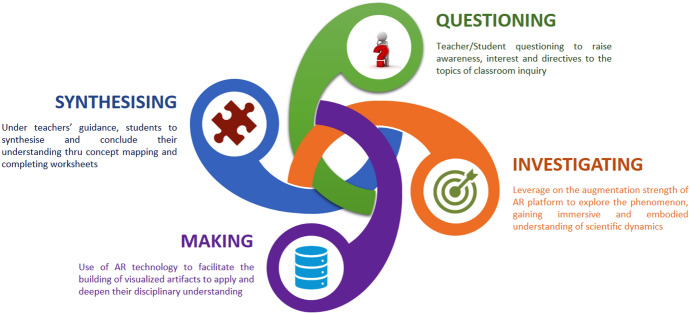
Notwithstanding the advantages of incorporating Augmented Reality (AR) in education, AR's concrete uses as compared to other technologies are not fully recognised. Moreover, many of the existing studies have neglected to examine the impact of pedagogy and its corresponding instructional models, whilst implementing AR in teaching and learning. In leveraging the affordances of AR, an inquiry-based learning framework, referred to as QIMS, was proposed in this study. A learning package was developed on the topic of plant reproduction for primary 5 students (aged 11-12) based on the QIMS framework. Using a quasi-experimental approach, this study evaluated three conditions (AR and QIMS; QIMS; Non-AR and Non-QIMS) for a series of science lessons in a primary school. 117 students took part in this study. The quantitative results showed that although there was no statistically significant difference in students' academic performance when AR was used, students' self-directed learning and creative thinking skills increased significantly after partaking in the QIMS inquiry-based lessons. The usage of AR and QIMS had a significant effect in increasing students' critical thinking and knowledge creation efficacy skills. Moreover, in view of students' academic outcomes, the integration of QIMS and AR proved to be more beneficial to low-progress students. Qualitative analysis of the interview data from teachers and students aids in accounting for the quantitative results and indicate productive implementation strategies. The findings of this study will guide the design of future AR interventions, by providing insights for both researchers and practitioners on how to integrate and implement AR with pedagogical approaches.
尽管在教育中融入增强现实(AR)有诸多优势,但与其他技术相比,AR的具体用途尚未得到充分认可。此外,许多现有研究在教学中应用AR时,忽略了考察教学法及其相应教学模式的影响。本研究利用AR的特性,提出了一个基于探究的学习框架,称为QIMS。基于QIMS框架,为小学五年级学生(11 - 12岁)开发了一个关于植物繁殖主题的学习包。本研究采用准实验方法,对一所小学一系列科学课程的三种情况(AR与QIMS;QIMS;非AR与非QIMS)进行了评估。117名学生参与了本研究。定量结果表明,虽然使用AR时学生的学业成绩没有统计学上的显著差异,但参与基于QIMS探究的课程后,学生的自主学习和创造性思维能力显著提高。AR和QIMS的使用对提高学生的批判性思维和知识创造效能技能有显著效果。此外,从学生的学业成果来看,QIMS与AR的整合对学习进度较慢的学生更为有益。对教师和学生访谈数据的定性分析有助于解释定量结果,并指出有效的实施策略。本研究的结果将为未来AR干预措施的设计提供指导,为研究人员和从业者提供关于如何将AR与教学方法整合和实施的见解。