Marcinechová Denisa, Záhorcová Lucia, Lohazerová Katarína
Institute of Experimental Psychology of the Centre of Social and Psychological Sciences, Slovak Academy of Sciences, Dúbravská Cesta 5819/9, 84104 Karlova Ves, Bratislava, Slovakia.
Department of Psychology, Trnava University in Trnava, Hornopotočná 23, 91701 Trnava, Slovakia.
Curr Psychol. 2023 Mar 10:1-16. doi: 10.1007/s12144-023-04476-6.
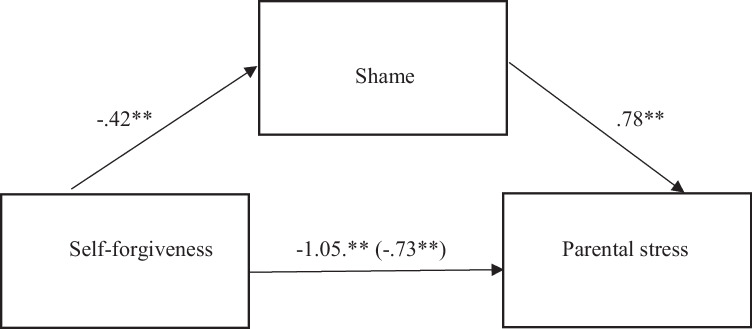
A mixed-method approach was used to explore and compare self-forgiveness, guilt, shame, and parental stress in parents of children with autism spectrum disorder (ASD) and parents of neurotypical (NT) children. The data were obtained by the Heartland Forgiveness Scale (Thompson et al., 2005), Guilt and Shame Experience Scale (Maliňáková et al., 2019), Parental Stress Scale (Berry & Jones, 1995) and by open-ended questions. The research sample consisted of 143 parents of children with ASD and 135 parents of NT children from Slovakia. The regression analysis confirmed that guilt, shame, and self-forgiveness explained 23% of the variance in parental stress, while the only significant negative predictor was self-forgiveness. Furthermore, shame mediated the pathway between self-forgiveness and parental stress in parents of children with ASD. Parents of children with ASD experience more shame than parents of NT children. The qualitative analysis obtained a more comprehensive understanding of both groups. Parents of children with ASD mostly experienced shame in regard to their child's inappropriate behavior or it being misunderstood by society, while parents of NT children mostly did not feel ashamed of their parenting. Acceptance, social support, religious beliefs, and love from the child were the most often mentioned factors helping self-forgiveness in parents of children with ASD. We highlight the importance of self-forgiveness as a potential coping mechanism for parental stress and suggest focusing on negative aspects of shame in parents of children with ASD.
采用混合方法探讨并比较自闭症谱系障碍(ASD)儿童的父母与神经典型(NT)儿童的父母在自我宽恕、内疚、羞耻及父母压力方面的情况。数据通过《中心地带宽恕量表》(汤普森等人,2005年)、《内疚与羞耻体验量表》(马利尼亚科娃等人,2019年)、《父母压力量表》(贝里和琼斯,1995年)以及开放式问题获取。研究样本包括来自斯洛伐克的143名ASD儿童的父母和135名NT儿童的父母。回归分析证实,内疚、羞耻和自我宽恕解释了父母压力中23%的方差,而唯一显著的负向预测因子是自我宽恕。此外,羞耻在ASD儿童的父母中中介了自我宽恕与父母压力之间的路径。ASD儿童的父母比NT儿童的父母体验到更多的羞耻。定性分析使对两组的理解更加全面。ASD儿童的父母大多因孩子的不当行为或其被社会误解而感到羞耻,而NT儿童的父母大多对自己的育儿方式不感到羞耻。接纳、社会支持、宗教信仰以及来自孩子的爱,是ASD儿童的父母中最常被提及的有助于自我宽恕的因素。我们强调自我宽恕作为应对父母压力的潜在机制的重要性,并建议关注ASD儿童的父母中羞耻感的消极方面。