Clegg Devin J, Salomon Brett J, Porter Christopher G, Mazonas Thomas W, Heidel Robert E, Stephenson Stacy M, Herbig Kathleen S, Chun Joseph T, Lloyd Jillian M, Boukovalas Stefanos
From the Department of Surgery, University of Tennessee Graduate School of Medicine, Knoxville, Tenn.
Department of Surgery, Division of Biostatistics, University of Tennessee Graduate School of Medicine, Knoxville, Tenn.
Plast Reconstr Surg Glob Open. 2023 May 22;11(5):e5025. doi: 10.1097/GOX.0000000000005025. eCollection 2023 May.
The risk of women developing breast cancer after augmentation mammaplasty may be lower than the general population, with minimal current literature on breast reconstruction in this population. We sought to evaluate the impact of previous augmentation on postmastectomy breast reconstruction.
Retrospective review of patients who underwent mastectomies from 2017 to 2021 at our institution was performed. Analysis included frequencies and percentages, descriptive statistics, chi-square analysis, and Fisher exact test.
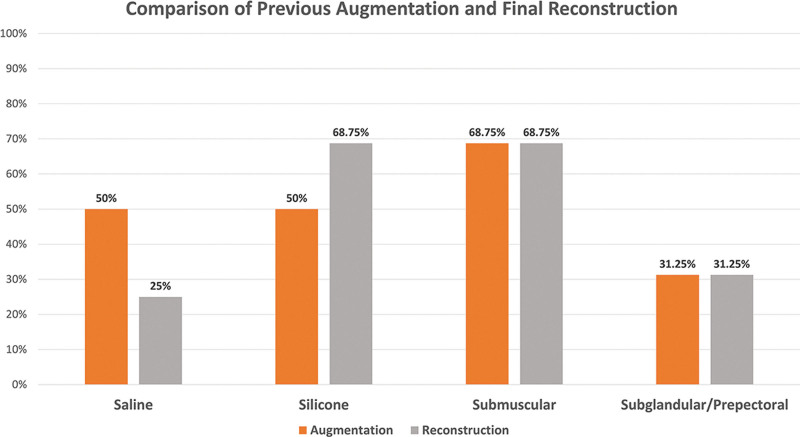
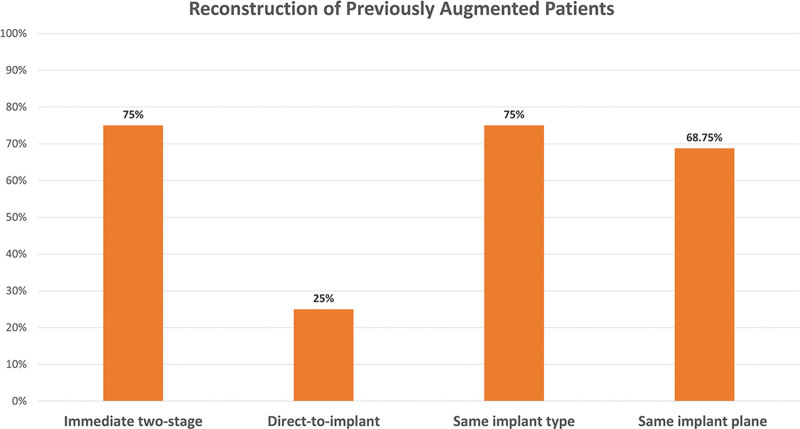
Four hundred seventy patients were included, with average body mass index of 29.1 kg/m, 96% identifying as White, and an average age at diagnosis of 59.3 years. Twenty (4.2%) patients had a prior breast augmentation. Reconstruction was performed in 80% of the previously augmented patients compared to 49.9% of nonaugmented patients ( = 0.01). Reconstruction was alloplastic in 100% of augmented and 88.7% of nonaugmented patients ( = 0.15). All reconstructed augmented patients underwent immediate reconstruction compared with 90.5% of nonaugmented patients ( = 0.37), and two-stage reconstruction was most common (75.0% versus 63.5%; = 0.42). Of the previously augmented patients, 87.5% increased implant volume, 75% underwent same implant plane reconstruction, and 68.75% underwent same implant-type reconstruction as their augmentation.
Previously augmented patients were more likely to undergo reconstruction after mastectomy at our institution. All reconstructed augmented patients underwent alloplastic reconstruction, with most performed immediately in staged fashion. Most patients favored silicone implants and maintained the same implant type and plane of reconstruction, with increased implant volume. Larger studies are required to further investigate these trends.
隆乳术后女性患乳腺癌的风险可能低于一般人群,目前关于该人群乳房重建的文献极少。我们试图评估既往隆乳对乳房切除术后乳房重建的影响。
对2017年至2021年在我院接受乳房切除术的患者进行回顾性研究。分析包括频率和百分比、描述性统计、卡方分析和Fisher精确检验。
共纳入470例患者,平均体重指数为29.1kg/m,96%为白人,诊断时平均年龄为59.3岁。20例(4.2%)患者既往有隆乳史。既往有隆乳史的患者中有80%进行了重建,而未隆乳患者中这一比例为49.9%(P = 0.01)。所有隆乳患者均采用异体材料重建,未隆乳患者中这一比例为88.7%(P = 0.15)。所有接受重建的隆乳患者均进行了即刻重建,未隆乳患者中这一比例为90.5%(P = 0.37),两阶段重建最为常见(75.0%对63.5%;P = 0.42)。在既往有隆乳史的患者中,87.5%增加了植入物体积,75%进行了相同植入平面的重建,68.75%进行了与隆乳时相同类型植入物的重建。
在我院,既往有隆乳史的患者在乳房切除术后更有可能接受重建。所有接受重建的隆乳患者均采用异体材料重建,大多数以分期方式即刻进行。大多数患者倾向于硅胶植入物,并保持相同的植入物类型和重建平面,同时增加了植入物体积。需要更大规模的研究来进一步探究这些趋势。