Li Lijing, Gao Zhengzheng, Zhang Jianmin, Zhang Fuzhou, Wang Fang, Wang Xiaoxue, Li Gan
Department of Anesthesiology, Beijing Children's Hospital, Capital Medical University, National Center for Children's Health, Beijing, China.
Front Pediatr. 2023 Jun 8;11:1117455. doi: 10.3389/fped.2023.1117455. eCollection 2023.
To assess whether decreased regional cerebral oxygen saturation (rScO) is associated with the emergence delirium (ED) following general anesthesia in the pediatric population.
A retrospective observational cohort study was conducted on 113 children (ASA I-III) aged 2-14 years who underwent selective surgery under general anesthesia between 2022-01 and 2022-04. Intraoperatively, the rScO was monitored using a cerebral oximeter. The Pediatric Anesthesia Emergence Delirium (PAED) score was used to evaluate the patients for ED.
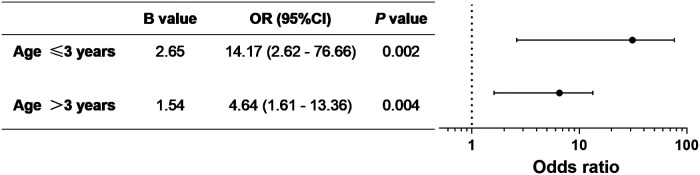
The incidence of ED was 31%. Low rScO was reported in 41.6% of patients, who had a higher incidence of ED ( < 0.001) than those who did not experience desaturation. Logistic regression analysis revealed that decreased rScO was significantly associated with incident ED events [odds ratio (OR), 10.77; 95% confidence interval, 3.31-35.05]. Children under 3 years of age had a higher incidence of ED after rScO desaturation during anesthesia compared to older children (OR, 14.17 vs. 4.64).
Intraoperative rScO desaturation significantly increased the incidence of ED following general anesthesia. Monitoring should be enhanced to improve the oxygen balance in vital organs to improve the quality and safety of anesthesia.
评估小儿全身麻醉后局部脑氧饱和度(rScO)降低是否与苏醒期谵妄(ED)相关。
对2022年1月至2022年4月期间接受全身麻醉下择期手术的113例2至14岁儿童(ASA I-III级)进行回顾性观察队列研究。术中使用脑氧饱和度仪监测rScO。采用小儿麻醉苏醒期谵妄(PAED)评分评估患者是否发生ED。
ED的发生率为31%。41.6%的患者报告有低rScO,这些患者的ED发生率(<0.001)高于未发生氧饱和度降低的患者。逻辑回归分析显示,rScO降低与ED事件显著相关[比值比(OR),10.77;95%置信区间,3.31-35.05]。与大龄儿童相比,3岁以下儿童在麻醉期间rScO降低后ED的发生率更高(OR,14.17对4.64)。
术中rScO降低显著增加了全身麻醉后ED的发生率。应加强监测以改善重要器官的氧平衡,从而提高麻醉质量和安全性。