Aigner Christof, Gaggl Martina, Schmidt Sophie, Kain Renate, Kozakowski Nicolas, Oszwald André, Prohászka Zoltán, Sunder-Plassmann Raute, Schmidt Alice, Sunder-Plassmann Gere
Division of Nephrology and Dialysis, Department of Medicine III, Medical University of Vienna, Vienna, Austria.
Department of Pathology, Medical University of Vienna, Vienna, Austria.
Kidney Int Rep. 2023 May 22;8(8):1506-13. doi: 10.1016/j.ekir.2023.05.010.
Infectious diseases and vaccinations are trigger factors for thrombotic microangiopathy. Consequently, the COVID-19 pandemic could have an effect on disease manifestation or relapse in patients with atypical hemolytic syndrome/complement-mediated thrombotic microangiopathy (aHUS/cTMA).
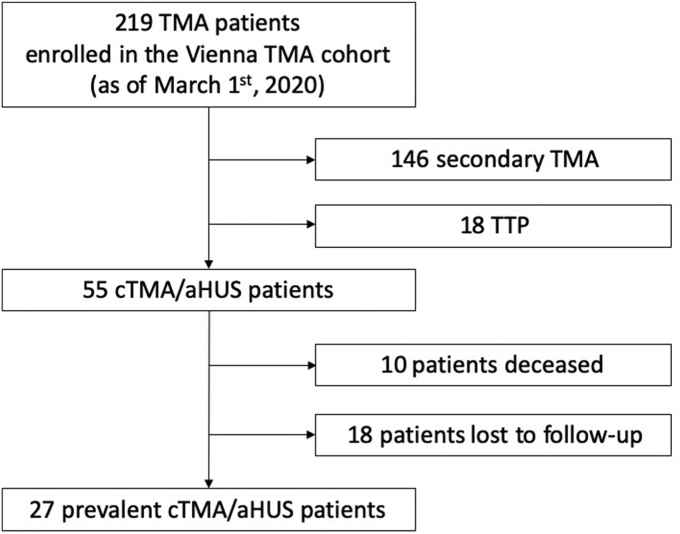
We employed the Vienna TMA cohort database to examine the incidence of COVID-19 related and of SARS-CoV-2 vaccination-related relapse of aHUS/cTMA among patients previously diagnosed with aHUS/cTMA during the first 2.5 years of the COVID-19 pandemic. We calculated incidence rates, including respective confidence intervals (CIs) and used Cox proportional hazard models for comparison of aHUS/cTMA episodes following infection or vaccination.
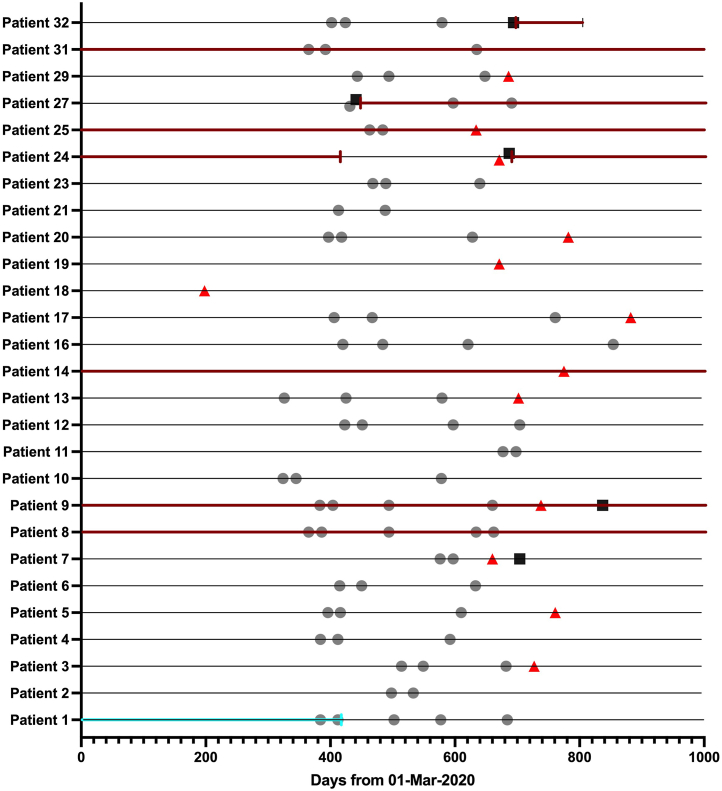
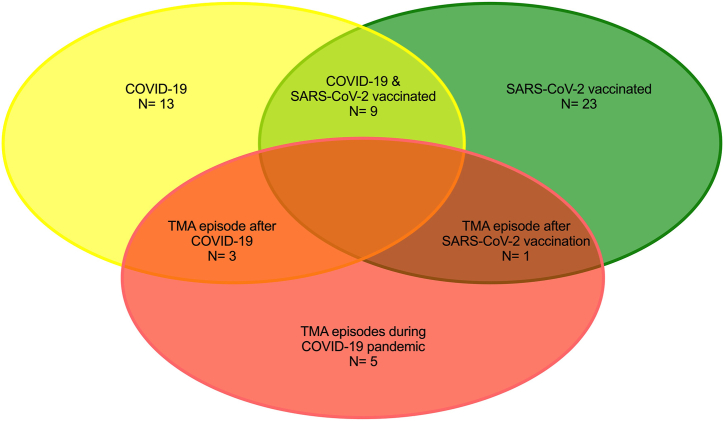
Among 27 patients with aHUS/cTMA, 13 infections triggered 3 (23%) TMA episodes, whereas 70 vaccinations triggered 1 TMA episode (1%; odds ratio 0.04; 95% CI 0.003-0.37, = 0.01). In total, the incidence of TMA after COVID-19 or SARS-CoV-2 vaccination was 6 cases per 100 patient years (95% CI 0.017-0.164) (4.5/100 patient years for COVID-19 and 1.5/100 patient years for SARS-CoV-2 vaccination). The mean follow-up time was 2.31 ± 0.26 years (total amount: 22,118 days; 62.5 years) to either the end of the follow-up or TMA relapse (outcome). Between 2012 and 2022 we did not find a significant increase in the incidence of aHUS/cTMA.
COVID-19 is associated with a higher risk for aHUS/cTMA recurrence when compared to SARS-CoV-2 vaccination. Overall, the incidence of aHUS/cTMA after COVID-19 infection or SARS-CoV-2 vaccination is low and comparable to that described in the literature.
传染病和疫苗接种是血栓性微血管病的触发因素。因此,新冠疫情可能会对非典型溶血性尿毒症综合征/补体介导的血栓性微血管病(aHUS/cTMA)患者的疾病表现或复发产生影响。
我们利用维也纳血栓性微血管病队列数据库,研究在新冠疫情的头2.5年中,先前被诊断为aHUS/cTMA的患者中与新冠相关的以及与新冠病毒疫苗接种相关的aHUS/cTMA复发的发生率。我们计算了发病率,包括各自的置信区间(CI),并使用Cox比例风险模型比较感染或接种疫苗后的aHUS/cTMA发作情况。
在27例aHUS/cTMA患者中,13次感染引发了3次(23%)血栓性微血管病发作,而70次疫苗接种引发了1次血栓性微血管病发作(1%;比值比0.04;95%CI 0.003-0.37,P=0.01)。总体而言,新冠感染或新冠病毒疫苗接种后的血栓性微血管病发病率为每100患者年6例(95%CI 0.017-0.164)(新冠感染为4.5/100患者年,新冠病毒疫苗接种为1.5/100患者年)。平均随访时间为2.31±0.26年(总计:22,118天;62.5年),至随访结束或血栓性微血管病复发(结局)。在2012年至2022年期间,我们未发现aHUS/cTMA发病率有显著增加。
与新冠病毒疫苗接种相比,新冠感染与aHUS/cTMA复发的风险更高。总体而言,新冠感染或新冠病毒疫苗接种后的aHUS/cTMA发病率较低,与文献报道相当。