Fabião Luís, Ribau Ana, Lemos Carolina, Rodrigues-Pinto Ricardo
Spinal Unit (UVM) Department of Orthopaedics, Centro Hospitalar Universitário do Porto, Porto, Portugal.
ICBAS-Instituto de Ciências Biomédicas Abel Salazar, Universidade do Porto, Porto, Portugal.
Porto Biomed J. 2023 Jun 23;8(3):e218. doi: 10.1097/j.pbj.0000000000000218. eCollection 2023 May-Jun.
While fluoroscopy is widely used in orthopedic trauma surgeries, it is associated with harmful effects and should, therefore, be minimized. However, reference values for these surgeries have not been defined, and it is not known how surgeon experience affects these factors. The aims of this study were to analyze the radiation emitted and exposure time for common orthopedic trauma surgeries and to assess whether they are affected by surgeon experience.
Data from 1842 trauma orthopedic procedures were retrospectively analyzed. A total of 1421 procedures were included in the analysis. Radiation dose and time were collected to identify reference values for each surgery and compared for when the lead surgeon was a young resident, a senior resident, or a specialist.
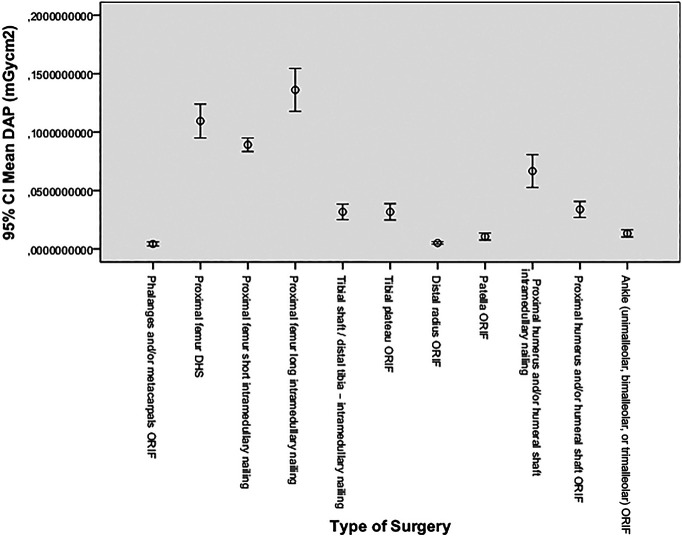
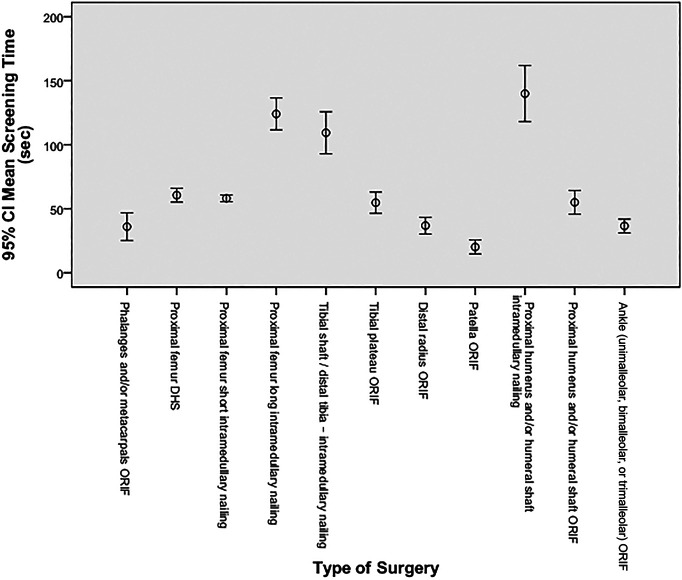
The most performed surgeries requiring fluoroscopy were proximal femur short intramedullary nailing (n = 401), ankle open reduction and internal fixation (ORIF) (n = 141), distal radius ORIF (n = 125), and proximal femur dynamic hip screw (DHS) (n = 114). Surgeries using higher radiation dose were proximal femur long intramedullary nailing (mean dose area [DAP]): 1361.35 mGycm), proximal femur DHS (1094.81 mGycm), and proximal femur short intramedullary nailing (891.41 mGycm). Surgeries requiring longer radiation time were proximal humerus and/or humeral shaft intramedullary nailing (02 mm:20 ss), proximal femur long intramedullary nailing (02 mm:04 ss), and tibial shaft/distal tibia intramedullary nailing (01 mm:49 ss). Senior residents required shorter radiation time when performing short intramedullary nailing of the proximal femur than young residents. Specialists required more radiation dose than residents when performing tibial nailing and tibial plateau ORIF and required longer radiation time than young residents when performing tibial nailing.
This study presents mean values of radiation dose and time for common orthopedic trauma surgeries. Orthopedic surgeon experience influences radiation dose and time values. Contrary to expected, less experience is associated with lower values in some of the cases analyzed.
虽然荧光透视在骨科创伤手术中广泛应用,但它会带来有害影响,因此应尽量减少使用。然而,这些手术的参考值尚未确定,而且外科医生的经验如何影响这些因素也不清楚。本研究的目的是分析常见骨科创伤手术的辐射剂量和照射时间,并评估它们是否受外科医生经验的影响。
对1842例创伤骨科手术的数据进行回顾性分析。分析共纳入1421例手术。收集辐射剂量和时间以确定每种手术的参考值,并比较主刀医生为年轻住院医师、高级住院医师或专科医生时的情况。
最常进行的需要荧光透视的手术是股骨近端短髓内钉固定术(n = 401)、踝关节切开复位内固定术(ORIF)(n = 141)、桡骨远端ORIF(n = 125)和股骨近端动力髋螺钉固定术(DHS)(n = 114)。使用较高辐射剂量的手术是股骨近端长髓内钉固定术(平均剂量面积[DAP]:1361.35 mGycm)、股骨近端DHS(1094.81 mGycm)和股骨近端短髓内钉固定术(891.41 mGycm)。需要较长辐射时间的手术是肱骨近端和/或肱骨干髓内钉固定术(02分20秒)、股骨近端长髓内钉固定术(02分04秒)和胫骨干/胫骨远端髓内钉固定术(01分49秒)。高级住院医师在进行股骨近端短髓内钉固定术时所需的辐射时间比年轻住院医师短。专科医生在进行胫骨钉固定术和胫骨平台ORIF时所需的辐射剂量比住院医师多,在进行胫骨钉固定术时所需的辐射时间比年轻住院医师长。
本研究给出了常见骨科创伤手术的辐射剂量和时间的平均值。骨科医生的经验会影响辐射剂量和时间值。与预期相反,在一些分析的病例中,经验较少与较低的值相关。