Anand Ayush, Adhikari Nabin, Gupta Ashwini, Ranjan Rajesh, Gautam Arun, Bhattarai Urza, Shah Bhupendra
BP Koirala Institute of Health Sciences, Dharan, Nepal.
Department of Internal Medicine, BP Koirala Institute of Health Sciences, Dharan, Nepal.
Ann Med Surg (Lond). 2023 May 10;85(6):3075-3078. doi: 10.1097/MS9.0000000000000800. eCollection 2023 Jun.
Consumption of mad honey can lead to intoxication. The exact incidence of mad honey-induced intoxication is unknown. Typically, the patients present with dizziness, nausea, syncope, and sinus bradycardia.
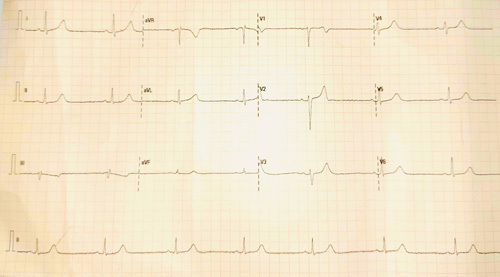
The authors reported the case of a middle-aged male patient who presented with blurring of vision, passage of loose stools, vomiting, and profuse sweating after ingestion of honey. He also had a history of loss of consciousness. On presentation, he was hypotensive and tachypneic with cold, clammy extremities. His ECG showed sinus bradycardia. The authors made a diagnosis of mad honey intoxication with suspected anaphylaxis. The authors treated him with intravenous normal saline, epinephrine, and atropine. He again developed hypotension and bradycardia in a few hours, for which hydrocortisone was administered, following which his heart rate was normalized in 2 h. Overall, the recovery time in our patient was 8 h. The patient was counseled to avoid consuming mad honey and did well on his monthly follow-up.
Our patient had signs and symptoms suggesting intoxication following ingestion of mad honey with suspicion of anaphylaxis. Similar to other reported cases, the patient had sinus bradycardia and hypotension. Epinephrine and atropine were administered to treat hypotension and bradycardia, respectively. Also, refractory hypotension was managed by intravenous hydrocortisone. Usually, atropine and saline infusion are sufficient to manage these cases, and simultaneous use of epinephrine and atropine should be avoided unless indicated.
Our case highlighted the approach to diagnosing and treating mad honey intoxication with suspected anaphylaxis.
食用疯蜜可导致中毒。疯蜜所致中毒的确切发病率尚不清楚。通常情况下,患者会出现头晕、恶心、晕厥和窦性心动过缓。
作者报告了一例中年男性患者,其在食用蜂蜜后出现视力模糊、腹泻、呕吐和大量出汗。他既往有过意识丧失病史。就诊时,他血压降低、呼吸急促,四肢冰冷潮湿。他的心电图显示窦性心动过缓。作者诊断为疯蜜中毒并怀疑有过敏反应。作者用静脉生理盐水、肾上腺素和阿托品对他进行治疗。数小时后他再次出现低血压和心动过缓,为此给予氢化可的松治疗,随后他的心率在2小时内恢复正常。总体而言,我们这位患者的恢复时间为8小时。建议该患者避免食用疯蜜,其在每月的随访中情况良好。
我们的患者在食用疯蜜后出现了提示中毒并怀疑有过敏反应的体征和症状。与其他报告的病例相似,该患者有窦性心动过缓和低血压。分别给予肾上腺素和阿托品来治疗低血压和心动过缓。此外,难治性低血压通过静脉注射氢化可的松来处理。通常,阿托品和生理盐水输注足以处理这些病例,除非有指征,应避免同时使用肾上腺素和阿托品。
我们的病例突出了对疑似过敏反应的疯蜜中毒的诊断和治疗方法。