Jaiswal Vikash, Ang Song Peng, Shrestha Abhigan Babu, Joshi Amey, Ishak Angela, Chia Jia Ee, Kanakannavr Sanchita Suresh, Naz Sidra, Doshi Neel, Nanavaty Dhairya, Gera Asmita, Kumar Vikash, Daneshvar Farshid, Song David, Rajak Kripa
JCCR Cardiology Research, Varanasi.
Department of Research, Larkin Community Hospital, South Miami.
Ann Med Surg (Lond). 2023 Apr 17;85(6):2849-2857. doi: 10.1097/MS9.0000000000000634. eCollection 2023 Jun.
Current guidelines have shown the superiority of coronary artery bypass grafting (CABG) over medical therapy. However, there is a paucity of data evaluating the optimal revascularization strategy in patients with ischemic left ventricular systolic dysfunction (LVSD).
The authors aimed to evaluate the clinical outcomes of postpercutaneous coronary intervention (PCI) and CABG among patients with LVSD.
The authors performed a systematic literature search using the PubMed, Embase, Scopus, and the Cochrane Libraries for relevant articles from inception until 30 November 2022. Outcomes were reported as pooled odds ratio (OR), and their corresponding 95% CI using STATA (version 17.0, StataCorp).
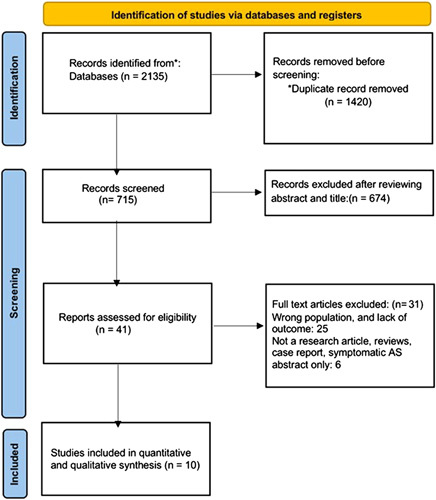
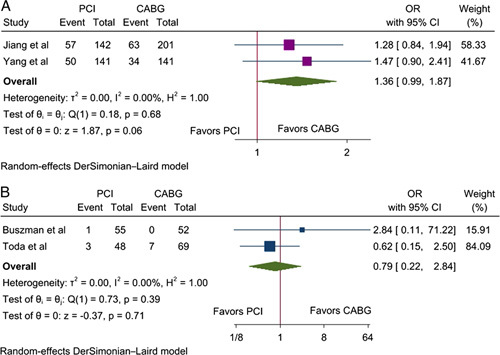
A total of 10 studies with 13 324 patients were included in the analysis. The mean age of patients in PCI was 65.3 years, and 64.1 years in the CABG group. The most common comorbidities included: HTN (80 vs. 78%) and DM (49.2 vs. 49%). The mean follow-up duration was 3.75 years. Compared with CABG, the PCI group had higher odds of all-cause mortality (OR 1.15, 95% CI 1.01-1.31, =0.03), repeat revascularization (OR 3.57, 95% CI 2.56-4.97, <0.001), MI (OR 1.92, 95% CI 1.01-3.86, =0.048) while the incidence of cardiovascular mortality (OR 1.23, 95% CI 0.98-1.55, =0.07), stroke (OR 0.73 95% CI: 0.51-1.04, =0.08), major adverse cardiovascular and cerebrovascular events (OR 1.36, 95% CI 0.99-1.87, =0.06), and ventricular tachycardia (OR 0.79, 95% CI 0.22-2.86, =0.72) was comparable between both the procedures.
The results of this meta-analysis suggest that CABG is superior to PCI for patients with LVSD. CABG was associated with a lower risk of all-cause mortality, repeat revascularization, and incidence of myocardial infarction compared with PCI in patients with LVSD.
当前指南已显示冠状动脉旁路移植术(CABG)优于药物治疗。然而,评估缺血性左心室收缩功能障碍(LVSD)患者最佳血运重建策略的数据匮乏。
作者旨在评估LVSD患者经皮冠状动脉介入治疗(PCI)和CABG后的临床结局。
作者使用PubMed、Embase、Scopus和Cochrane图书馆进行系统文献检索,以获取从创刊至2022年11月30日的相关文章。结果报告为合并比值比(OR)及其相应的95%置信区间(CI),使用STATA(版本17.0,StataCorp)软件。
共有10项研究、13324例患者纳入分析。PCI组患者的平均年龄为65.3岁,CABG组为64.1岁。最常见的合并症包括:高血压(80%对78%)和糖尿病(49.2%对49%)。平均随访时间为3.75年。与CABG相比,PCI组全因死亡率(OR 1.15,95% CI 1.01 - 1.31,P = 0.03)重复血运重建(OR 3.57,95% CI 2.56 - 4.97,P < 0.001)、心肌梗死(OR 1.92,95% CI 1.01 - 3.86,P = 0.048)的发生几率更高,而心血管死亡率(OR 1.23,95% CI 0.98 - 1.55,P = 0.07)、中风(OR 0.73,95% CI:0.51 - 1.04,P = 0.08)、主要不良心血管和脑血管事件(OR 1.36,95% CI 0.99 - 1.87,P = 0.06)以及室性心动过速(OR 0.79,95% CI 0.22 - 2.86,P = 0.72)在两种手术之间相当。
这项荟萃分析的结果表明,对于LVSD患者,CABG优于PCI。与LVSD患者的PCI相比,CABG与全因死亡率、重复血运重建和心肌梗死发生率较低相关。