Badillo-Alonso Humberto, Martínez-Alanis Marisol, Sánchez-Huesca Ramiro, Lerma Abel, Lerma Claudia
Centro de Investigación en Ciencias de la Salud (CICSA), FCS, Universidad Anáhuac México Campus Norte, Huixquilucan Edo. de Mexico 52786, Mexico.
Jalalpa el Grande Health Center, Mexico City Health Secreatariat, Mexico City 01377, Mexico.
J Cardiovasc Dev Dis. 2023 May 31;10(6):243. doi: 10.3390/jcdd10060243.
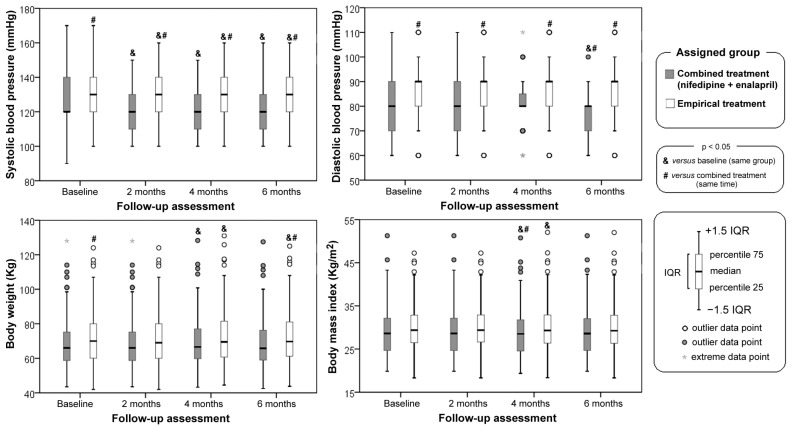
Hypertension in Mexico has a prevalence of 32% and is the second most widespread cause of consultation in primary care. Only 40% of patients in treatment have a blood pressure (BP) below 140/90 mmHg. This clinical trial aimed to compare the effectiveness of the combination of enalapril and nifedipine versus the empirical treatment for hypertension in patients with uncontrolled BP in a primary care center in Mexico City. Participants were randomized to treatment with enalapril and nifedipine (combination group) or to continue with the empirical treatment. Outcome variables were BP control, therapeutic adherence, and adverse effects at 6 months of follow-up. At the end of the follow-up period, BP control (64% versus 77%) and therapeutic adherence (53% versus 93%) showed an improvement from the baseline values in the group that received the combination treatment. BP control (51% versus 47%) and therapeutic adherence (64% versus 59%) in the group who received the empirical treatment did not show improvement from the baseline to follow-up. Combined treatment was 31% more efficacious than conventional empirical treatment (odds ratio = 3.9), which yielded an incremental clinical utility of 18% with high tolerability extent among patients in primary care in Mexico City. These results contribute to the control of arterial hypertension.
墨西哥高血压患病率为32%,是初级保健中第二大常见的就诊原因。接受治疗的患者中只有40%的血压(BP)低于140/90 mmHg。这项临床试验旨在比较在墨西哥城一家初级保健中心,依那普利和硝苯地平联合用药与高血压经验性治疗对血压控制不佳患者的有效性。参与者被随机分配接受依那普利和硝苯地平治疗(联合治疗组)或继续接受经验性治疗。观察指标为随访6个月时的血压控制情况、治疗依从性和不良反应。在随访期结束时,接受联合治疗的组中,血压控制情况(64%对77%)和治疗依从性(53%对93%)较基线值有所改善。接受经验性治疗的组中,血压控制情况(51%对47%)和治疗依从性(64%对59%)从基线到随访未显示改善。联合治疗比传统经验性治疗有效31%(优势比=3.9),在墨西哥城初级保健患者中产生了18%的增量临床效用,且耐受性较高。这些结果有助于控制动脉高血压。