Meshkovska Biljana, Gebremariam Mekdes Kebede, Atukunda Prudence, Iversen Per Ole, Wandel Margareta, Lien Nanna
Department of Nutrition, Institute of Basic Medical Sciences, Faculty of Medicine, University of Oslo, Blindern, P.O. Box 1046, 0316, Oslo, Norway.
Department of Community Medicine and Global Health, Institute of Health and Society, University of Oslo, Kirkeveien 166, Fredrik Holsts hus, 0450, Oslo, Norway.
Implement Sci Commun. 2023 Jun 27;4(1):73. doi: 10.1186/s43058-023-00454-y.
Low- and middle-income countries (LMICs) are particularly vulnerable to the double burden of malnutrition: co-existence of underweight, overweight, obesity, and/or diet-related non-communicable diseases. Nutrition-related double-duty actions in school settings have been identified as one of the ways to address this challenge. However, to be able to take full advantage of the potential impact, it is important to understand their implementation as well. The aim of this paper is to systematically review qualitative research on barriers and facilitators to the implementation of nutrition-related actions in the school settings in LMICs.
The following databases were searched: EMBASE, ERIC, MEDLINE, Global Health and PsycInfo (all on Ovid), Scopus (Elsevier), the Web of Science Social Sciences Citation Index, and Global Index Medicus from the World Health Organization. Of the 4253 identified records, 4030 were excluded after the abstract and title screen, leaving 223 for the full-text screen. A final 36 papers were included in this review. The consolidated framework for implementation research (CFIR) was used in the analysis.
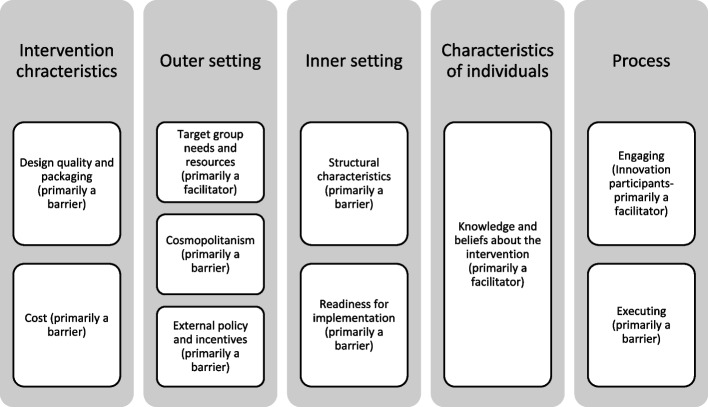
We identified barriers and facilitators to implementation linked to the following CFIR constructs/sub-constructs: design quality and packaging, cost (intervention characteristics); target group needs and resources, cosmopolitanism, external policy and incentives (outer setting); structural characteristics, readiness for implementation (inner setting); knowledge and beliefs (characteristics of individuals) and engaging, executing (process). All identified constructs apart from target group needs and resources, knowledge and beliefs, and engaging were predominantly barriers. Available resources were the most prevalent barriers across studies.
This review identified barriers and facilitators to the implementation of nutrition-related actions based on qualitative articles in the school setting in LMICs, using the CFIR. Schools face continuous challenges in regard to funding and the government sector may have a role to play not only by offering financial assistance, but also through policy-making that would support healthy eating practices on school grounds.
PROSPERO ID: CRD42022296159.
低收入和中等收入国家(LMICs)特别容易受到营养不良双重负担的影响:体重不足、超重、肥胖和/或与饮食相关的非传染性疾病并存。学校环境中与营养相关的双重职责行动已被确定为应对这一挑战的方法之一。然而,为了能够充分利用其潜在影响,了解其实施情况也很重要。本文的目的是系统评价关于低收入和中等收入国家学校环境中营养相关行动实施的障碍和促进因素的定性研究。
检索了以下数据库:EMBASE、教育资源信息中心(ERIC)、医学期刊数据库(MEDLINE)、全球健康数据库和心理学文摘数据库(均来自Ovid)、Scopus(爱思唯尔)、科学网社会科学引文索引以及世界卫生组织的全球医学索引。在识别出的4253条记录中,经过摘要和标题筛选后排除了4030条,剩下223条进行全文筛选。本综述最终纳入了36篇论文。分析采用了实施研究的整合框架(CFIR)。
我们确定了与以下CFIR结构/子结构相关的实施障碍和促进因素:设计质量和包装、成本(干预特征);目标群体需求和资源、世界性、外部政策和激励措施(外部环境);结构特征、实施准备情况(内部环境);知识和信念(个体特征)以及参与、执行(过程)。除目标群体需求和资源、知识和信念以及参与外,所有确定的结构主要都是障碍。在各项研究中,可用资源是最普遍的障碍。
本综述利用CFIR,基于低收入和中等收入国家学校环境中的定性文章,确定了营养相关行动实施的障碍和促进因素。学校在资金方面面临持续挑战,政府部门不仅可以通过提供财政援助发挥作用,还可以通过制定支持校园健康饮食行为的政策来发挥作用。
国际系统评价注册平台(PROSPERO)标识符:CRD42022296159 。