Cremone Ivan Mirko, Nardi Benedetta, Amatori Giulia, Palego Lionella, Baroni Dario, Casagrande Danila, Massimetti Enrico, Betti Laura, Giannaccini Gino, Dell'Osso Liliana, Carpita Barbara
Department of Clinical and Experimental Medicine, University of Pisa, via Roma 67, 56126 Pisa, Italy.
Department of Pharmacy, University of Pisa, 56126 Pisa, Italy.
Biomedicines. 2023 May 31;11(6):1600. doi: 10.3390/biomedicines11061600.
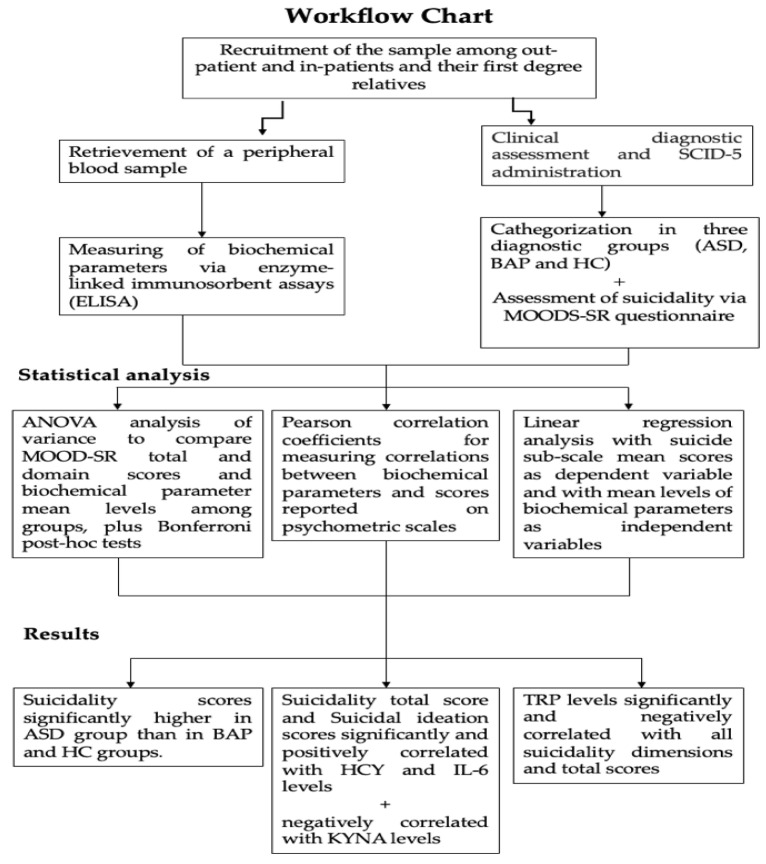
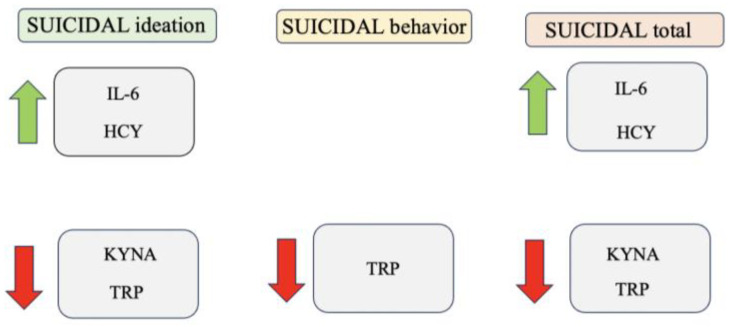
Involving 1 million people a year, suicide represents one of the major topics of psychiatric research. Despite the focus in recent years on neurobiological underpinnings, understanding and predicting suicide remains a challenge. Many sociodemographical risk factors and prognostic markers have been proposed but they have poor predictive accuracy. Biomarkers can provide essential information acting as predictive indicators, providing proof of treatment response and proposing potential targets while offering more assurance than psychological measures. In this framework, the aim of this study is to open the way in this field and evaluate the correlation between blood levels of serotonin, brain derived neurotrophic factor, tryptophan and its metabolites, IL-6 and homocysteine levels and suicidality. Blood samples were taken from 24 adults with autism, their first-degree relatives, and 24 controls. Biochemical parameters were measured with enzyme-linked immunosorbent assays. Suicidality was measured through selected items of the MOODS-SR. Here we confirm the link between suicidality and autism and provide more evidence regarding the association of suicidality with increased homocysteine (0.278) and IL-6 (0.487) levels and decreased tryptophan (-0.132) and kynurenic acid (-0.253) ones. Our results suggest a possible transnosographic association between these biochemical parameters and increased suicide risk.
自杀每年涉及100万人,是精神病学研究的主要课题之一。尽管近年来关注神经生物学基础,但理解和预测自杀仍然是一项挑战。已经提出了许多社会人口统计学风险因素和预后标志物,但它们的预测准确性很差。生物标志物可以提供作为预测指标的重要信息,提供治疗反应的证据并提出潜在靶点,同时比心理测量提供更多保证。在此框架下,本研究的目的是在该领域开辟道路,并评估血清素、脑源性神经营养因子、色氨酸及其代谢物、IL-6和同型半胱氨酸水平与自杀倾向之间的相关性。从24名患有自闭症的成年人、他们的一级亲属和24名对照中采集血样。用酶联免疫吸附测定法测量生化参数。通过MOODS-SR的选定项目测量自杀倾向。在这里,我们证实了自杀倾向与自闭症之间的联系,并提供了更多证据,证明自杀倾向与同型半胱氨酸(0.278)和IL-6(0.487)水平升高以及色氨酸(-0.132)和犬尿烯酸(-0.253)水平降低有关。我们的结果表明,这些生化参数与自杀风险增加之间可能存在跨疾病关联。