de Oliveira Natasha Rodrigues, Santos Francisco Denis Souza, Dos Santos Vitória Adrielly Catschor, Maia Mara Andrade Colares, Oliveira Thaís Larré, Dellagostin Odir Antônio
Núcleo de Biotecnologia, Centro de Desenvolvimento Tecnológico, Universidade Federal de Pelotas, Pelotas 96010-610, RS, Brazil.
Pathogens. 2023 May 31;12(6):787. doi: 10.3390/pathogens12060787.
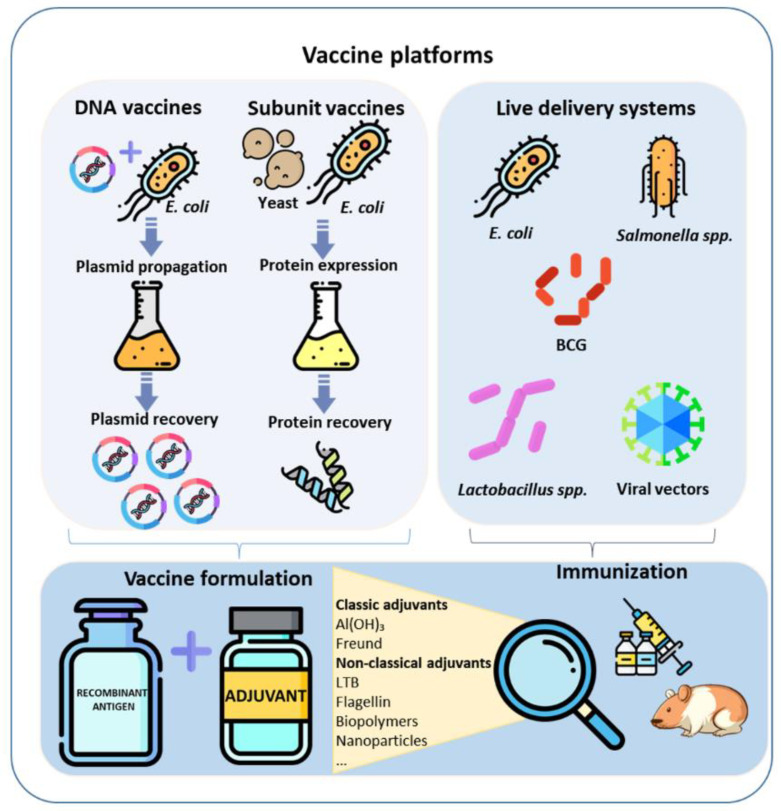
The first leptospiral recombinant vaccine was developed in the late 1990s. Since then, progress in the fields of reverse vaccinology (RV) and structural vaccinology (SV) has significantly improved the identification of novel surface-exposed and conserved vaccine targets. However, developing recombinant vaccines for leptospirosis faces various challenges, including selecting the ideal expression platform or delivery system, assessing immunogenicity, selecting adjuvants, establishing vaccine formulation, demonstrating protective efficacy against lethal disease in homologous challenge, achieving full renal clearance using experimental models, and reproducibility of protective efficacy against heterologous challenge. In this review, we highlight the role of the expression/delivery system employed in studies based on the well-known LipL32 and leptospiral immunoglobulin-like (Lig) proteins, as well as the choice of adjuvants, as key factors to achieving the best vaccine performance in terms of protective efficacy against lethal infection and induction of sterile immunity.
第一种钩端螺旋体重组疫苗是在20世纪90年代后期研发出来的。从那时起,反向疫苗学(RV)和结构疫苗学(SV)领域的进展显著提高了对新型表面暴露且保守的疫苗靶点的识别。然而,开发钩端螺旋体病的重组疫苗面临各种挑战,包括选择理想的表达平台或递送系统、评估免疫原性、选择佐剂、确定疫苗配方、在同源攻击中证明对致死性疾病的保护效力、使用实验模型实现完全肾脏清除以及在异源攻击中保护效力的可重复性。在本综述中,我们强调了基于著名的LipL32和钩端螺旋体免疫球蛋白样(Lig)蛋白的研究所采用的表达/递送系统的作用,以及佐剂的选择,这些是在针对致死性感染的保护效力和诱导无菌免疫方面实现最佳疫苗性能的关键因素。