Hindi Sherif S, Sabir Jamal S M, Dawoud Uthman M, Ismail Iqbal M, Asiry Khalid A, Mirdad Zohair M, Abo-Elyousr Kamal A, Shiboob Mohamed H, Gabal Mohamed A, Albureikan Mona Othman I, Alanazi Rakan A, Ibrahim Omer H M
Department of Agriculture, Faculty of Environmental Sciences, King Abdullaziz University (KAU), P.O. Box 80208, Jeddah 21589, Saudi Arabia.
Department of Biological Sciences, Faculty of Sciences, King Abdullaziz University (KAU), P.O. Box 80208, Jeddah 21589, Saudi Arabia.
Polymers (Basel). 2023 Jun 12;15(12):2660. doi: 10.3390/polym15122660.
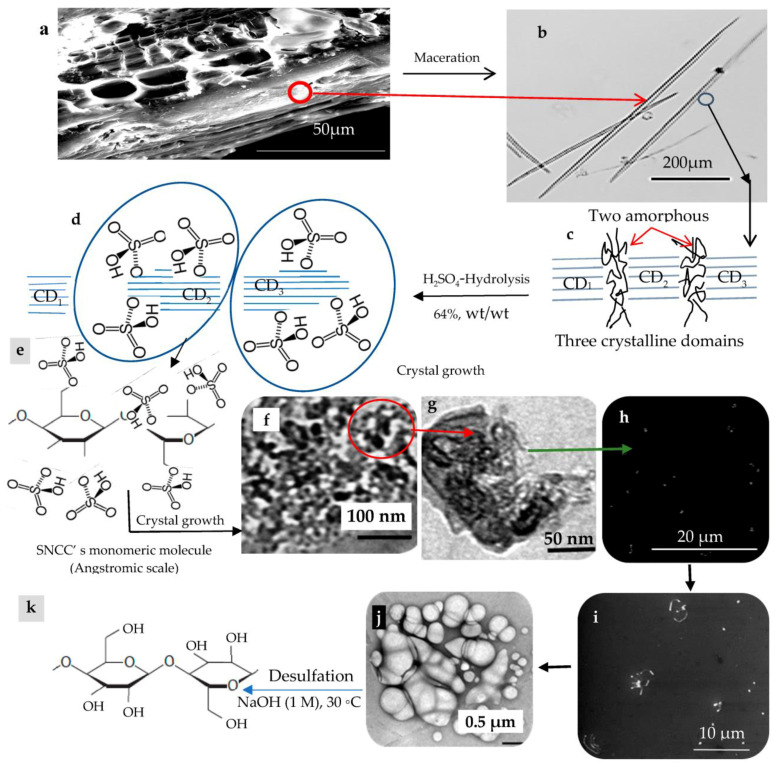
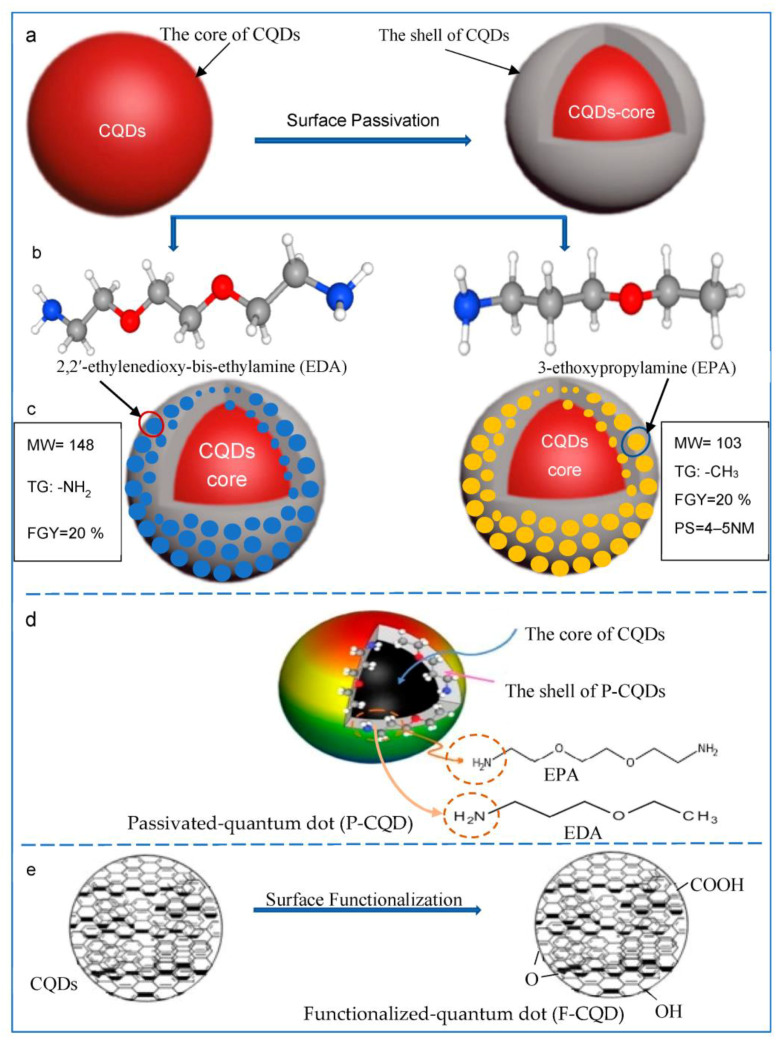
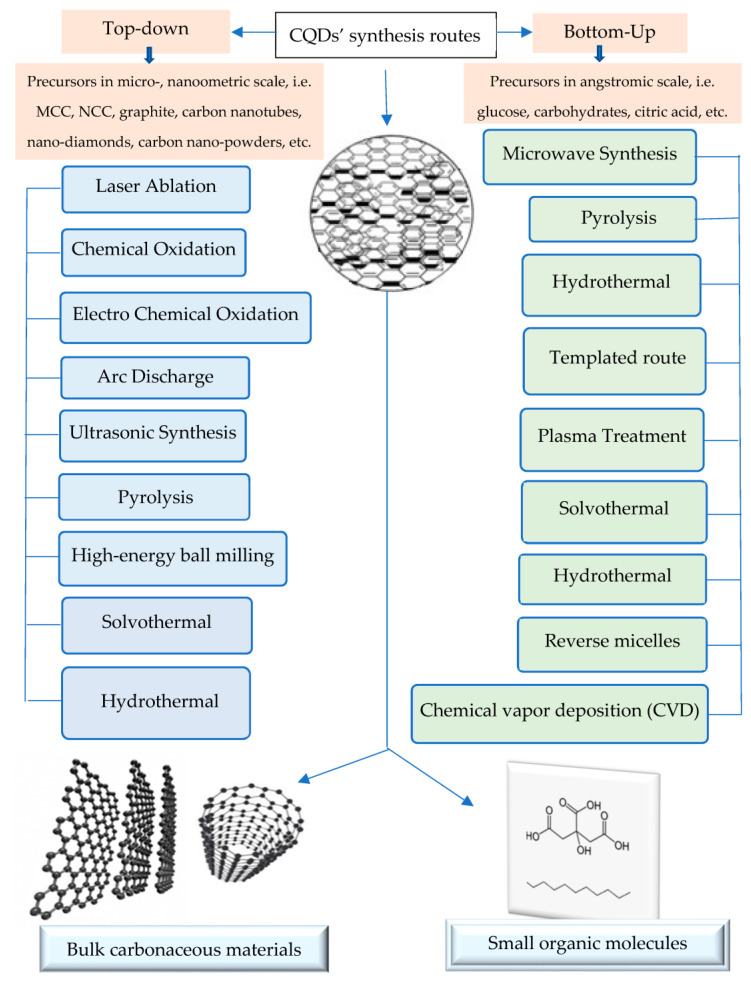
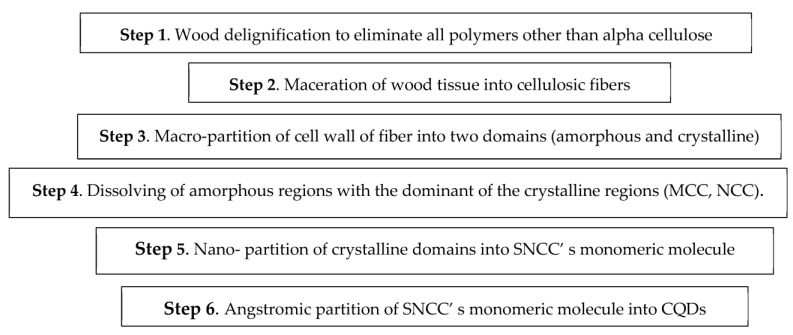
Passivated-carbon quantum dots (P-CQDs) have been attracting great interest as an antimicrobial therapy tool due to their bright fluorescence, lack of toxicity, eco-friendly nature, simple synthetic schemes, and possession of photocatalytic functions comparable to those present in traditional nanometric semiconductors. Besides synthetic precursors, CQDs can be synthesized from a plethora of natural resources including microcrystalline cellulose (MCC) and nanocrystalline cellulose (NCC). Converting MCC into NCC is performed chemically via the top-down route, while synthesizing CODs from NCC can be performed via the bottom-up route. Due to the good surface charge status with the NCC precursor, we focused in this review on synthesizing CQDs from nanocelluloses (MCC and NCC) since they could become a potential source for fabricating carbon quantum dots that are affected by pyrolysis temperature. There are several P-CQDs synthesized with a wide spectrum of featured properties, namely functionalized carbon quantum dots (F-CQDs) and passivated carbon quantum dots (P-CQDs). There are two different important P-CQDs, namely 2,2'-ethylenedioxy-bis-ethylamine (EDA-CQDs) and 3-ethoxypropylamine (EPA-CQDs), that have achieved desirable results in the antiviral therapy field. Since NoV is the most common dangerous cause of nonbacterial, acute gastroenteritis outbreaks worldwide, this review deals with NoV in detail. The surficial charge status (SCS) of the P-CQDs plays an important role in their interactions with NoVs. The EDA-CQDs were found to be more effective than EPA-CQDs in inhibiting the NoV binding. This difference may be attributed to their SCS as well as the virus surface. EDA-CQDs with surficial terminal amino (-NH) groups are positively charged at physiological pH (-NH), whereas EPA-CQDs with surficial terminal methyl groups (-CH) are not charged. Since the NoV particles are negatively charged, they are attracted to the positively charged EDA-CQDs, resulting in enhancing the P-CQDs concentration around the virus particles. The carbon nanotubes (CNTs) were found to be comparable to the P-CQDs in the non-specific binding with NoV capsid proteins, through complementary charges, π-π stacking, and/or hydrophobic interactions.
钝化碳量子点(P-CQDs)作为一种抗菌治疗工具,因其明亮的荧光、无毒性、环保性质、简单的合成方案以及具有与传统纳米半导体相当的光催化功能而备受关注。除了合成前体之外,碳量子点还可以从包括微晶纤维素(MCC)和纳米晶纤维素(NCC)在内的大量自然资源中合成。通过自上而下的化学途径将MCC转化为NCC,而从NCC合成碳量子点可以通过自下而上的途径进行。由于NCC前体具有良好的表面电荷状态,因此在本综述中我们重点关注从纳米纤维素(MCC和NCC)合成碳量子点,因为它们可能成为制备受热解温度影响的碳量子点的潜在来源。有几种具有广泛特性的P-CQDs被合成出来,即功能化碳量子点(F-CQDs)和钝化碳量子点(P-CQDs)。有两种不同的重要P-CQDs,即2,2'-乙二氧基双乙胺(EDA-CQDs)和3-乙氧基丙胺(EPA-CQDs),它们在抗病毒治疗领域取得了理想的效果。由于诺如病毒(NoV)是全球非细菌性急性肠胃炎爆发的最常见危险病因,因此本综述对NoV进行了详细阐述。P-CQDs的表面电荷状态(SCS)在它们与NoV的相互作用中起着重要作用。研究发现EDA-CQDs在抑制NoV结合方面比EPA-CQDs更有效。这种差异可能归因于它们的SCS以及病毒表面。具有表面末端氨基(-NH)基团的EDA-CQDs在生理pH值下带正电(-NH),而具有表面末端甲基(-CH)基团的EPA-CQDs不带电。由于NoV颗粒带负电,它们会被带正电的EDA-CQDs吸引,从而导致病毒颗粒周围的P-CQDs浓度增加。研究发现碳纳米管(CNTs)在与NoV衣壳蛋白的非特异性结合方面与P-CQDs相当,通过互补电荷、π-π堆积和/或疏水相互作用实现。