
阿根廷的 Lambda 变体:分析 SARS-CoV-2 谱系 C.37 的进化和传播。
The Lambda Variant in Argentina: Analyzing the Evolution and Spread of SARS-CoV-2 Lineage C.37.
机构信息
Laboratorio de Virologia, Hospital de Ninos Dr. Ricardo Gutierrez, Gallo 1330, Ciudad Autónoma de Buenos Aires 1425, Argentina.
Consejo Nacional de Investigaciones Cientificas y Tecnicas (CONICET), Godoy Cruz 2390, Ciudad Autónoma de Buenos Aires 2915, Argentina.
出版信息
Viruses. 2023 Jun 16;15(6):1382. doi: 10.3390/v15061382.
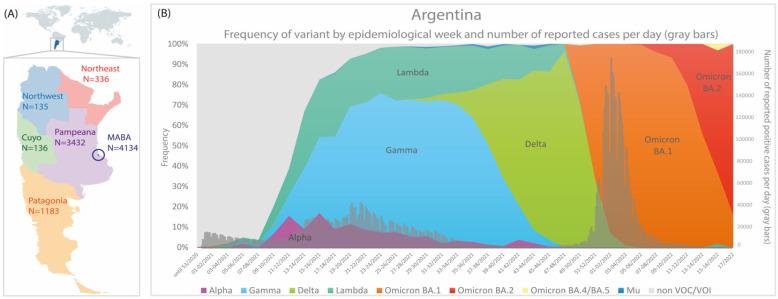
The second wave of COVID-19 occurred in South America in early 2021 and was mainly driven by Gamma and Lambda variants. In this study, we aimed to describe the emergence and local genomic diversity of the SARS-CoV-2 Lambda variant in Argentina, from its initial entry into the country until its detection ceased. Molecular surveillance was conducted on 9356 samples from Argentina between October 2020 and April 2022, and sequencing, phylogenetic, and phylogeographic analyses were performed. Our findings revealed that the Lambda variant was first detected in Argentina in January 2021 and steadily increased in frequency until it peaked in April 2021, with continued detection throughout the year. Phylodynamic analyses showed that at least 18 introductions of the Lambda variant into the country occurred, with nine of them having evidence of onward local transmission. The spatial--temporal reconstruction showed that Argentine clades were associated with Lambda sequences from Latin America and suggested an initial diversification in the Metropolitan Area of Buenos Aires before spreading to other regions in Argentina. Genetic analyses of genome sequences allowed us to describe the mutational patterns of the Argentine Lambda sequences and detect the emergence of rare mutations in an immunocompromised patient. Our study highlights the importance of genomic surveillance in identifying the introduction and geographical distribution of the SARS-CoV-2 Lambda variant, as well as in monitoring the emergence of mutations that could be involved in the evolutionary leaps that characterize variants of concern.
2021 年初,第二波 COVID-19 在南美洲爆发,主要由 Gamma 和 Lambda 变体驱动。在这项研究中,我们旨在描述 SARS-CoV-2 Lambda 变体在阿根廷的出现和本地基因组多样性,从其最初进入该国到检测停止。在 2020 年 10 月至 2022 年 4 月期间,对来自阿根廷的 9356 个样本进行了分子监测,并进行了测序、系统发育和系统地理学分析。我们的研究结果表明,Lambda 变体于 2021 年 1 月首次在阿根廷检测到,并稳步增加频率,直到 2021 年 4 月达到峰值,全年持续检测到。系统发育分析表明,至少有 18 次 Lambda 变体进入该国,其中 9 次有证据表明存在本地传播。时空重建表明,阿根廷分支与来自拉丁美洲的 Lambda 序列有关,提示在扩散到阿根廷其他地区之前,在布宜诺斯艾利斯大都市区最初出现了多样化。对基因组序列的遗传分析使我们能够描述阿根廷 Lambda 序列的突变模式,并在免疫功能低下的患者中检测到罕见突变的出现。我们的研究强调了基因组监测在识别 SARS-CoV-2 Lambda 变体的引入和地理分布以及监测可能涉及到特征变体的进化飞跃的突变的重要性。




 Zotero 插件