LABRESIS-Laboratório de Pesquisa em Resistência Bacteriana, Hospital de Clínicas de Porto Alegregrid.414449.8, Porto Alegre, Rio Grande do Sul, Brazil.
Laboratório de Diagnóstico de SARS-CoV-2, Hospital de Clínicas de Porto Alegregrid.414449.8, Porto Alegre, Rio Grande do Sul, Brazil.
Microbiol Spectr. 2022 Feb 23;10(1):e0151121. doi: 10.1128/spectrum.01511-21. Epub 2022 Feb 16.
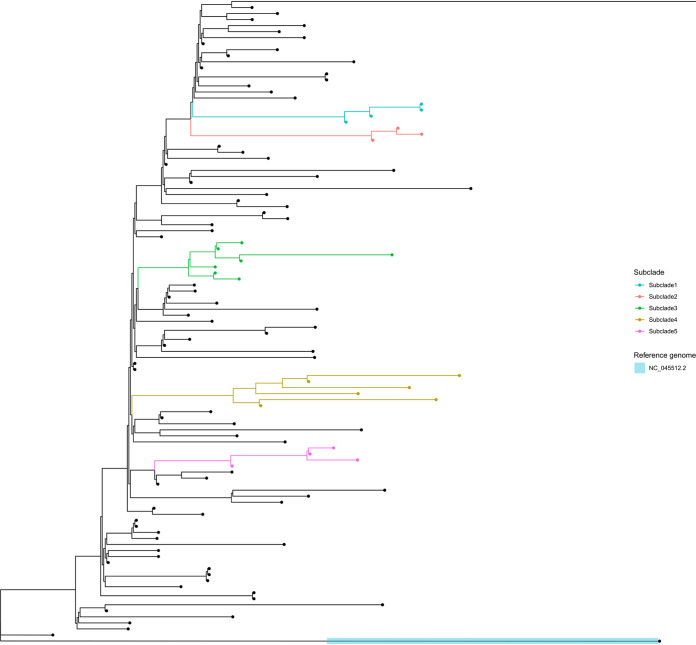
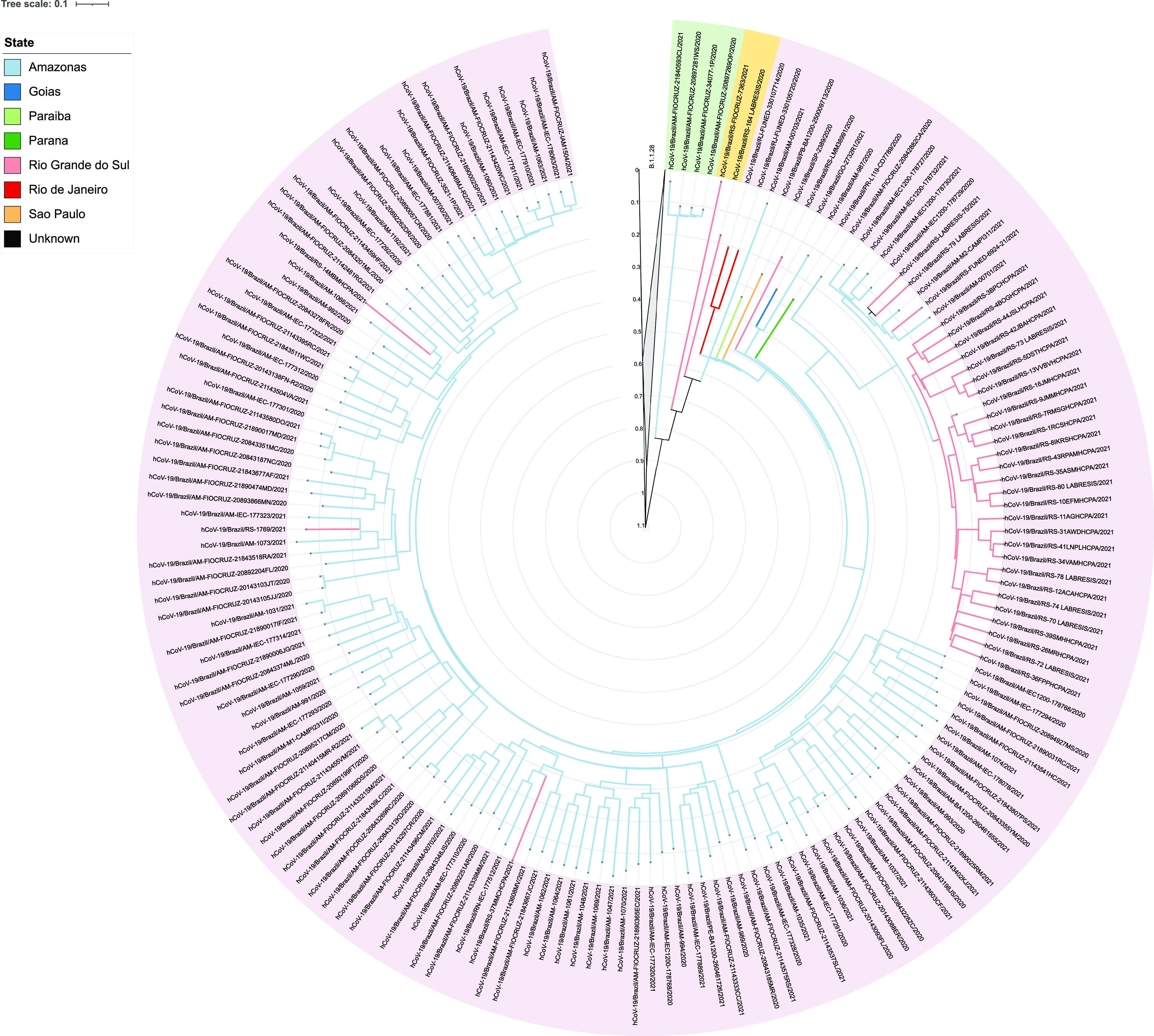
The SARS-CoV-2 P.1 lineage emerged in Amazonas (AM), North Brazil and its evolution has been dynamically reported associated with increased transmissibility and/or immune evasion. Here, we evaluated the lineages circulating in 29 cities in Rio Grande do Sul (RS), Southern Brazil between March 2020 and May 2021 and investigated the genetic events associated with the emergence of the P.1. A total of 202 oro/nasopharyngeal SARS-CoV-2 specimens from patients during routine hospital care were submitted to whole-genome sequencing. Phylogenetic and Bayesian Evolutionary Analyses of the P.1 lineage were carried out to determine the relationship between sequences from RS and AM and dated their common ancestor and origin. One hundred six (53%) sequences were assigned as P.1 and most carried the 22 lineage-defining mutations. All the P.1 sequences included other important mutations, such as P314L and R203K/G204R, and revealed a high genetic diversity in the phylogenetic tree. The time-scaled inference suggests that the oldest P.1 sequences from different Brazilian states share a ancestor with those from AM, but the origin of some sequences from RS is unknown. Further, the common ancestor of sequences from RS is dated to mid-June/July 2020, earlier than those previously reported from AM. Our results demonstrate that there is a high degree of genetic diversity among P.1 sequences, which suggests a continuous evolution and community spread of the virus. Although the first P.1 outbreak was reported in AM, the lineage was associated with multiple introductory events and had already been circulating in Southern Brazil prior to November 2020. The SARS-CoV-2 P.1 lineage is associated with increased transmissibility and/or immune evasion and presents a dynamic evolution in Brazil. The significance of our research relies in the fact that we evaluated the SARS-CoV-2 lineages circulating in Southern Brazil between March 2020 and May 2021. This evaluation allowed us to detect the genetic events associated with the emergence of the P.1 and its sublineages. This study is important because we were able to establish that the common ancestor of P.1 sequences from Rio Grande do Sul, Southern Brazil, is dated of mid-June/July 2020, earlier than the P.1 sequences previously reported from Amazonas (AM) state. Noteworthy, the high degree of genetic diversity among P.1 sequences found in this study suggests a continuous evolution and community spread of the virus. Moreover, the oldest P.1 sequences from different Brazilian states share a ancestor with those from AM.
SARS-CoV-2 P.1 谱系在巴西北部的亚马逊州(AM)出现,其进化情况与传播能力增强和/或免疫逃逸有关。在这里,我们评估了 2020 年 3 月至 2021 年 5 月期间在巴西南部南里奥格兰德州(RS)的 29 个城市中循环的谱系,并调查了与 P.1 出现相关的遗传事件。对来自常规医院护理期间的患者的 202 个口咽/鼻咽 SARS-CoV-2 标本进行了全基因组测序。对 P.1 谱系进行了系统发育和贝叶斯进化分析,以确定 RS 和 AM 之间序列之间的关系,并确定其共同祖先和起源。106 个(53%)序列被指定为 P.1,大多数携带 22 个谱系定义突变。所有 P.1 序列都包含其他重要突变,例如 P314L 和 R203K/G204R,并在系统发育树上显示出很高的遗传多样性。时间推断表明,来自不同巴西州的最古老的 P.1 序列与来自 AM 的序列共享一个祖先,但 RS 一些序列的起源未知。此外,RS 序列的共同祖先可追溯到 2020 年 6 月中旬/ 7 月,早于此前来自 AM 的报告。我们的研究结果表明,P.1 序列之间存在高度的遗传多样性,这表明病毒的持续进化和社区传播。尽管 P.1 的首次爆发是在 AM 报告的,但该谱系与多个引入事件有关,并且早在 2020 年 11 月之前就在巴西南部传播。SARS-CoV-2 P.1 谱系与传播能力增强和/或免疫逃逸有关,并在巴西呈现出动态进化。我们研究的意义在于我们评估了 2020 年 3 月至 2021 年 5 月期间在巴西南部流行的 SARS-CoV-2 谱系。这种评估使我们能够检测与 P.1 及其亚谱系出现相关的遗传事件。这项研究很重要,因为我们能够确定南里奥格兰德州(RS)的 P.1 序列的共同祖先可以追溯到 2020 年 6 月中旬/7 月,早于此前来自亚马逊州(AM)的报告。值得注意的是,本研究中发现的 P.1 序列之间高度的遗传多样性表明病毒的不断进化和社区传播。此外,来自不同巴西州的最古老的 P.1 序列与来自 AM 的序列共享一个祖先。