Universidad de Carabobo, Instituto de Investigaciones Biomédicas, Maracay, Venezuela.
US Centers for Disease Control and Prevention, Center for Global Health, Division of Parasitic Diseases and Malaria, Entomology Branch, Atlanta, GA, USA.
Mem Inst Oswaldo Cruz. 2023 Jun 23;118:e220210. doi: 10.1590/0074-02760220210. eCollection 2023.
The massive use of insecticides in public health has exerted selective pressure resulting in the development of resistance in Aedes aegypti to different insecticides in Venezuela. Between 2010 and 2020, the only insecticides available for vector control were the organophosphates (Ops) fenitrothion and temephos which were focally applied.
To determine the state of insecticide resistance and to identify the possible biochemical and molecular mechanisms involved in three populations of Ae. aegypti from Venezuela.
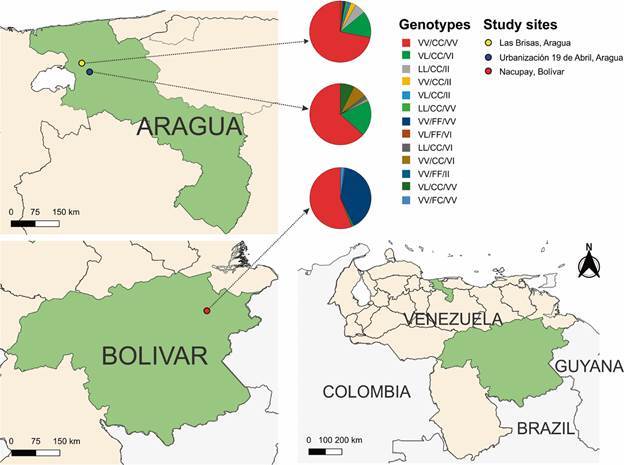
CDC bottle bioassays were conducted on Ae. aegypti collected between October 2019 and February 2020 in two hyperendemic localities for dengue in Aragua State and in a malaria endemic area in Bolívar State. Insecticide resistance mechanisms were studied using biochemical assays and polymerase chain reaction (PCR) to detect kdr mutations.
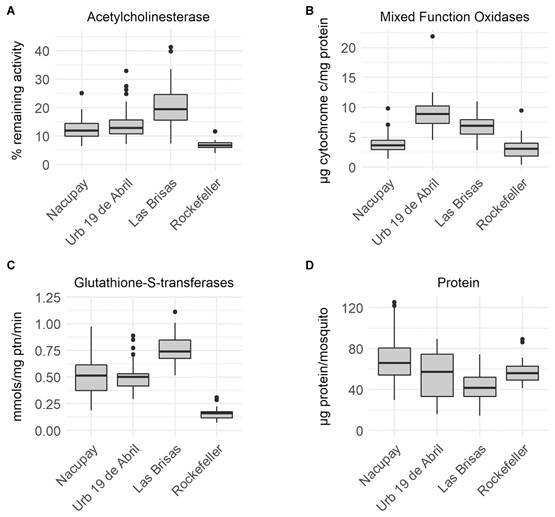
Bioassays showed contrasting results among populations; Las Brisas was resistant to malathion, permethrin and deltamethrin, Urbanización 19 de Abril was resistant to permethrin and Nacupay to malathion. All populations showed significantly higher activity of mixed function oxidases and glutathione-S-transferases (GSTs) in comparison with the susceptible strain. The kdr mutations V410L, F1534C, and V1016I were detected in all populations, with F1534C at higher frequencies.
Insecticide resistance persists in three Ae. aegypti populations from Venezuela even in the relative absence of insecticide application.
在委内瑞拉,大量使用杀虫剂对登革热媒介埃及伊蚊(Aedes aegypti)产生了选择压力,导致其对不同杀虫剂产生了抗性。在 2010 年至 2020 年期间,可用于病媒控制的杀虫剂仅有有机磷类杀虫剂(Ops)fenitrothion 和 temephos,且仅局部使用。
确定委内瑞拉三个埃及伊蚊种群的抗药性状况,并确定可能涉及的生化和分子机制。
于 2019 年 10 月至 2020 年 2 月在 Aragua 州两个登革热高度流行地区和 Bolívar 州一个疟疾流行地区采集埃及伊蚊,用 CDC 瓶生物测定法进行测定。使用生化测定和聚合酶链反应(PCR)检测 kdr 突变来研究杀虫剂抗性机制。
生物测定结果显示不同种群间存在差异;Las Brisas 对马拉硫磷、氯菊酯和溴氰菊酯具有抗性,Urbanización 19 de Abril 对氯菊酯具有抗性,Nacupay 对马拉硫磷具有抗性。与敏感株相比,所有种群的多功能氧化酶和谷胱甘肽-S-转移酶(GSTs)活性均显著升高。在所有种群中均检测到 kdr 突变 V410L、F1534C 和 V1016I,其中 F1534C 出现的频率更高。
即使在相对缺乏杀虫剂应用的情况下,委内瑞拉的三个埃及伊蚊种群仍存在抗药性。