Ji Yu-Qin, Tian Hao, Zheng Ze-Yu, Ye Zhuo-Yan, Ye Qiang
School of Sport and Health, Nanjing Sport Institute, Nanjing, Jiangsu, China.
School of Physical Education and Humanities, Nanjing Sport Institute, Nanjing, Jiangsu, China.
Front Psychiatry. 2023 Jun 12;14:1132074. doi: 10.3389/fpsyt.2023.1132074. eCollection 2023.
Autism spectrum disorder (ASD) is a severe public health concern, and most of the children with ASD experience a substantial delay in FMS. This study aimed to investigate the effectiveness of exercise interventions in improving FMS in children with ASD, and provide evidence to support the scientific use of exercise interventions in practice.
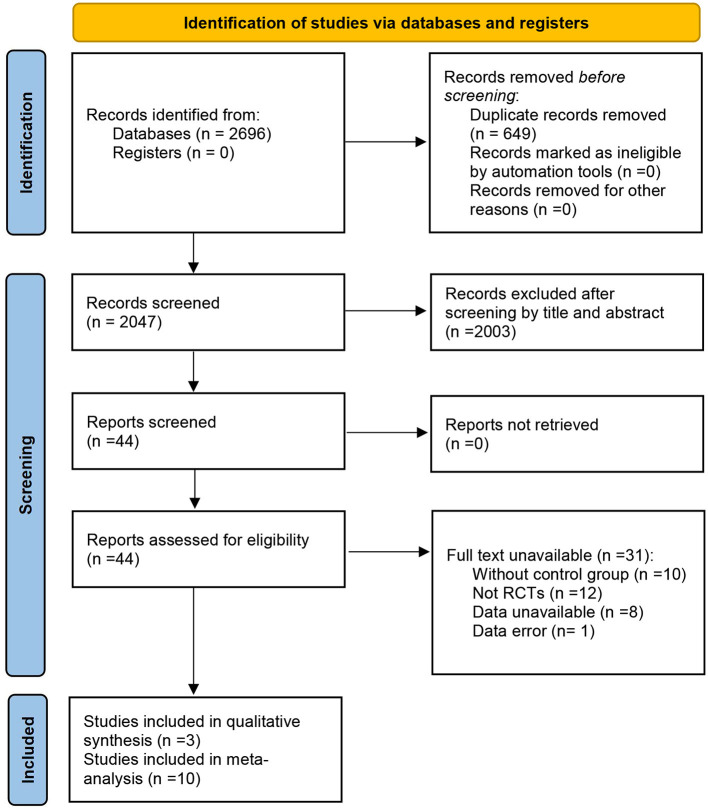
We searched seven online databases (PubMed, Scopus, Web of Science, Embase, EBSCO, Clinical Trials, and The Cochrane Library) from inception to May 20, 2022. We included randomized control trials of exercise interventions for FMS in children with ASD. The methodological quality of the included studies was assessed using the Physiotherapy Evidence Database Scale. Stata 14.0 software was used for meta-analysis, forest plotting, subgroup analysis, heterogeneity analysis, and meta-regression.
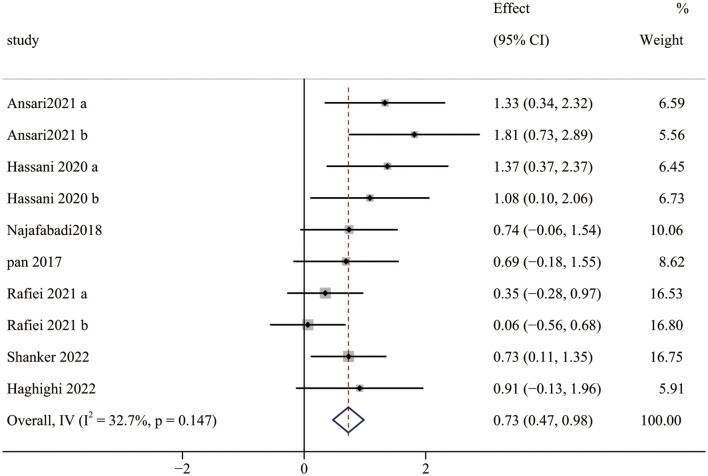
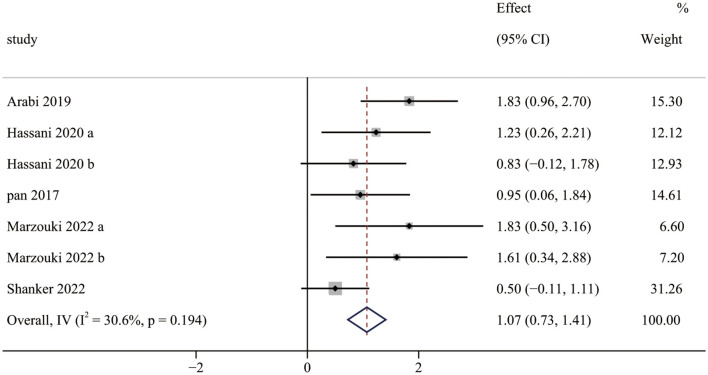
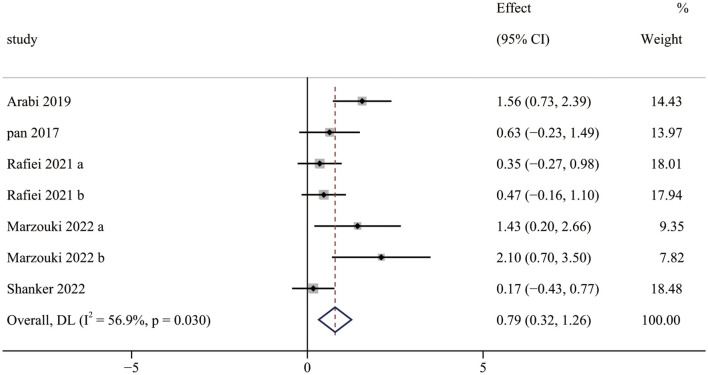
Thirteen studies underwent systematic review (541 participants), of which 10 underwent meta-analysis (297 participants). Overall, exercise interventions significantly improved overall FMS in children with ASD. Regarding the three categories of FMS, exercise interventions significantly improved LMS (SMD = 1.07; 95% CI 0.73 to 1.41, < 0.001), OCS (SMD = 0.79; 95% CI 0.32 to 1.26, = 0.001), and SS (SMD = 0.72; 95% CI 0.45 to 0.98, < 0.0001).
exercise interventions can effectively improve the FMS of children with ASD. The effects on LMS are considered as large effect sizes, while the effects on OCS and SS are considered as moderate effect sizes. These findings can inform clinical practice.
自闭症谱系障碍(ASD)是一个严重的公共卫生问题,大多数自闭症谱系障碍儿童在功能性动作技能(FMS)方面存在显著延迟。本研究旨在探讨运动干预对改善自闭症谱系障碍儿童功能性动作技能的有效性,并为实践中科学使用运动干预提供证据。
我们检索了7个在线数据库(PubMed、Scopus、科学网、Embase、EBSCO、临床试验和考克兰图书馆),检索时间从建库至2022年5月20日。我们纳入了针对自闭症谱系障碍儿童功能性动作技能的运动干预随机对照试验。使用物理治疗证据数据库量表评估纳入研究的方法学质量。采用Stata 14.0软件进行荟萃分析、森林图绘制、亚组分析、异质性分析和荟萃回归分析。
13项研究接受了系统评价(541名参与者),其中10项进行了荟萃分析(297名参与者)。总体而言,运动干预显著改善了自闭症谱系障碍儿童的整体功能性动作技能。在功能性动作技能的三个类别方面,运动干预显著改善了下肢运动技能(标准化均数差[SMD]=1.07;95%置信区间[CI]为0.73至1.41,P<0.001)、物体操控技能(SMD=0.79;95%CI为0.32至1.26,P=0.001)和稳定性技能(SMD=0.72;95%CI为0.45至0.98,P<0.0001)。
运动干预可有效改善自闭症谱系障碍儿童的功能性动作技能。对下肢运动技能的影响被认为是大效应量,而对物体操控技能和稳定性技能的影响被认为是中等效应量。这些研究结果可为临床实践提供参考。