Bao Xianguo, Chen Yingjun, Guo Chen, Xu Shuai
Spinal Surgery, Nanjing Lishui People's Hospital, Nanjing, China.
Spinal Surgery, Peking University People's Hospital, Beijing, China.
Front Surg. 2023 Jun 12;10:1125665. doi: 10.3389/fsurg.2023.1125665. eCollection 2023.
Odontoid fractures account for 15%-20% of cervical injuries. Although the operation methods vary in different types, the superiority of overall outcomes of the anterior approach (AA) and posterior approach (PA) in treating odontoid fractures still remains controversial. Thus, a meta-analysis was performed comparing AA and PA for these fractures.
The relevant studies were searched in PubMed/MEDLINE, Cochrane Library, EMBASE, China Biological Medicine (CBM), and Wanfang Database from the onset of conception to June 2022. Prospective or retrospective comparative studies on AA and PA for odontoid fractures were screened, referring to fusion rates (primary outcomes), complications, and postoperative mortality rates. A meta-analysis of the primary outcomes and a systematic review of other outcomes were performed; the procedure was conducted with Review Manager 5.3.
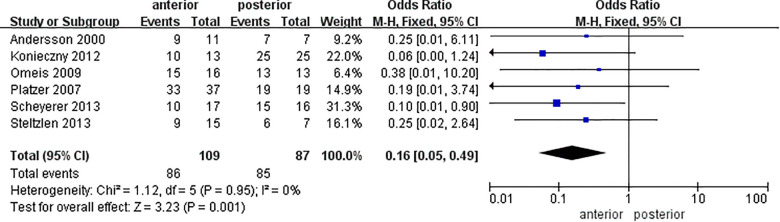
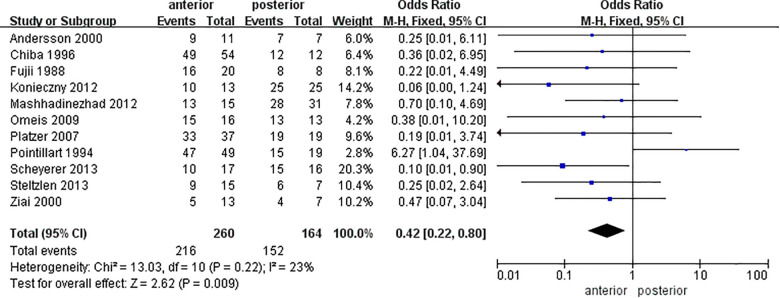
Twelve articles comrising 452 patients were included, and all publications were retrospective cohort studies. The average postoperative fusion rate was 77.5 ± 17.9% and 91.4 ± 13.5% in AA and PA, respectively, with statistical significance [OR = 0.42 (0.22, 0.80), = 0.009]. Subgroup analysis showed a difference in fusion rates between AA and PA in the elderly group [OR = 0.16 (0.05, 0.49), = 0.001]. Five articles referred to postoperative mortality, and the mortality rates of AA (5.0%) and PA (2.3%) showed no statistical difference ( = 0.148). Nine studies referred to complications, with a rate of 9.7%. The incidence of complications in AA and PA groups was comparable ( = 0.338), and the incidence of nonfusion and complications was irrelevant. The prevalent cause of death was myocardial infarction. The time and segmental movement retention of AA were possibly superior to those of PA.
AA may be superior in regard to operation time and motion retention. There was no difference in complications and mortality rates between the two approaches. The posterior approach would be preferred in consideration of the fusion rate.
齿状突骨折占颈椎损伤的15%-20%。尽管不同类型的手术方法各异,但前路(AA)和后路(PA)治疗齿状突骨折的总体疗效优势仍存在争议。因此,进行了一项荟萃分析,比较AA和PA治疗这些骨折的效果。
从概念形成开始至2022年6月,在PubMed/MEDLINE、Cochrane图书馆、EMBASE、中国生物医学文献数据库(CBM)和万方数据库中检索相关研究。筛选关于AA和PA治疗齿状突骨折的前瞻性或回顾性比较研究,参考融合率(主要结局)、并发症及术后死亡率。对主要结局进行荟萃分析,对其他结局进行系统评价;使用Review Manager 5.3进行该过程。
纳入12篇文章共452例患者,所有出版物均为回顾性队列研究。AA和PA的术后平均融合率分别为77.5±17.9%和91.4±13.5%,具有统计学意义[比值比(OR)=0.42(0.22,0.80),P=0.009]。亚组分析显示老年组中AA和PA的融合率存在差异[OR=0.16(0.05,0.49),P=0.001]。5篇文章提及术后死亡率,AA(5.0%)和PA(2.3%)的死亡率无统计学差异(P=0.148)。9项研究提及并发症,发生率为9.7%。AA组和PA组的并发症发生率相当(P=0.338),不融合和并发症的发生率无关。主要死亡原因是心肌梗死。AA的手术时间和节段运动保留可能优于PA。
AA在手术时间和运动保留方面可能更具优势。两种方法在并发症和死亡率方面无差异。考虑到融合率,后路手术可能更受青睐。