Solé Mireia, Pascual Álvaro, Anton Ester, Blanco Joan, Sarrate Zaida
Departament de Biologia Cel·lular, Genetics of Male Fertility Group, Unitat de Biologia Cel·lular, Fisiologia i Immunologia, Universitat Autònoma de Barcelona, Barcelona, Spain.
Front Cell Dev Biol. 2023 Jun 12;11:1191156. doi: 10.3389/fcell.2023.1191156. eCollection 2023.
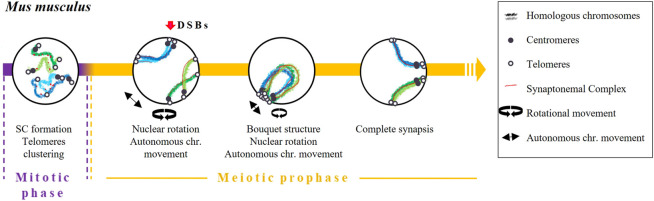
Meiosis involves deep changes in the spatial organisation and interactions of chromosomes enabling the two primary functions of this process: increasing genetic diversity and reducing ploidy level. These two functions are ensured by crucial events such as homologous chromosomal pairing, synapsis, recombination and segregation. In most sexually reproducing eukaryotes, homologous chromosome pairing depends on a set of mechanisms, some of them associated with the repair of DNA double-strand breaks (DSBs) induced at the onset of prophase I, and others that operate before DSBs formation. In this article, we will review various strategies utilised by model organisms for DSB-independent pairing. Specifically, we will focus on mechanisms such as chromosome clustering, nuclear and chromosome movements, as well as the involvement of specific proteins, non-coding RNA, and DNA sequences.
减数分裂涉及染色体空间组织和相互作用的深刻变化,从而实现该过程的两个主要功能:增加遗传多样性和降低倍性水平。这两个功能由同源染色体配对、联会、重组和分离等关键事件来确保。在大多数有性生殖的真核生物中,同源染色体配对依赖于一系列机制,其中一些与前期I开始时诱导的DNA双链断裂(DSB)修复相关,另一些则在DSB形成之前起作用。在本文中,我们将综述模式生物用于不依赖DSB配对的各种策略。具体而言,我们将关注染色体聚集、细胞核和染色体运动等机制,以及特定蛋白质、非编码RNA和DNA序列的参与情况。