Romer Daniel, Jamieson Kathleen H
Annenberg Public Policy Center, University of Pennsylvania, Philadelphia, PA, United States.
Front Psychol. 2023 Jun 13;14:1175571. doi: 10.3389/fpsyg.2023.1175571. eCollection 2023.
We have previously proposed and tested a model that predicts reluctance to vaccinate against COVID-19 in the US from embrace of a conspiracy mindset that distrusts the federal health agencies of the US government and regards their intentions as malevolent. In this study, we tested the model's ability to predict adult support for COVID vaccination of children ages 5-11 after the vaccine was approved for this age group.
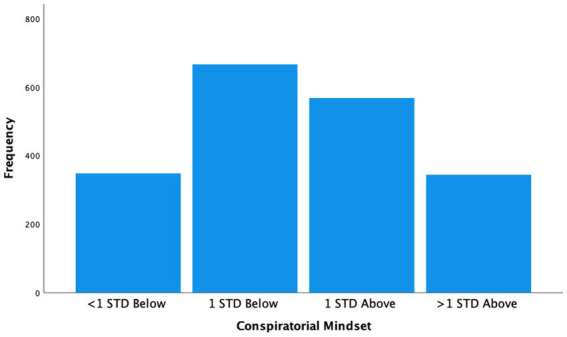
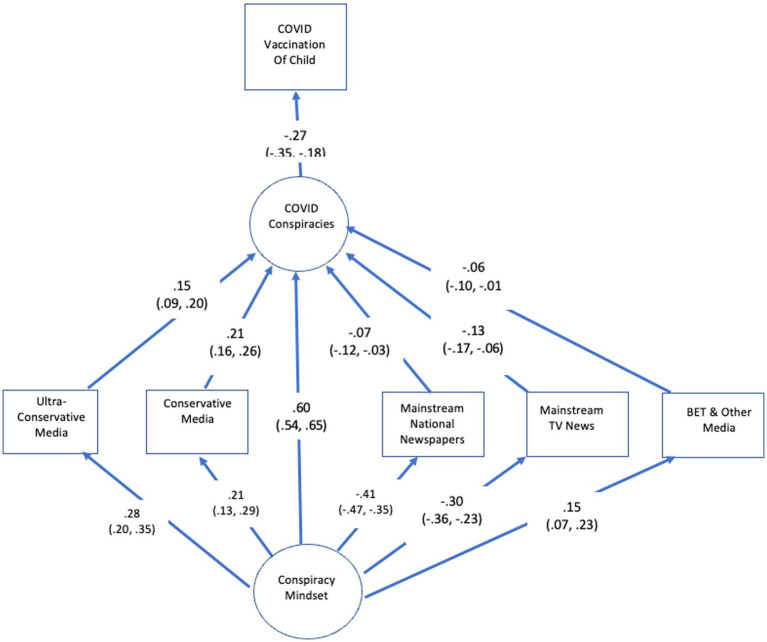
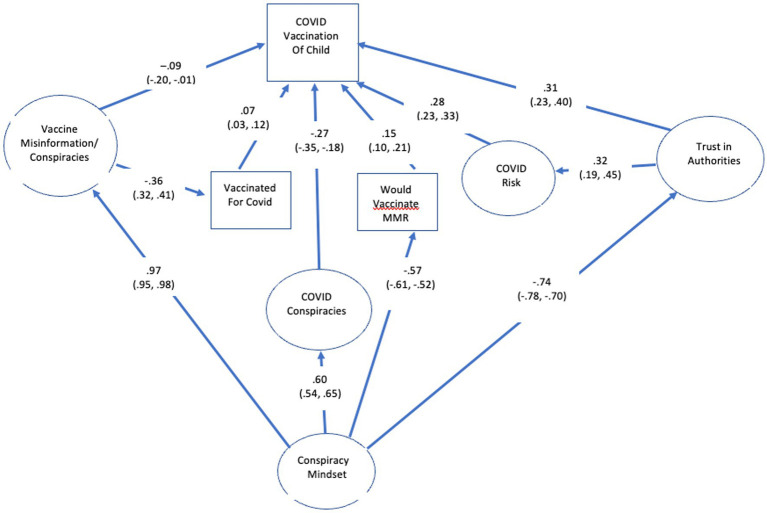
Relying on a national panel that was established in April 2021 ( = 1941) and followed until March of 2022, we examined the relation between conspiratorial thinking measured at baseline and belief in misinformation and conspiracies about COVID vaccines, trust in various health authorities, perceived risk of COVID to children, and belief in conspiracy theories about the pandemic's origin and impact. In addition, we tested a structural equation model (SEM) in which conspiracy mindset predicted adult support for childhood vaccination for COVID in January and March of 2022 as well as the adults own vaccination status and their willingness to recommend vaccinating children against measles, mumps and rubella (MMR).
The model accounted for 76% of the variance in support for childhood vaccination for COVID-19; the relation between the mindset and support for vaccination was entirely mediated by baseline assessments of misinformation, trust, risk, and acceptance of pandemic conspiracy theories.
The SEM replicated the prior test of the model, indicating that a conspiracy mindset present among at least 17% of the panel underlies their resistance to vaccinate both themselves and children. Efforts to counteract the mindset will likely require the intervention of trusted spokespersons who can overcome the skepticism inherent in conspiratorial thinking about the government and its health-related agencies' recommendations for a particular vaccine.
我们之前提出并测试了一个模型,该模型通过接受一种阴谋思维模式来预测美国民众对新冠疫苗接种的抵触情绪,这种阴谋思维模式不信任美国政府的联邦卫生机构,并认为其意图是恶意的。在本研究中,我们测试了该模型在新冠疫苗被批准用于5至11岁儿童年龄组后,预测成年人对该年龄组儿童新冠疫苗接种支持度的能力。
我们依靠一个于2021年4月设立(n = 1941)并持续到2022年3月的全国性样本小组,研究了基线时测量的阴谋思维与对新冠疫苗的错误信息和阴谋论的相信程度、对各种卫生当局的信任、对儿童感染新冠风险的认知以及对疫情起源和影响的阴谋论的相信程度之间的关系。此外,我们测试了一个结构方程模型(SEM),其中阴谋思维模式预测了2022年1月和3月成年人对儿童新冠疫苗接种的支持度,以及成年人自身的疫苗接种状况和他们推荐儿童接种麻疹、腮腺炎和风疹(MMR)疫苗的意愿。
该模型解释了对儿童新冠疫苗接种支持度差异的76%;思维模式与疫苗接种支持度之间的关系完全由对错误信息、信任、风险和对疫情阴谋论的接受程度的基线评估所介导。
结构方程模型重复了该模型之前的测试,表明至少17%的样本小组成员中存在的阴谋思维模式是他们抵制自己和儿童接种疫苗的基础。要消除这种思维模式,可能需要可信的代言人进行干预,他们能够克服阴谋思维中固有的对政府及其卫生相关机构关于特定疫苗建议的怀疑态度。