Farina Bruna M, Godoy Pedro L, Benson Roger B J, Langer Max C, Ferreira Gabriel S
Department of Biology University of Fribourg Fribourg Switzerland.
Swiss Institute of Bioinformatics Fribourg Switzerland.
Ecol Evol. 2023 Jun 26;13(6):e10201. doi: 10.1002/ece3.10201. eCollection 2023 Jun.
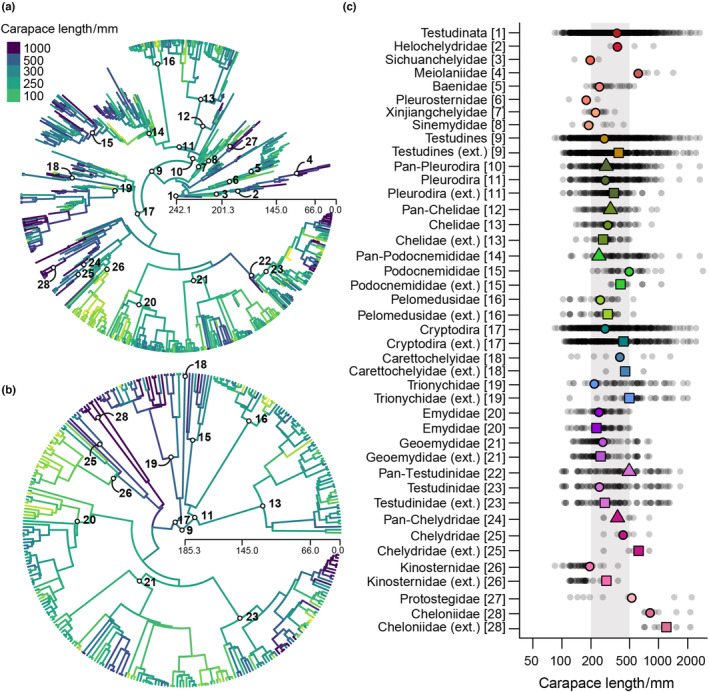
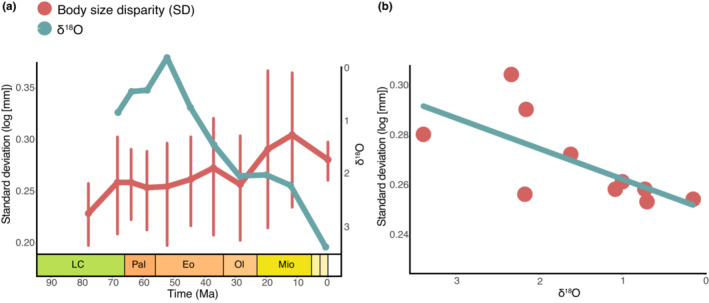
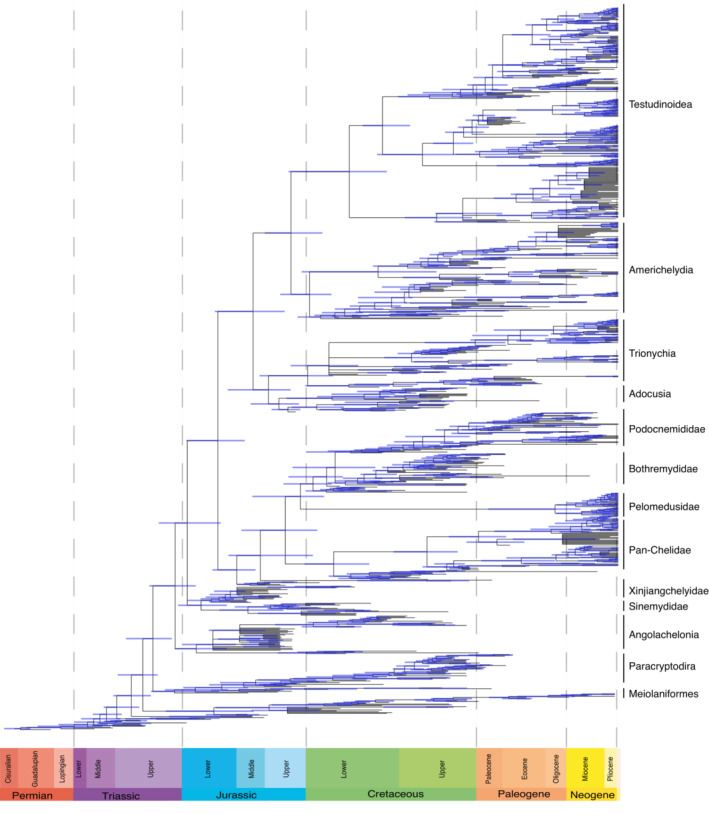
Organisms display a considerable variety of body sizes and shapes, and macroevolutionary investigations help to understand the evolutionary dynamics behind such variations. Turtles (Testudinata) show great body size disparity, especially when their rich fossil record is accounted for. We explored body size evolution in turtles, testing which factors might influence the observed patterns and evaluating the existence of long-term directional trends. We constructed the most comprehensive body size dataset for the group to date, tested for correlation with paleotemperature, estimated ancestral body sizes, and performed macroevolutionary model-fitting analyses. We found no evidence for directional body size evolution, even when using very flexible models, thereby rejecting the occurrence of Cope's rule. We also found no significant effect of paleotemperature on overall through-time body size patterns. In contrast, we found a significant influence of habitat preference on turtle body size. Freshwater turtles display a rather homogeneous body size distribution through time. In contrast, terrestrial and marine turtles show more pronounced variation, with terrestrial forms being restricted to larger body sizes, up to the origin of testudinids in the Cenozoic, and marine turtles undergoing a reduction in body size disparity after the extinctions of many groups in the mid-Cenozoic. Our results, therefore, suggest that long-term, generalized patterns are probably explained by factors specific to certain groups and related at least partly to habitat use.
生物呈现出多种多样的体型和形状,宏观进化研究有助于理解这些变异背后的进化动态。龟类(龟鳖目)表现出巨大的体型差异,尤其是考虑到它们丰富的化石记录时。我们探索了龟类的体型进化,测试了哪些因素可能影响观察到的模式,并评估了长期定向趋势的存在。我们构建了该类群迄今为止最全面的体型数据集,测试了与古温度的相关性,估计了祖先的体型,并进行了宏观进化模型拟合分析。我们没有发现定向体型进化的证据,即使使用非常灵活的模型,从而否定了柯普法则的存在。我们也没有发现古温度对整个时间范围内的体型模式有显著影响。相比之下,我们发现栖息地偏好对龟类体型有显著影响。淡水龟类在时间上呈现出相当均匀的体型分布。相比之下,陆生和海生龟类表现出更明显的变异,陆生龟类的体型局限于较大尺寸,直到新生代龟科动物的起源,而海生龟类在新生代中期许多类群灭绝后体型差异减小。因此,我们的结果表明,长期的、普遍的模式可能由特定类群特有的因素解释,并且至少部分与栖息地利用有关。