Rhee Hyungjin, Park Jae Hyon, Park Young Nyun
Department of Radiology, Research Institute of Radiological Science, Center for Clinical Imaging Data Science, Severance Hospital, Seoul, Korea.
Department of Pathology, Graduate School of Medical Science, Brain Korea 21 Project, Yonsei University College of Medicine, Seoul, Korea.
J Liver Cancer. 2021 Mar;21(1):12-24. doi: 10.17998/jlc.21.1.12. Epub 2021 Mar 31.
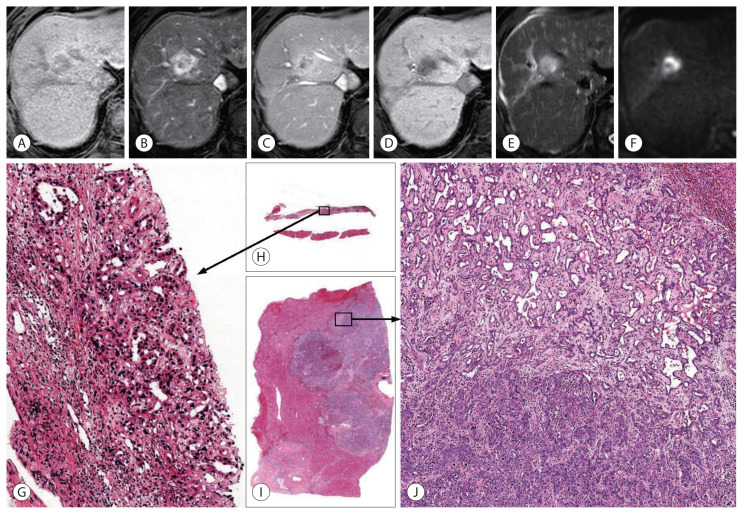
Combined hepatocellular-cholangiocarcinoma (cHCC-CCA) is a malignant primary liver carcinoma characterized by the unequivocal presence of both hepatocytic and cholangiocytic differentiation within the same tumor. Recent research has highlighted that cHCC-CCAs are more heterogeneous than previously expected. In the updated consensus terminology and WHO 2019 classification, "classical type" and "subtypes with stem-cell features" of the WHO 2010 classification are no longer recommended. Instead, it is recommended that the presence and percentages of various histopathologic components and stem-cell features be mentioned in the pathologic report. The new terminology and classification enable the exchange of clearer and more objective information about cHCC-CCAs, facilitating multi-center and multi-national research. However, there are limitations to the diagnosis of cHCC-CCA by imaging and biopsy. cHCC-CCAs showing typical imaging findings of HCC could be misdiagnosed as HCC and subjected to inappropriate treatment, if other clinical findings are not sufficiently considered. cHCC-CCAs showing at least one of the CCA-like imaging features or unusual clinical features should be subjected to biopsy. There may be a sampling error for the biopsy diagnosis of cHCC-CCA. An optimized diagnostic algorithm integrating clinical, radiological, and histopathologic information of biopsy is required to resolve these diagnostic pitfalls.
肝内胆管癌合并肝细胞癌(cHCC-CCA)是一种原发性肝癌,其特征是在同一肿瘤中明确存在肝细胞和胆管细胞分化。最近的研究强调,cHCC-CCA比之前预期的更具异质性。在更新的共识术语和WHO 2019分类中,不再推荐WHO 2010分类中的“经典型”和“具有干细胞特征的亚型”。相反,建议在病理报告中提及各种组织病理学成分和干细胞特征的存在及百分比。新的术语和分类能够就cHCC-CCA交换更清晰、更客观的信息,促进多中心和跨国研究。然而,通过影像学和活检诊断cHCC-CCA存在局限性。如果没有充分考虑其他临床发现,表现出典型肝癌影像学表现的cHCC-CCA可能被误诊为肝癌并接受不适当的治疗。表现出至少一种胆管癌样影像学特征或不寻常临床特征的cHCC-CCA应进行活检。cHCC-CCA的活检诊断可能存在抽样误差。需要一种优化的诊断算法,整合活检的临床、放射学和组织病理学信息,以解决这些诊断陷阱。