Yu Katharine, Basu Amrita, Yau Christina, Wolf Denise M, Goodarzi Hani, Bandyopadhyay Sourav, Korkola James E, Hirst Gillian L, Asare Smita, DeMichele Angela, Hylton Nola, Yee Douglas, Esserman Laura, van 't Veer Laura, Sirota Marina
Bakar Computational Health Sciences Institute, University of California, San Francisco, San Francisco, CA, United States.
Department of Surgery, University of California, San Francisco, San Francisco, CA, United States.
Front Oncol. 2023 Jun 13;13:1192208. doi: 10.3389/fonc.2023.1192208. eCollection 2023.
Drug resistance is a major obstacle in cancer treatment and can involve a variety of different factors. Identifying effective therapies for drug resistant tumors is integral for improving patient outcomes.
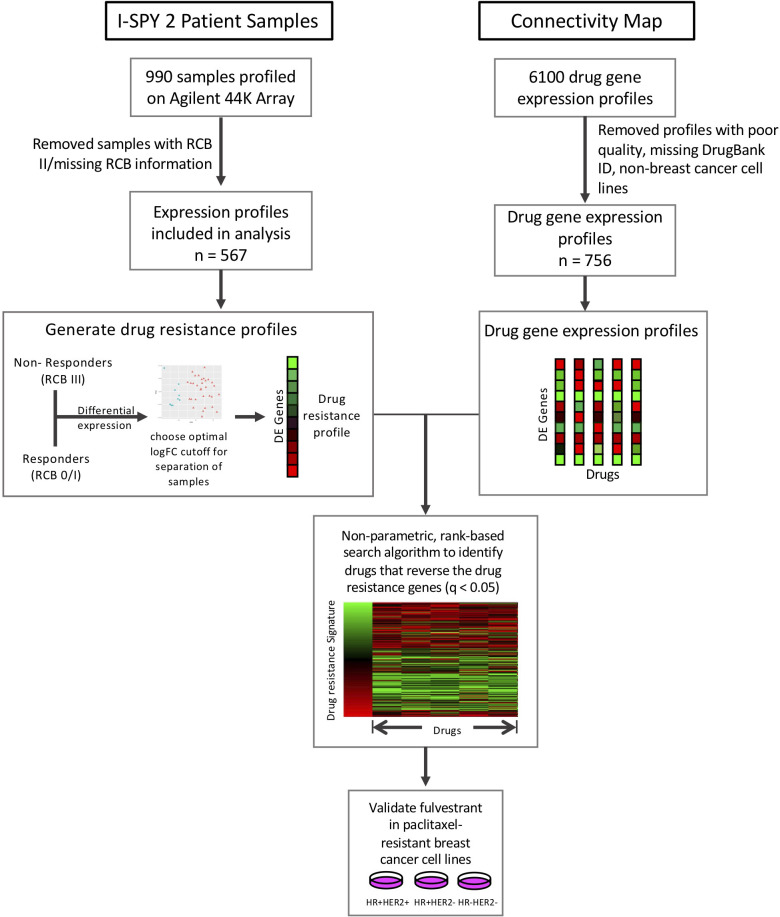
In this study, we applied a computational drug repositioning approach to identify potential agents to sensitize primary drug resistant breast cancers. We extracted drug resistance profiles from the I-SPY 2 TRIAL, a neoadjuvant trial for early stage breast cancer, by comparing gene expression profiles of responder and non-responder patients stratified into treatments within HR/HER2 receptor subtypes, yielding 17 treatment-subtype pairs. We then used a rank-based pattern-matching strategy to identify compounds in the Connectivity Map, a database of cell line derived drug perturbation profiles, that can reverse these signatures in a breast cancer cell line. We hypothesize that reversing these drug resistance signatures will sensitize tumors to treatment and prolong survival.
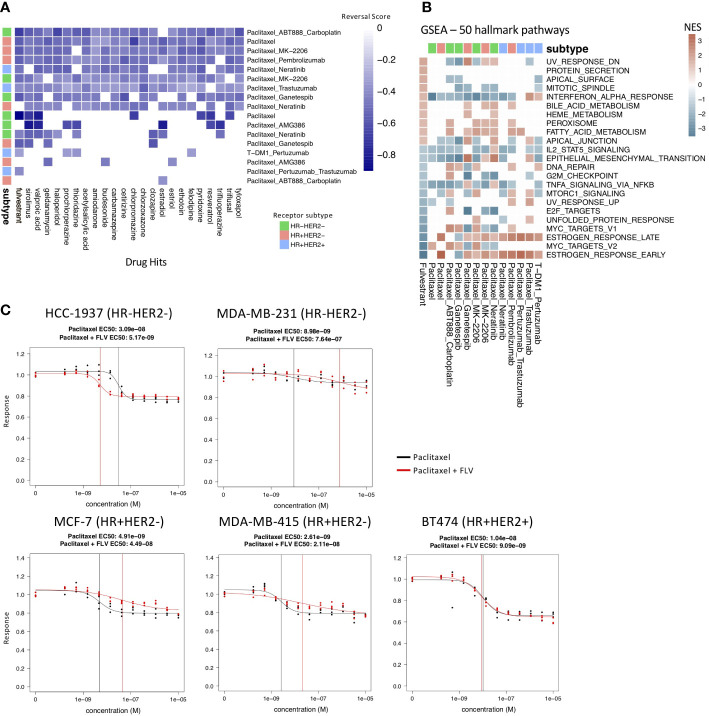
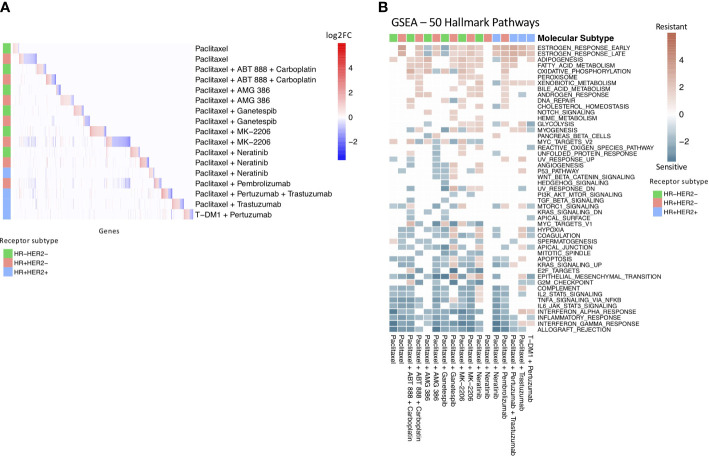
We found that few individual genes are shared among the drug resistance profiles of different agents. At the pathway level, however, we found enrichment of immune pathways in the responders in 8 treatments within the HR+HER2+, HR+HER2-, and HR-HER2- receptor subtypes. We also found enrichment of estrogen response pathways in the non-responders in 10 treatments primarily within the hormone receptor positive subtypes. Although most of our drug predictions are unique to treatment arms and receptor subtypes, our drug repositioning pipeline identified the estrogen receptor antagonist fulvestrant as a compound that can potentially reverse resistance across 13/17 of the treatments and receptor subtypes including HR+ and triple negative. While fulvestrant showed limited efficacy when tested in a panel of 5 paclitaxel resistant breast cancer cell lines, it did increase drug response in combination with paclitaxel in HCC-1937, a triple negative breast cancer cell line.
We applied a computational drug repurposing approach to identify potential agents to sensitize drug resistant breast cancers in the I-SPY 2 TRIAL. We identified fulvestrant as a potential drug hit and showed that it increased response in a paclitaxel-resistant triple negative breast cancer cell line, HCC-1937, when treated in combination with paclitaxel.
耐药性是癌症治疗中的主要障碍,可能涉及多种不同因素。确定针对耐药肿瘤的有效疗法对于改善患者预后至关重要。
在本研究中,我们应用了一种计算药物重新定位方法,以识别使原发性耐药乳腺癌敏感的潜在药物。我们通过比较I-SPY 2试验(一项早期乳腺癌新辅助试验)中根据HR/HER2受体亚型分层的治疗组中反应者和无反应者患者的基因表达谱,提取了耐药谱,得到17个治疗-亚型对。然后,我们使用基于排名的模式匹配策略,在连接图谱(一个源自细胞系的药物扰动谱数据库)中识别能够在乳腺癌细胞系中逆转这些特征的化合物。我们假设逆转这些耐药特征将使肿瘤对治疗敏感并延长生存期。
我们发现不同药物的耐药谱中很少有共同的单个基因。然而,在通路水平上,我们发现在HR+HER2+、HR+HER2-和HR-HER2-受体亚型的8种治疗中,反应者的免疫通路富集。我们还发现,在主要为激素受体阳性亚型的10种治疗中,无反应者的雌激素反应通路富集。尽管我们的大多数药物预测对于治疗组和受体亚型是独特的,但我们的药物重新定位流程确定雌激素受体拮抗剂氟维司群是一种能够潜在逆转17种治疗和受体亚型中的13种(包括HR+和三阴性)耐药性的化合物。虽然氟维司群在一组5种耐紫杉醇乳腺癌细胞系中测试时疗效有限,但它与紫杉醇联合使用时确实增加了三阴性乳腺癌细胞系HCC-1937中的药物反应。
我们应用了一种计算药物重新定位方法,以识别I-SPY 2试验中使耐药乳腺癌敏感的潜在药物。我们确定氟维司群为一种潜在的药物靶点,并表明它与紫杉醇联合治疗时增加了耐紫杉醇的三阴性乳腺癌细胞系HCC-1937中的反应。