Arthritis Clinic and Research Center, Peking University People's Hospital, Beijing, 100044, China.
Arthritis Institute, Peking University, Beijing, China.
BMC Musculoskelet Disord. 2023 Jun 29;24(1):528. doi: 10.1186/s12891-023-06665-7.
Musculoskeletal pain is a major cause of physical disability, associated with huge socioeconomic burden. Patient preference for treatment is an important factor contributing to the choice of treatment strategies. However, effective measurements for evaluating the ongoing management of musculoskeletal pain are lacking. To help improve clinical decision making, it's important to estimate the current state of musculoskeletal pain management and analyze the contribution of patient treatment preference.
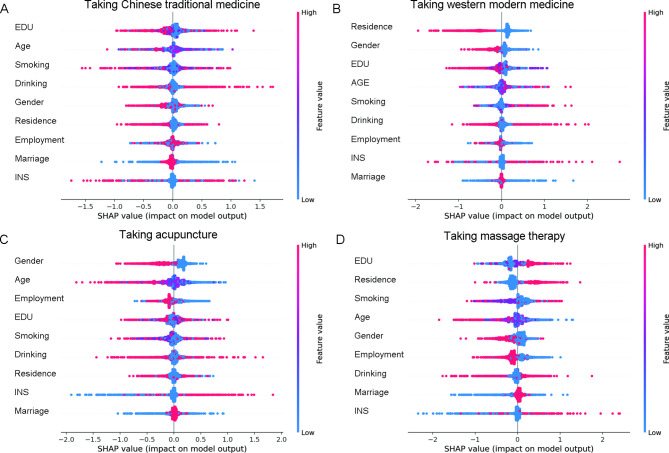
A nationally representative sample for the Chinese population was derived from the China Health and Retirement Longitudinal Study (CHARLS). Information on the patients' demographic characteristics, socioeconomic status, other health-related behavior, as well as history on musculoskeletal pain and treatment data were obtained. The data was used to estimate the status of musculoskeletal pain treatment in China in the year 2018. Univariate analysis and multivariate analysis were used to find the effect factors of treatment preference. XGBoost model and Shapley Additive exPlanations (SHAP) method were performed to analyze the contribution of each variable to different treatment preferences.
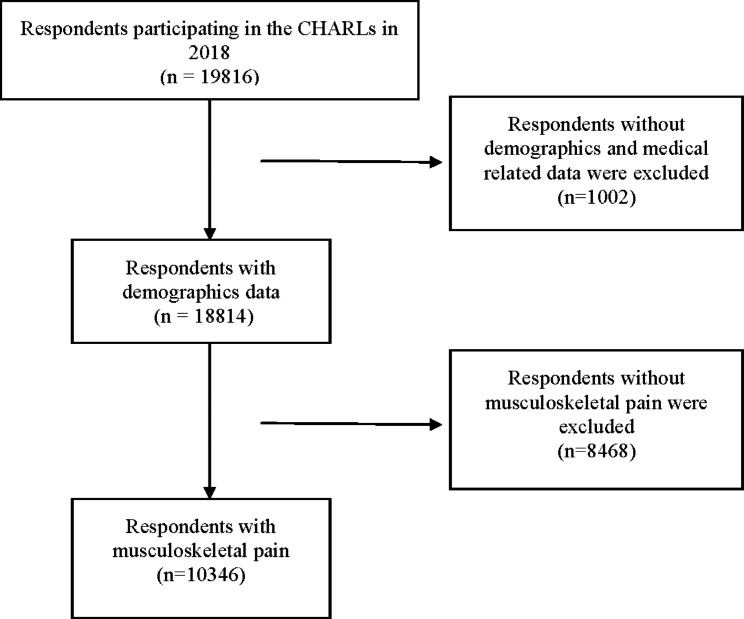
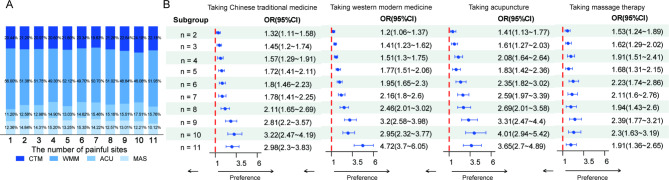
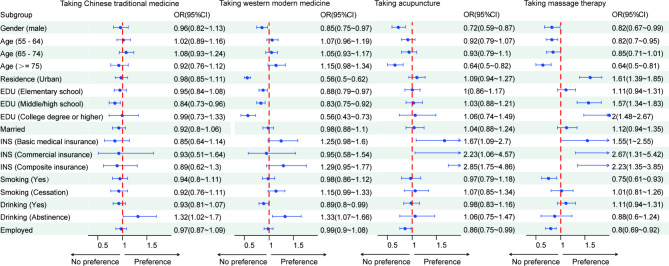
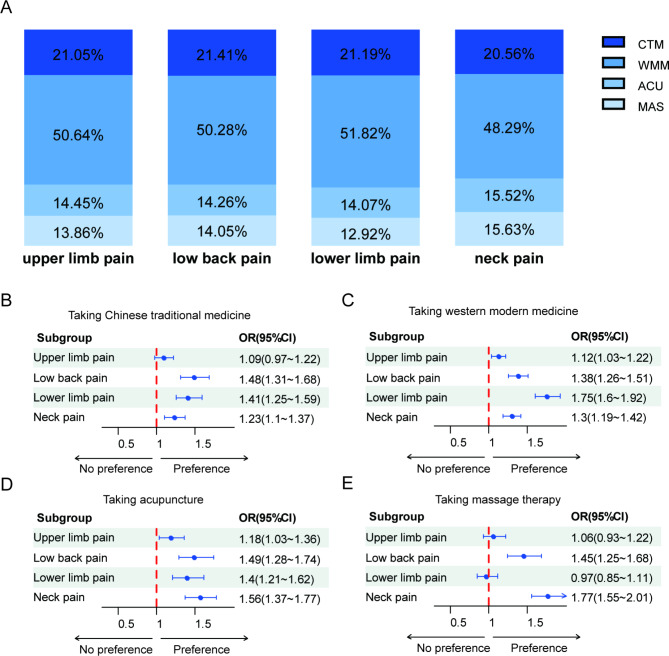
Among 18,814 respondents, 10,346 respondents suffered from musculoskeletal pain. Approximately 50% of musculoskeletal pain patients preferred modern medicine, while about 20% chose traditional Chinese medicine and another 15% chose acupuncture or massage therapy. Differing preferences for musculoskeletal pain treatment was related to the respondents' gender, age, place of residence, education level, insurance status, and health-related behavior such as smoking and drinking. Compared with upper or lower limb pain, neck pain and lower back pain were more likely to make respondents choose massage therapy (P < 0.05). A greater number of pain sites was associated with an increasing preference for respondents to seek medical care for musculoskeletal pain (P < 0.05), while different pain sites did not affect treatment preference.
Factors including gender, age, socioeconomic status, and health-related behavior may have potential effects on people' s choice of treatment for musculoskeletal pain. The information derived from this study may be useful for helping to inform clinical decisions for orthopedic surgeons when devising treatment strategies for musculoskeletal pain.
肌肉骨骼疼痛是身体残疾的主要原因,与巨大的社会经济负担有关。患者对治疗的偏好是影响治疗策略选择的一个重要因素。然而,目前缺乏评估肌肉骨骼疼痛管理效果的有效措施。为了帮助改善临床决策,估计肌肉骨骼疼痛管理的现状并分析患者治疗偏好的贡献非常重要。
从中国健康与养老追踪调查(CHARLS)中获得了中国人群的全国代表性样本。收集了患者的人口统计学特征、社会经济状况、其他与健康相关的行为以及肌肉骨骼疼痛和治疗数据。利用这些数据估计了 2018 年中国肌肉骨骼疼痛治疗的现状。采用单因素分析和多因素分析来发现治疗偏好的影响因素。使用 XGBoost 模型和 Shapley Additive exPlanations(SHAP)方法分析每个变量对不同治疗偏好的贡献。
在 18814 名受访者中,有 10346 名受访者患有肌肉骨骼疼痛。大约 50%的肌肉骨骼疼痛患者更喜欢现代医学,约 20%的患者选择传统中医,另有 15%的患者选择针灸或按摩疗法。不同的肌肉骨骼疼痛治疗偏好与受访者的性别、年龄、居住地、教育程度、保险状况以及吸烟和饮酒等健康相关行为有关。与上肢或下肢疼痛相比,颈部疼痛和下腰痛更有可能使受访者选择按摩疗法(P<0.05)。疼痛部位越多,受访者越倾向于选择就医治疗肌肉骨骼疼痛(P<0.05),而不同的疼痛部位并不影响治疗偏好。
性别、年龄、社会经济状况和健康相关行为等因素可能对人们选择肌肉骨骼疼痛的治疗方法有潜在影响。本研究提供的信息可能有助于指导骨科医生在制定肌肉骨骼疼痛治疗策略时做出临床决策。