Department of Internal Medicine (Medical Oncology), Yale University School of Medicine, New Haven, Connecticut.
Department of Medicine, Division of Hematology/Oncology, University of Pittsburgh, Pittsburgh, Pennsylvania.
Cancer Res Commun. 2023 Jun 28;3(6):1132-1139. doi: 10.1158/2767-9764.CRC-23-0045. eCollection 2023 Jun.
O-methylguanine DNA methyltransferase ()-silenced tumors reveal sensitivity to temozolomide (TMZ), which may be enhanced by PARP inhibitors. Approximately 40% of colorectal cancer has silencing and we aimed to measure antitumoral and immunomodulatory effects from TMZ and olaparib in colorectal cancer.
Patients with advanced colorectal cancer were screened for promoter hypermethylation using methylation-specific PCR of archival tumor. Eligible patients received TMZ 75 mg/m days 1-7 with olaparib 150 mg twice daily every 21 days. Pretreatment tumor biopsies were collected for whole-exome sequencing (WES), and multiplex quantitative immunofluorescence (QIF) of MGMT protein expression and immune markers.
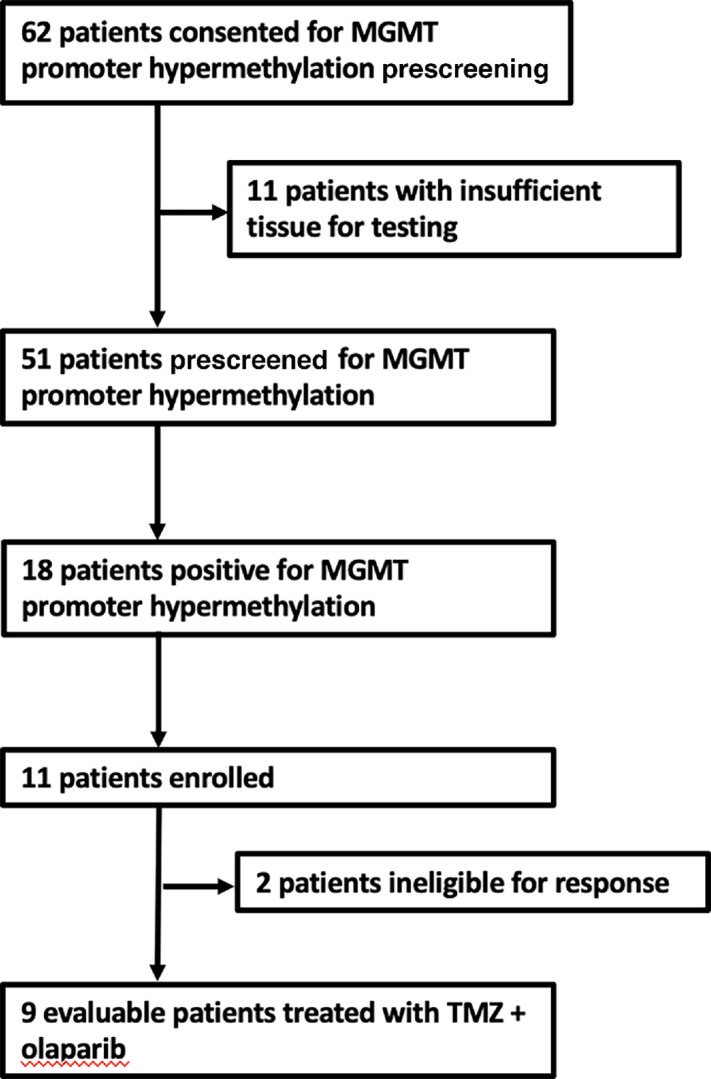
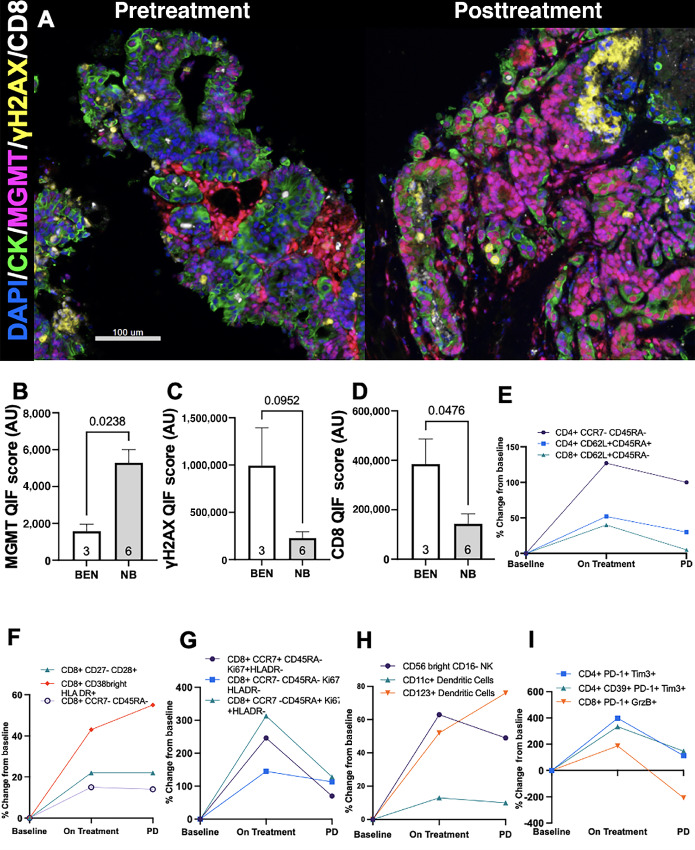
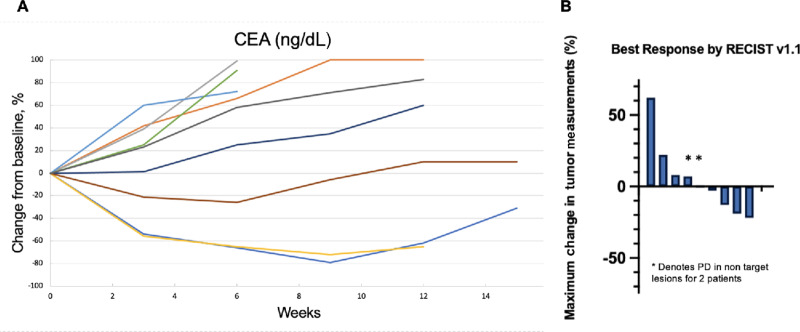
promoter hypermethylation was detected in 18/51 (35%) patients, 9 received study treatment with no objective responses, 5/9 had stable disease (SD) and 4/9 had progressive disease as best response. Three patients had clinical benefit: carcinoembryonic antigen reduction, radiographic tumor regression, and prolonged SD. MGMT expression by multiplex QIF revealed prominent tumor MGMT protein from 6/9 patients without benefit, while MGMT protein was lower in 3/9 with benefit. Moreover, benefitting patients had higher baseline CD8 tumor-infiltrating lymphocytes. WES revealed 8/9 patients with MAP kinase variants (7 and 1 ). Flow cytometry identified peripheral expansion of effector T cells.
Our results indicate discordance between promoter hypermethylation and MGMT protein expression. Antitumor activity seen in patients with low MGMT protein expression, supports MGMT protein as a predictor of alkylator sensitivity. Increased CD8 TILs and peripheral activated T cells, suggest a role for immunostimulatory combinations.
TMZ and PARP inhibitors synergize and in tumors with MGMT silencing. Up to 40% of colorectal cancer is MGMT promoter hypermethylated, and we investigated whether TMZ and olaparib are effective in this population. We also measured MGMT by QIF and observed efficacy only in patients with low MGMT, suggesting quantitative MGMT biomarkers more accurately predict benefit to alkylator combinations.
O-甲基鸟嘌呤 DNA 甲基转移酶(MGMT)沉默的肿瘤对替莫唑胺(TMZ)敏感,而 PARP 抑制剂可能会增强其敏感性。大约 40%的结直肠癌存在 MGMT 沉默,我们旨在测量 TMZ 和奥拉帕利在结直肠癌中的抗肿瘤和免疫调节作用。
使用存档肿瘤的甲基化特异性 PCR 筛选晚期结直肠癌患者的 MGMT 启动子高甲基化。符合条件的患者接受 TMZ 75mg/m²,每天 1-7 天,奥拉帕利 150mg,每天 2 次,每 21 天一次。收集预处理肿瘤活检进行全外显子组测序(WES)和 MGMT 蛋白表达和免疫标志物的多重定量免疫荧光(QIF)。
在 51 名患者中检测到 MGMT 启动子高甲基化 18 例(35%),9 例接受研究治疗,无客观缓解,5 例疾病稳定(SD),4 例疾病进展为最佳反应。3 例患者具有临床获益:癌胚抗原降低、影像学肿瘤消退和延长的 SD。通过多重 QIF 显示 6/9 例无获益患者的肿瘤 MGMT 蛋白表达明显升高,而 3/9 例获益患者的 MGMT 蛋白表达较低。此外,获益患者的基线 CD8 肿瘤浸润淋巴细胞更高。WES 显示 8/9 例患者存在 MAP 激酶变异(7 例 和 1 例)。流式细胞术鉴定外周效应 T 细胞的扩增。
我们的结果表明 MGMT 启动子高甲基化与 MGMT 蛋白表达之间存在不一致性。在 MGMT 蛋白表达较低的患者中观察到抗肿瘤活性,支持 MGMT 蛋白作为烷基化剂敏感性的预测因子。CD8 TILs 和外周活化 T 细胞的增加表明免疫刺激联合治疗的作用。
TMZ 和 PARP 抑制剂在 MGMT 沉默的肿瘤中协同增效。高达 40%的结直肠癌存在 MGMT 启动子高甲基化,我们研究了 TMZ 和奥拉帕利在该人群中的有效性。我们还通过 QIF 测量了 MGMT,并仅在 MGMT 较低的患者中观察到疗效,这表明定量 MGMT 生物标志物更准确地预测烷基化剂联合治疗的获益。