Buto Peter T, Shah Amit, Pearce Brad D, Lima Bruno B, Almuwaqqat Zakaria, Martini Afif, Al-Abboud Omar, Tarlapally Nitya, Sullivan Samaah, Sun Yan V, Murrah Nancy V, Driggers Emily, Shallenberger Lucy, Lewis Tené T, Elon Lisa, Bremner J Douglas, Raggi Paolo, Quyyumi Arshed, Vaccarino Viola
Department of Epidemiology, Rollins School of Public Health, Emory University, Atlanta, GA, USA.
Department of Medicine, Division of Cardiology, Emory University School of Medicine, Atlanta, GA, USA.
Brain Behav Immun Health. 2023 Apr 26;30:100629. doi: 10.1016/j.bbih.2023.100629. eCollection 2023 Jul.
Adverse mental health conditions including depression, posttraumatic stress disorder (PTSD), and anxiety are prevalent among patients who survive myocardial infarctions (MI) and are associated with adverse outcomes. The mechanisms underlying these associations, however, are not well understood. Inflammatory pathways may mediate the cardiovascular outcomes of patients with mental health disorders. We examined the bidirectional association between PTSD symptoms and inflammatory biomarkers in a young/middle-aged post MI population. We further examined how this association may differ between women and men as well as between Black and non-Black individuals.
Participants included individuals with early onset MI between the ages 25 and 60. Mental health scores for depression, PTSD, perceived stress, and anxiety as well as inflammatory biomarkers, interleukin-6 (IL-6) and high sensitivity C-reactive protein (hsCRP), were collected at baseline and at six-month follow up. We examined the bidirectional changes in mental health symptoms and inflammatory biomarkers between baseline and follow-up.
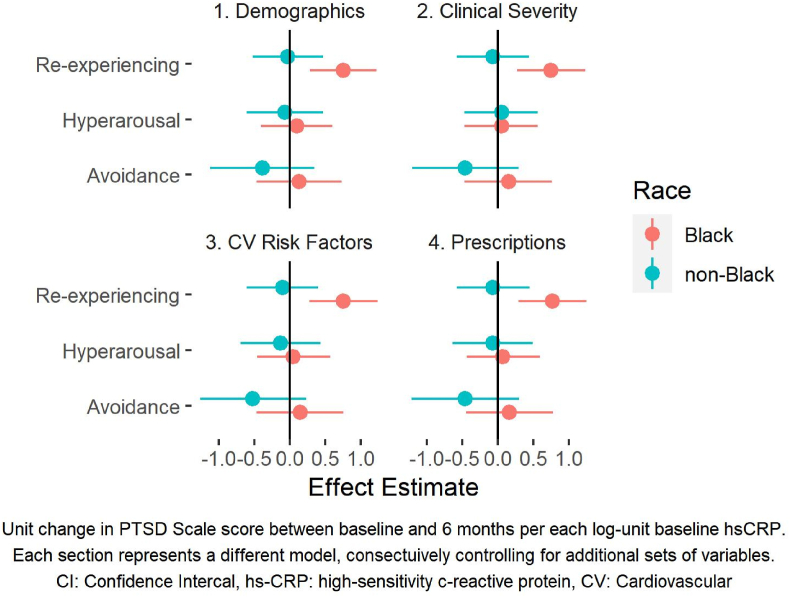
Among 244 patients in the study (mean age: 50.8, 48.4% female, 64.3% Black), the geometric means for IL-6 level and hsCRP at rest were 1.7 pg/mL and 2.76 mg/L, respectively. Mental health scores at baseline did not consistently predict changes in inflammatory biomarkers at follow-up. However, baseline levels of both IL-6 and hsCRP were robustly associated with an increase in re-experiencing PTSD symptoms at 6 months: in adjusted linear mixed models, there was a 1.58-point increase in re-experiencing PTSD symptoms per unit of baseline hsCRP (p = 0.01) and 2.59-point increase per unit of baseline IL-6 (p = 0.02). Once the analysis was stratified by race, the association was only noted in Black individuals. Baseline inflammation was not associated with change in any of the other mental health symptom scores.
Markers of inflammation are associated with an increase in post-event PTSD symptoms in younger or middle-aged patients who experienced an MI, especially Black patients. These results suggest a mechanistic link between inflammation and the development of PTSD among individuals with cardiovascular disease.
包括抑郁症、创伤后应激障碍(PTSD)和焦虑症在内的不良心理健康状况在心肌梗死(MI)幸存者中很常见,并且与不良后果相关。然而,这些关联背后的机制尚不清楚。炎症途径可能介导心理健康障碍患者的心血管结局。我们研究了年轻/中年心肌梗死后人群中PTSD症状与炎症生物标志物之间的双向关联。我们进一步研究了这种关联在女性和男性之间以及黑人和非黑人个体之间可能存在的差异。
参与者包括年龄在25至60岁之间的早发性心肌梗死患者。在基线和六个月随访时收集抑郁症、PTSD、感知压力和焦虑症的心理健康评分以及炎症生物标志物白细胞介素-6(IL-6)和高敏C反应蛋白(hsCRP)。我们研究了基线和随访之间心理健康症状和炎症生物标志物的双向变化。
在该研究的244名患者中(平均年龄:50.8岁,48.4%为女性,64.3%为黑人),静息时IL-6水平和hsCRP的几何平均值分别为1.7 pg/mL和2.76 mg/L。基线时的心理健康评分并不能一致地预测随访时炎症生物标志物的变化。然而,IL-6和hsCRP的基线水平均与6个月时PTSD症状重现的增加密切相关:在调整后的线性混合模型中,每单位基线hsCRP,PTSD症状重现增加1.58分(p = 0.01),每单位基线IL-6增加2.59分(p = 0.02)。一旦按种族分层分析,这种关联仅在黑人个体中被发现。基线炎症与任何其他心理健康症状评分的变化均无关联。
炎症标志物与经历心肌梗死的年轻或中年患者,尤其是黑人患者事件后PTSD症状的增加有关。这些结果表明炎症与心血管疾病患者中PTSD的发生之间存在机制联系。