Vasli Parvaneh, Mortazavi Yousef, Aziznejadroshan Parvin, Esbakian Behnam, Ahangar Hemmat Gholinia, Jafarpoor Hasanali
School of Nursing and Midwifery, Shahid Beheshti University of Medical Sciences, Tehran, Iran.
Department of Anaesthesiology and Operating Room, School of Allied Medical Sciences, Babol University of Medical Sciences, Babol, Iran.
J Educ Health Promot. 2023 Apr 28;12:144. doi: 10.4103/jehp.jehp_1481_22. eCollection 2023.
Critical thinking has been acknowledged as a key component of clinical decision-making and professional competency. Therefore, it is of great importance to reflect on how critical thinking is acquired and investigate its determinants, including self-esteem, in nursing education. The present study was thus to assess the correlation between critical thinking and self-esteem in nursing students.
This descriptive correlational study was fulfilled in 2019 on 276 nursing students selected via the random sampling method. For this purpose, Ricketts' Critical Thinking Disposition Questionnaire and Eysenck's Self-Esteem Scale were employed to collect the data, which were then analyzed using the SPSS Statistics (ver. 22) software along with independent-samples -test, Pearson correlation coefficient, and one-way analysis of variance, considering the significance level of < 0.05.
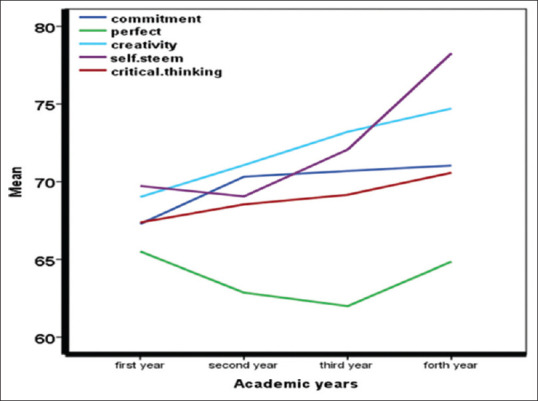
The study findings showed a significant correlation between critical thinking and self-esteem ( = 0.529, < 0.001) as well as self-esteem and critical thinking dispositions, that is, commitment, perfectionism, and creativity ( = 0.40, < 0.001). Moreover, these dispositions had a significantly increasing trend during various academic years, but the difference was not significant with regard to perfectionism ( < 0.001).
Given the positive correlation between self-esteem and critical thinking, commitment, perfectionism, and creativity in nursing students, it is essential to develop self-esteem skills in such students, using appropriate approaches to boost self-esteem as one of the important missions of higher education systems. As well, a lack of perfectionism during academic years confirms that it is possible that determinants other than educational environments, for example, families, are involved. Therefore, managers are suggested to hold meetings with parents and nursing students.
批判性思维已被公认为临床决策和专业能力的关键组成部分。因此,反思如何培养批判性思维并探究其决定因素,包括自尊,在护理教育中具有重要意义。本研究旨在评估护理专业学生批判性思维与自尊之间的相关性。
本描述性相关性研究于2019年对通过随机抽样法选取的276名护理专业学生进行。为此,采用里基茨批判性思维倾向问卷和艾森克自尊量表收集数据,然后使用SPSS Statistics(版本22)软件进行分析,采用独立样本t检验、皮尔逊相关系数和单因素方差分析,显著性水平设定为<0.05。
研究结果显示批判性思维与自尊之间存在显著相关性(=0.529,<0.001),自尊与批判性思维倾向,即尽责性、完美主义和创造力之间也存在显著相关性(=0.40,<0.001)。此外,这些倾向在不同学年呈显著上升趋势,但在完美主义方面差异不显著(<0.001)。
鉴于护理专业学生的自尊与批判性思维、尽责性、完美主义和创造力之间存在正相关,通过适当方法培养这些学生的自尊技能至关重要,这是高等教育系统的重要使命之一。同样,学年期间缺乏完美主义证实可能涉及教育环境以外的决定因素,例如家庭。因此,建议管理人员与家长和护理专业学生举行会议。