Kehoe Devin H, Schießer Lukas, Malik Hassaan, Fallah Mazyar
Department of Psychology, York University, Toronto, M3J 1P3, Canada.
Centre for Vision Research, York University, Toronto, M3J 1P3, Canada.
Curr Res Neurobiol. 2023 Jun 10;4:100092. doi: 10.1016/j.crneur.2023.100092. eCollection 2023.
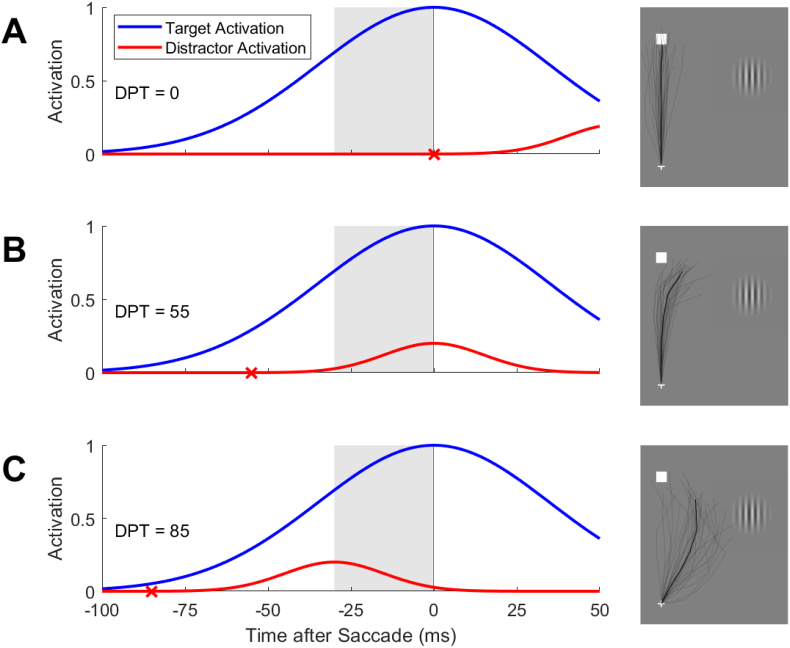
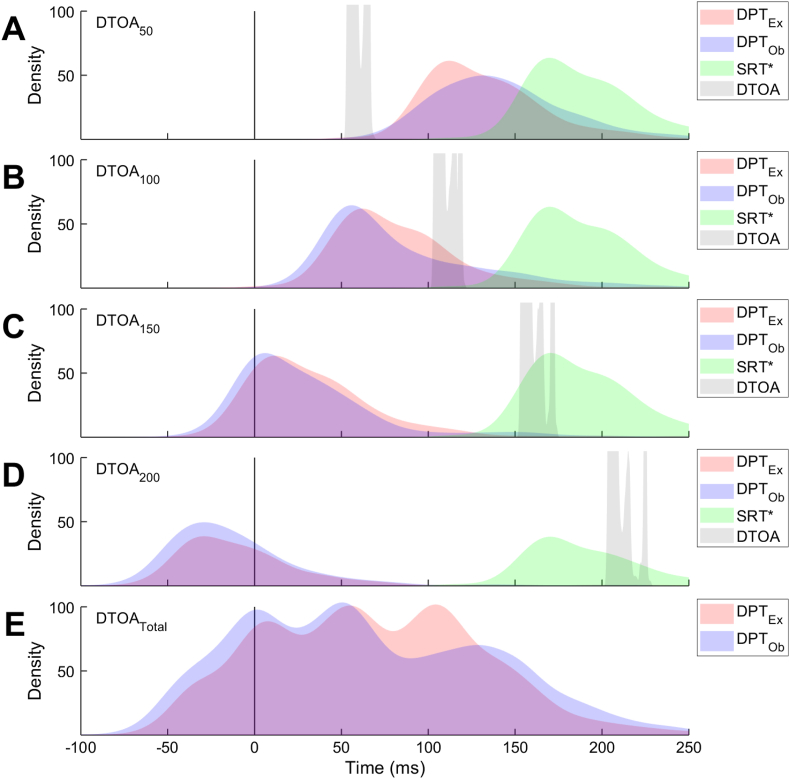
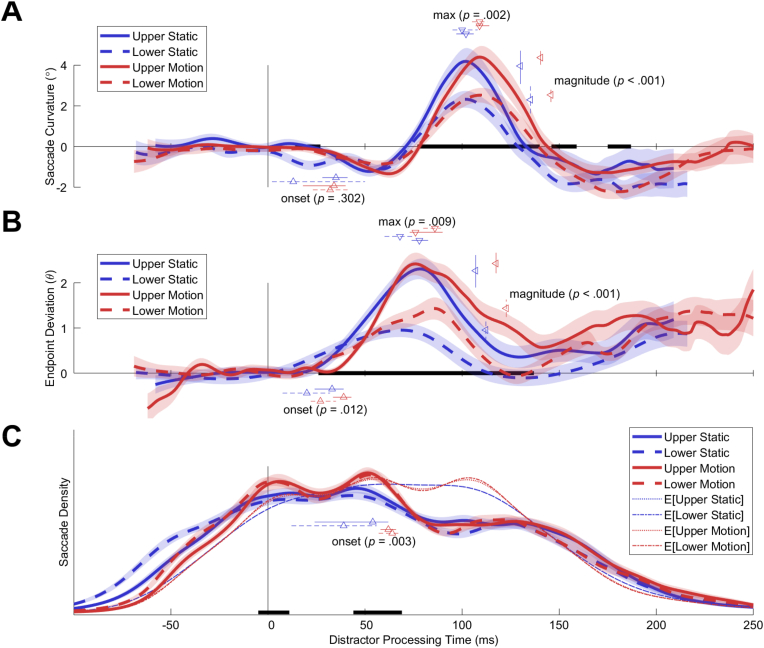
The mechanism that reweights oculomotor vectors based on visual features is unclear. However, the latency of oculomotor visual activations gives insight into their antecedent featural processing. We compared the oculomotor processing time course of grayscale, task-irrelevant static and motion distractors during target selection by continuously measuring a battery of human saccadic behavioral metrics as a function of time after distractor onset. The motion direction was towards or away from the target and the motion speed was fast or slow. We compared static and motion distractors and observed that both distractors elicited curved saccades and shifted endpoints at short latencies (∼25 ms). After 50 ms, saccade trajectory biasing elicited by motion distractors lagged static distractor trajectory biasing by 10 ms. There were no such latency differences between distractor motion directions or motion speeds. This pattern suggests that additional processing of motion stimuli occurred prior to the propagation of visual information into the oculomotor system. We examined the interaction of distractor processing time (DPT) with two additional factors: saccadic reaction time (SRT) and saccadic amplitude. Shorter SRTs were associated with shorter DPT latencies of biased saccade trajectories. Both SRT and saccadic amplitude were associated with the magnitude of saccade trajectory biases.
基于视觉特征对眼动向量进行重新加权的机制尚不清楚。然而,眼动视觉激活的潜伏期有助于深入了解其先前的特征处理过程。我们通过持续测量一系列人类扫视行为指标,作为干扰物出现后时间的函数,比较了在目标选择过程中灰度、与任务无关的静态和动态干扰物的眼动处理时间进程。运动方向朝向或远离目标,运动速度快或慢。我们比较了静态和动态干扰物,观察到两种干扰物在短潜伏期(约25毫秒)时都会引发曲线扫视并使终点偏移。50毫秒后,动态干扰物引发的扫视轨迹偏差比静态干扰物轨迹偏差滞后10毫秒。干扰物的运动方向或运动速度之间不存在这种潜伏期差异。这种模式表明,在视觉信息传播到眼动系统之前,对运动刺激进行了额外的处理。我们研究了干扰物处理时间(DPT)与另外两个因素的相互作用:扫视反应时间(SRT)和扫视幅度。较短的SRT与有偏差的扫视轨迹的较短DPT潜伏期相关。SRT和扫视幅度都与扫视轨迹偏差的大小相关。