Pusateri Antoinette, Litzenberg Kevin, Griffiths Claire, Hayes Caitlin, Gnyawali Bipul, Manious Michelle, Kelly Sean G, Conteh Lanla F, Jalil Sajid, Nagaraja Haikady N, Mumtaz Khalid
Division of Gastroenterology, Hepatology and Nutrition, The Ohio State University Wexner Medical Center, Columbus, OH 43210, United States.
Division of Internal Medicine, The Ohio State University Wexner Medical Center, Columbus, OH 43210, United States.
World J Hepatol. 2023 Jun 27;15(6):826-840. doi: 10.4254/wjh.v15.i6.826.
We previously reported national 30-d readmission rates of 27% in patients with decompensated cirrhosis (DC).
To study prospective interventions to reduce early readmissions in DC at our tertiary center.
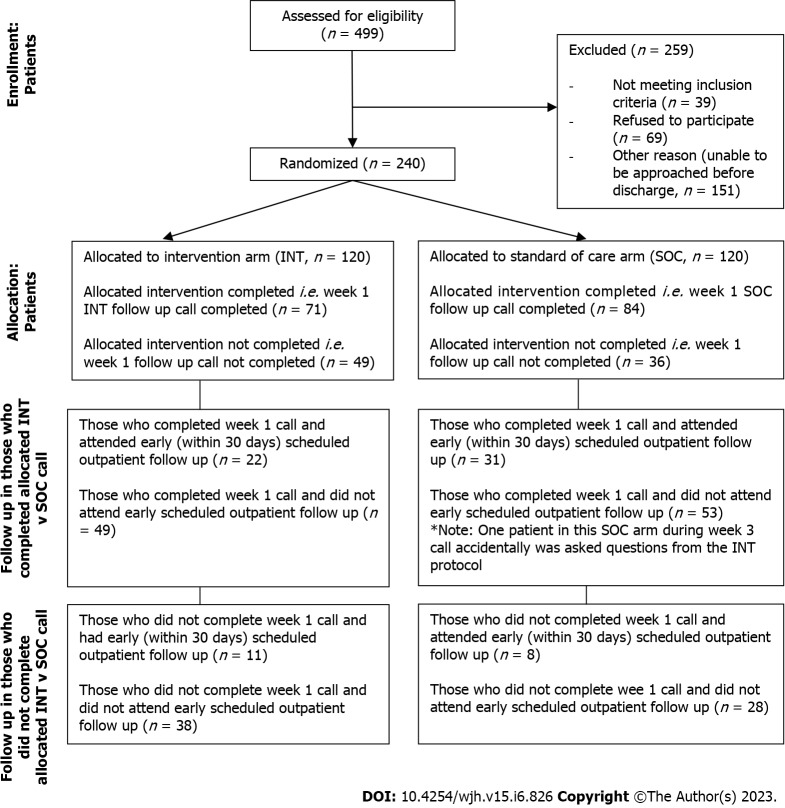
Adults with DC admitted July 2019 to December 2020 were enrolled and randomized into the intervention (INT) or standard of care (SOC) arms. Weekly phone calls for a month were completed. In the INT arm, case managers ensured outpatient follow-up, paracentesis, and medication compliance. Thirty-day readmission rates and reasons were compared.
Calculated sample size was not achieved due to coronavirus disease 2019; 240 patients were randomized into INT and SOC arms. 30-d readmission rate was 33.75%, 35.83% in the INT 31.67% in the SOC arm ( = 0.59). The top reason for 30-d readmission was hepatic encephalopathy (HE, 32.10%). There was a lower rate of 30-d readmissions for HE in the INT (21%) SOC arm (45%, = 0.03). There were fewer 30-d readmissions in patients who attended early outpatient follow-up ( = 17, 23.61% = 55, 76.39%, = 0.04).
Our 30-d readmission rate was higher than the national rate but reduced by interventions in patients with DC with HE and early outpatient follow-up. Development of interventions to reduce early readmission in patients with DC is needed.
我们之前报告了失代偿性肝硬化(DC)患者的全国30天再入院率为27%。
研究在我们的三级医疗中心减少DC患者早期再入院的前瞻性干预措施。
纳入2019年7月至2020年12月收治的成年DC患者,并随机分为干预组(INT)或标准治疗组(SOC)。进行为期一个月的每周一次电话随访。在INT组,个案管理员确保患者门诊随访、腹腔穿刺术及药物依从性。比较两组的30天再入院率及原因。
由于2019冠状病毒病,未达到计算的样本量;240例患者被随机分为INT组和SOC组。30天再入院率为33.75%,INT组为35.83%,SOC组为31.67%(P = 0.59)。30天再入院的首要原因是肝性脑病(HE,32.10%)。INT组HE的30天再入院率较低(21%),而SOC组为45%(P = 0.03)。早期门诊随访的患者30天再入院次数较少(n = 17,23.61%对比n = 55,76.39%,P = 0.04)。
我们的30天再入院率高于全国水平,但通过对DC合并HE患者的干预及早期门诊随访得以降低。需要制定减少DC患者早期再入院的干预措施。