Department of Education and Psychology, Division of Clinical Psychological Intervention, Freie Universität Berlin, Berlin, Germany.
Department of Experimental Psychopathology, Institute for Psychology, University of Hildesheim, Hildesheim, Germany.
Eur J Psychotraumatol. 2023;14(2):2225153. doi: 10.1080/20008066.2023.2225153.
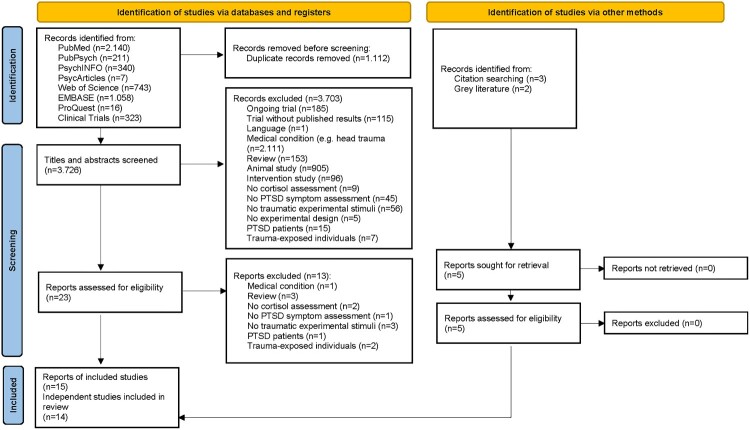
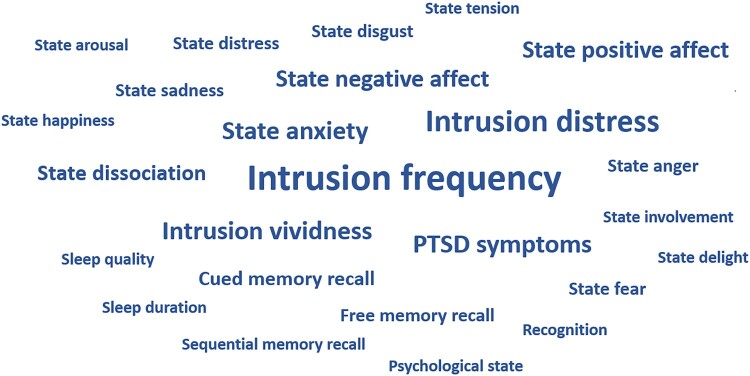
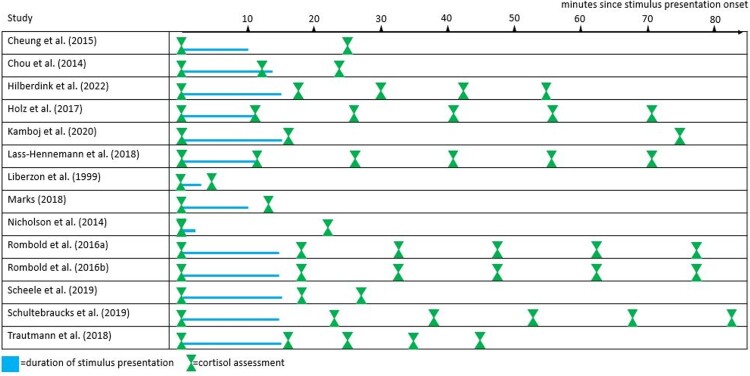
Pre-and post-traumatic hypothalamic-pituitary-adrenal (HPA) axis markers have been studied to predict posttraumatic stress disorder (PTSD) risk, but its acute reactivity cannot be measured in real-life settings. Experimental paradigms can depict the cortisol response to stimuli that simulate traumatic events. To review experimental studies on the cortisol response to traumatic stimuli and the correlation between cortisol and PTSD symptoms. Experimental, (un-)published studies in German or English from any year were eligible if they confronted non-traumatized humans with traumatic stimuli, assessed cortisol before, during or after stimulus presentation and subsequent PTSD symptoms. The literature was searched via PubMed, PubPsych, PsychINFO, PsycArticle, Web of Science, EMBASE, ProQuest and ClinicalTrials.gov up to 16th February 2021. Risk of bias was assessed with the Cortisol Assessment List. Multilevel-meta-analyses were conducted under the random effects model. The standardized mean change () indicated the cortisol response. Coefficient indicated the correlations between cortisol and PTSD symptoms. 14 studies, investigating 1004 individuals, were included. A cortisol response was successfully induced between 21 and 40 min post-presentation onset (= 25, = 0.15 [.03; .26]). Cortisol was not associated with overall or cluster-level PTSD symptoms. On a symptom-level, higher pre-presentation onset cortisol was correlated with lower state tension (= 8, = -.18 [-.35; -.01]), higher state happiness (= 8, = -.34 [-.59; -.03], variable inverted) and lower state anger (= 9, = -.14 [-.26; -.01]). Higher post-presentation onset cortisol was correlated with higher state happiness (= 16, = -.20 [-.33; -.06]) and lower state sadness (= 17, = -.16 [-.25; -.05]), whereas cortisol response was positively correlated with state anxiety (= 9, = .16 [0.04; 0.27]). Experimental paradigms effectively induce a cortisol response. Higher basal cortisol, higher cortisol, as measured after traumatic stimulus presentation, and a lower cortisol response were associated with more adaptive emotional reactions. These markers did not predict longer-term PTSD symptoms.
研究表明,创伤前和创伤后下丘脑-垂体-肾上腺(HPA)轴标志物可用于预测创伤后应激障碍(PTSD)风险,但在现实环境中无法测量其急性反应。实验范式可以描述皮质醇对模拟创伤事件的刺激的反应。本研究旨在综述皮质醇对创伤性刺激的反应以及皮质醇与 PTSD 症状之间的相关性的实验研究。研究对象为非创伤人群,实验使用的刺激为创伤性刺激,评估皮质醇在刺激呈现前后的变化,并随后评估 PTSD 症状。文献检索数据库包括 PubMed、PubPsych、PsychINFO、PsycArticle、Web of Science、EMBASE、ProQuest 和 ClinicalTrials.gov,检索时间截至 2021 年 2 月 16 日。采用皮质醇评估清单评估偏倚风险。采用随机效应模型进行多水平荟萃分析。标准化均数差()表示皮质醇的反应。表示皮质醇与 PTSD 症状之间的相关性。共纳入 14 项研究,涉及 1004 人。在刺激呈现后 21-40 分钟内成功诱导了皮质醇反应(=25,=0.15[0.03;0.26])。皮质醇与整体或簇水平的 PTSD 症状无关。在症状水平上,较高的刺激前皮质醇与较低的状态紧张(=8,=-.18[-0.35;-0.01])、较高的状态幸福感(=8,=-.34[-0.59;-0.03],变量倒置)和较低的状态愤怒(=9,=-.14[-0.26;-0.01])呈负相关。较高的刺激后皮质醇与较高的状态幸福感(=16,=-.20[-0.33;-0.06])和较低的状态悲伤(=17,=-.16[-0.25;-0.05])呈正相关,而皮质醇反应与状态焦虑(=9,=0.16[0.04;0.27])呈正相关。实验范式有效地诱导了皮质醇反应。较高的基础皮质醇、较高的刺激后皮质醇和较低的皮质醇反应与更适应的情绪反应有关。这些标志物与长期 PTSD 症状无关。