Engel Sinha, Klusmann Hannah, Laufer Sebastian, Kapp Claudia, Schumacher Sarah, Knaevelsrud Christine
Freie Universität Berlin, Division of Clinical Psychological Intervention, Schwendenerstr. 27, 14195, Berlin, Germany.
Health and Medical University Potsdam, Clinical Psychology and Psychotherapy, Faculty of Health, Olympischer Weg 1, 14471, Potsdam, Germany.
Compr Psychoneuroendocrinol. 2022 Jun 9;11:100148. doi: 10.1016/j.cpnec.2022.100148. eCollection 2022 Aug.
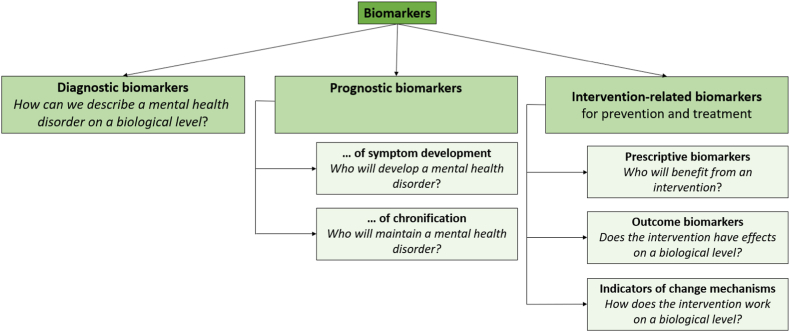
Biological markers, particularly endocrine measurements, are increasingly being integrated into clinical psychological research. We introduce a systematic framework that classifies different functions of such biomarkers. The framework distinguishes between diagnostic biomarkers which add a biological perspective to conventional clinical assessments, prognostic biomarkers that inform about an individual's risk to develop or maintain a mental health disorder, and intervention-related biomarkers. Regarding interventions, including prevention and treatment, it further distinguishes between prescriptive biomarkers which predict an individual's response to an intervention, outcome biomarkers which evaluate intervention-related changes on a biological level and indicators of change mechanisms. We demonstrate how to apply the framework by exemplarily classifying and describing previously published systematic reviews and primary empirical studies on endogenous, peripheral cortisol concentrations as a biomarker for posttraumatic stress disorder (PTSD). The evidence on cortisol's diagnostic and prognostic value is heterogeneous and still sparse regarding parameters based on multiple cortisol measurements, such as the cortisol awakening response. With regard to interventions, most research focused on trauma-focused psychotherapy and cortisol reactivity to trauma reminders. This field of research appears to be growing and very promising due to its potential to optimize PTSD-related interventions. The proposed framework can help in gaining a systematic overview of existing research. It can assist in structuring, comparing, summarizing and evaluating empirical studies, and in identifying research gaps.
生物标志物,尤其是内分泌测量指标,正越来越多地被纳入临床心理学研究。我们引入了一个系统框架,对这类生物标志物的不同功能进行分类。该框架区分了诊断性生物标志物(为传统临床评估增添生物学视角)、预后性生物标志物(告知个体患心理健康障碍或维持该障碍的风险)以及与干预相关的生物标志物。关于包括预防和治疗在内的干预措施,它进一步区分了预测个体对干预反应的处方性生物标志物、在生物学水平上评估与干预相关变化的结果生物标志物以及变化机制指标。我们通过对先前发表的关于内源性、外周皮质醇浓度作为创伤后应激障碍(PTSD)生物标志物的系统评价和主要实证研究进行示例性分类和描述,展示了该框架的应用方法。关于皮质醇诊断和预后价值的证据存在异质性,而且基于多次皮质醇测量的参数(如皮质醇觉醒反应)的证据仍然很少。关于干预措施,大多数研究集中在以创伤为重点的心理治疗以及皮质醇对创伤提示的反应性。由于其优化与PTSD相关干预措施的潜力,该研究领域似乎正在发展且前景广阔。所提出的框架有助于对现有研究进行系统概述。它可以协助构建、比较、总结和评估实证研究,并识别研究空白。