Institute of Evolution and Marine Biodiversity, Key Laboratory of Mariculture (Ministry of Education), Ocean University of China, Qingdao, China.
Laoshan Laboratory, Qingdao, China.
Genome Biol Evol. 2023 Jul 3;15(7). doi: 10.1093/gbe/evad125.
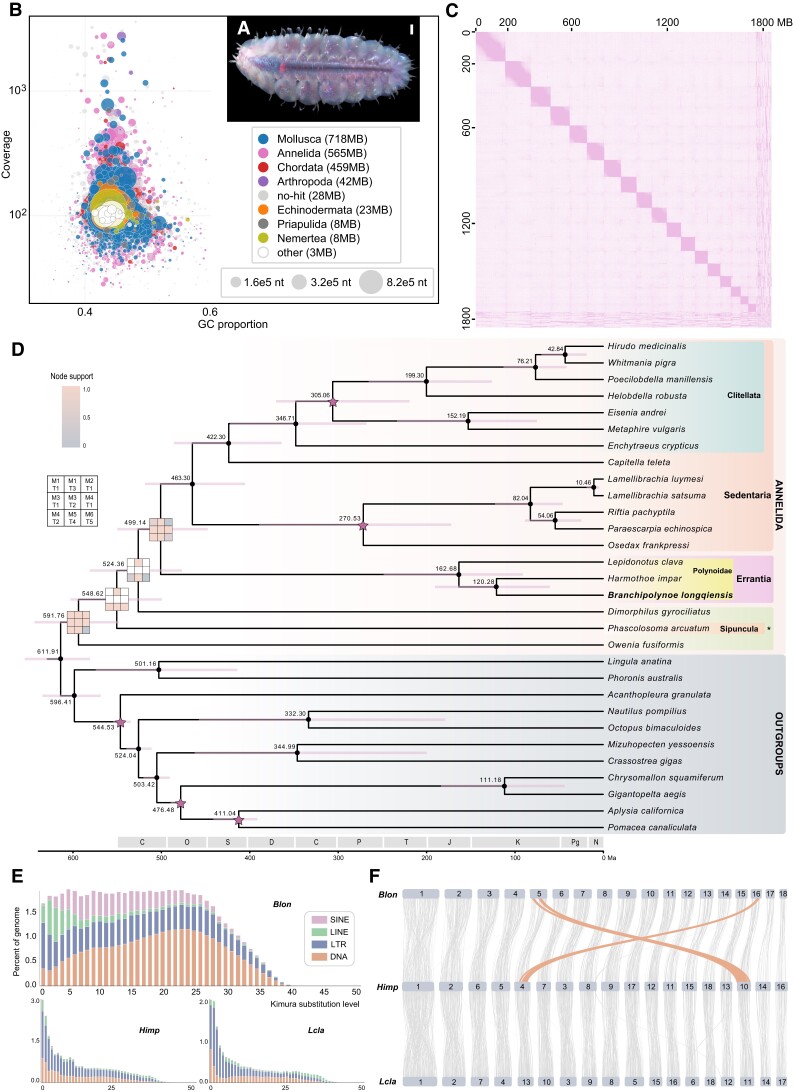
Deep-sea polynoid scale worms endemic to hydrothermal vents have evolved an adaptive strategy to the chronically hypoxic environment, but its underlying molecular mechanisms remain elusive. Here, we assembled a chromosome-scale genome of the vent-endemic scale worm Branchipolynoe longqiensis (the first annotated genome in the subclass Errantia) and annotated two shallow-water polynoid genomes, aiming to elucidate the adaptive mechanisms. We present a genome-wide molecular phylogeny of Annelida which calls for extensive taxonomy revision by including more genomes from key lineages. The B. longqiensis genome with a genome size of 1.86 Gb and 18 pseudochromosomes is larger than the genomes of two shallow-water polynoids, possibly due to the expansion of various transposable elements (TEs) and transposons. We revealed two interchromosomal rearrangements in B. longqiensis when compared with the two shallow-water polynoid genomes. The intron elongation and interchromosomal rearrangement can influence a number of biological processes, such as vesicle transport, microtubules, and transcription factors. Furthermore, the expansion of cytoskeleton-related gene families may favor the cell structure maintenance of B. longqiensis in the deep ocean. The expansion of synaptic vesicle exocytosis genes has possibly contributed to the unique complex structure of the nerve system in B. longqiensis. Finally, we uncovered an expansion of single-domain hemoglobin and a unique formation of tetra-domain hemoglobin via tandem duplications, which may be related to the adaptation to a hypoxic environment.
深海多毛类环节动物特有于热液喷口,已经进化出一种适应慢性缺氧环境的策略,但其中的潜在分子机制仍不清楚。在这里,我们组装了一个热液喷口特有环节动物龙介虫(第一个在类群 ERRANTIA 中注释的基因组)的染色体级别的基因组,并注释了两个浅海多毛类的基因组,旨在阐明适应机制。我们展示了一个环节动物的全基因组分子系统发育,它呼吁通过包括更多来自关键谱系的基因组来进行广泛的分类学修订。B. longqiensis 基因组的大小为 1.86Gb,有 18 个假染色体,比两个浅海多毛类的基因组更大,这可能是由于各种转座元件(TEs)和转座子的扩张。与两个浅海多毛类基因组相比,我们在 B. longqiensis 中发现了两个染色体间的重排。内含子的延长和染色体间的重排可以影响许多生物学过程,如囊泡运输、微管和转录因子。此外,细胞骨架相关基因家族的扩张可能有利于 B. longqiensis 在深海中的细胞结构维持。突触小泡胞吐基因的扩张可能有助于 B. longqiensis 独特的神经系统复杂结构的形成。最后,我们发现了单结构域血红蛋白的扩张和通过串联重复形成的独特的四结构域血红蛋白,这可能与对低氧环境的适应有关。