School of Biological Sciences, The University of Hong Kong, Hong Kong, China.
Department of Organismic and Evolutionary Biology, Museum of Comparative Zoology, Harvard University, Cambridge, MA, USA.
Mol Biol Evol. 2023 Jul 3;40(7). doi: 10.1093/molbev/msad155.
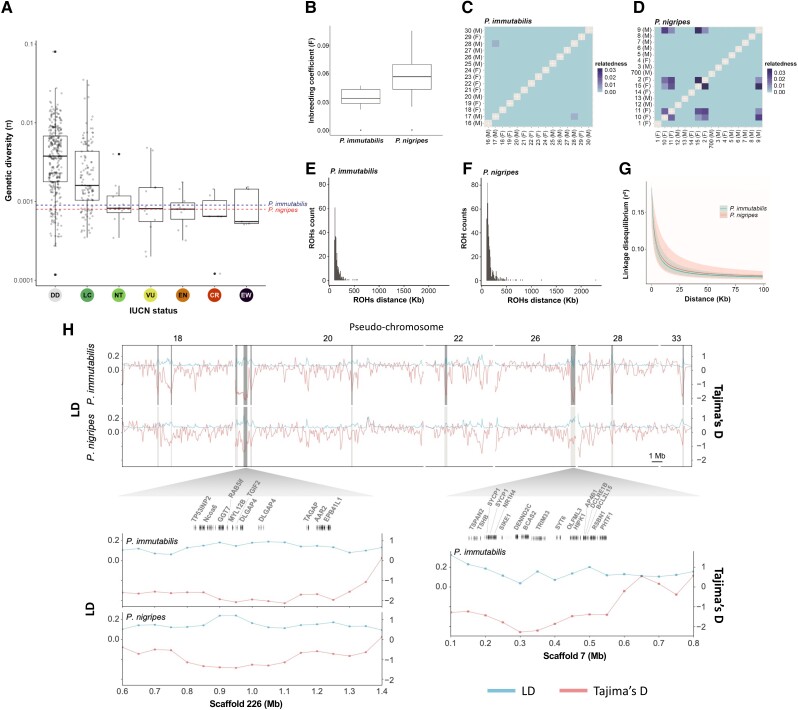
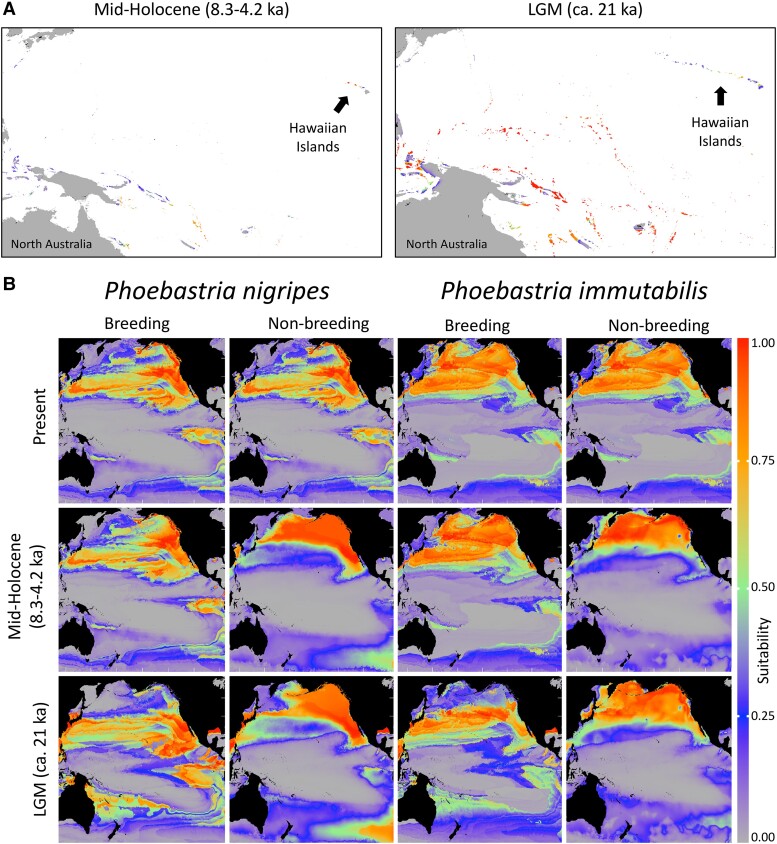
Throughout the Plio-Pleistocene, climate change has impacted tropical marine ecosystems substantially, with even more severe impacts predicted in the Anthropocene. Although many studies have clarified demographic histories of seabirds in polar regions, the history of keystone seabirds of the tropics is unclear, despite the prominence of albatrosses (Diomedeidae, Procellariiformes) as the largest and most threatened group of oceanic seabirds. To understand the impact of climate change on tropical albatrosses, we investigated the evolutionary and demographic histories of all four North Pacific albatrosses and their prey using whole-genome analyses. We report a striking concordance in demographic histories among the four species, with a notable dip in effective population size at the beginning of the Pleistocene and a population expansion in the Last Glacial Period when sea levels were low, which resulted in increased potential coastal breeding sites. Abundance of the black-footed albatross dropped again during the Last Glacial Maximum, potentially linked to climate-driven loss of breeding sites and concordant genome-derived decreases in its major prey. We find very low genome-wide (π < 0.001) and adaptative genetic diversities across the albatrosses, with genes of the major histocompatibility complex close to monomorphic. We also identify recent selective sweeps at genes associated with hyperosmotic adaptation, longevity, and cognition and memory. Our study has shed light on the evolutionary and demographic histories of the largest tropical oceanic seabirds and provides evidence for their large population fluctuations and alarmingly low genetic diversities.
整个上新世-更新世期间,气候变化对热带海洋生态系统产生了重大影响,而在人类世,预计还会产生更严重的影响。尽管许多研究已经阐明了极地海鸟的种群历史,但热带关键海鸟的历史尚不清楚,尽管信天翁(Diomedeidae,海燕目)作为最大和受威胁最严重的海洋海鸟群体而备受关注。为了了解气候变化对热带信天翁的影响,我们使用全基因组分析研究了所有四种北太平洋信天翁及其猎物的进化和种群历史。我们报告说,这四种物种的种群历史惊人地一致,在更新世初期有效种群数量明显下降,在末次冰期海平面较低时种群扩张,这导致潜在的沿海繁殖地增加。在末次冰盛期,黑脚信天翁的数量再次下降,可能与气候驱动的繁殖地丧失以及与其主要猎物的协同基因组下降有关。我们发现信天翁的全基因组(π<0.001)和适应性遗传多样性非常低,主要组织相容性复合体的基因接近单态性。我们还鉴定出与高渗适应、长寿和认知记忆相关的基因最近发生了选择清除。我们的研究揭示了最大的热带海洋海鸟的进化和种群历史,并为它们的大规模种群波动和惊人的低遗传多样性提供了证据。