Rutgers Institute for Health, Center for Pharmacoepidemiology and Treatment Sciences, New Brunswick, NJ, United States of America.
Department of Medicine, Rutgers Robert Wood Johnson Medical School, New Brunswick, NJ, United States of America.
PLoS One. 2023 Jul 5;18(7):e0287218. doi: 10.1371/journal.pone.0287218. eCollection 2023.
Much of the data on BMI-mortality associations stem from 20th century U.S. cohorts. The purpose of this study was to determine the association between BMI and mortality in a contemporary, nationally representative, 21st century, U.S. adult population.
This was a retrospective cohort study of U.S. adults from the 1999-2018 National Health Interview Study (NHIS), linked to the National Death Index (NDI) through December 31st, 2019. BMI was calculated using self-reported height & weight and categorized into 9 groups. We estimated risk of all-cause mortality using multivariable Cox proportional hazards regression, adjusting for covariates, accounting for the survey design, and performing subgroup analyses to reduce analytic bias.
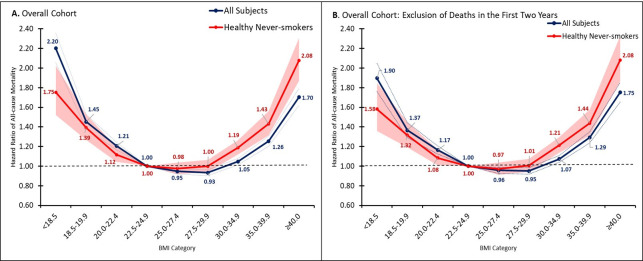
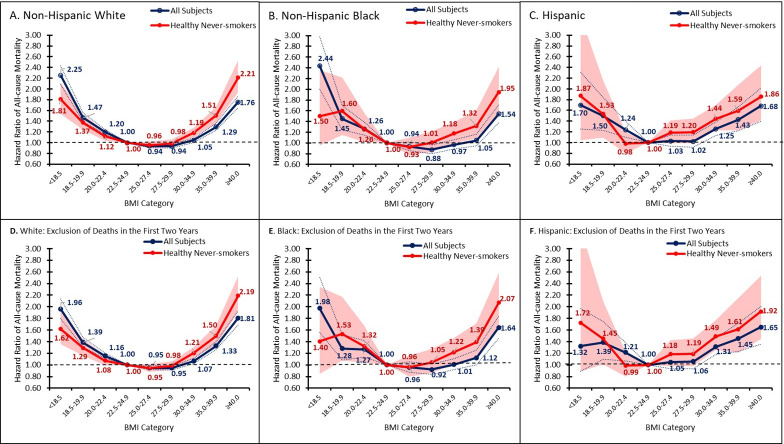
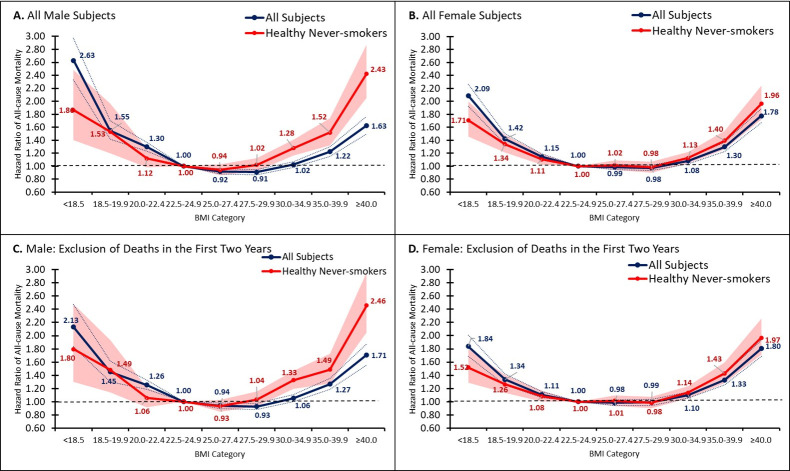
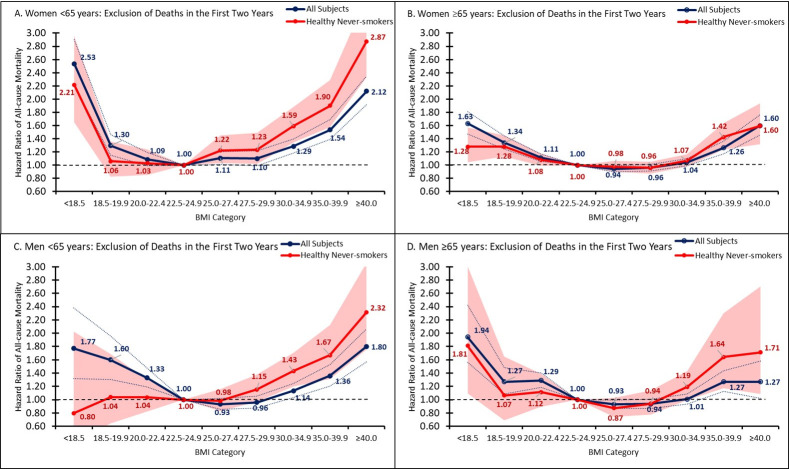
The study sample included 554,332 adults (mean age 46 years [SD 15], 50% female, 69% non-Hispanic White). Over a median follow-up of 9 years (IQR 5-14) and maximum follow-up of 20 years, there were 75,807 deaths. The risk of all-cause mortality was similar across a wide range of BMI categories: compared to BMI of 22.5-24.9 kg/m2, the adjusted HR was 0.95 [95% CI 0.92, 0.98] for BMI of 25.0-27.4 and 0.93 [0.90, 0.96] for BMI of 27.5-29.9. These results persisted after restriction to healthy never-smokers and exclusion of subjects who died within the first two years of follow-up. A 21-108% increased mortality risk was seen for BMI ≥30. Older adults showed no significant increase in mortality between BMI of 22.5 and 34.9, while in younger adults this lack of increase was limited to the BMI range of 22.5 to 27.4.
The risk of all-cause mortality was elevated by 21-108% among participants with BMI ≥30. BMI may not necessarily increase mortality independently of other risk factors in adults, especially older adults, with overweight BMI. Further studies incorporating weight history, body composition, and morbidity outcomes are needed to fully characterize BMI-mortality associations.
BMI 与死亡率之间的关联大多来自 20 世纪美国队列研究的数据。本研究的目的是确定 BMI 与 21 世纪美国当代、全国代表性成年人的死亡率之间的关联。
这是一项回顾性队列研究,研究对象为 1999 年至 2018 年美国国家健康访谈研究(NHIS)中的成年人,通过国家死亡指数(NDI)与 2019 年 12 月 31 日进行链接。BMI 通过自我报告的身高和体重计算得出,并分为 9 组。我们使用多变量 Cox 比例风险回归来估计全因死亡率,调整协变量,考虑到调查设计,并进行亚组分析以减少分析偏倚。
研究样本包括 554332 名成年人(平均年龄 46 岁[15 岁标准差],50%为女性,69%为非西班牙裔白人)。在中位数为 9 年(IQR 5-14)的随访期间和最长 20 年的随访期间,有 75807 人死亡。在广泛的 BMI 范围内,全因死亡率的风险相似:与 BMI 为 22.5-24.9kg/m2 相比,BMI 为 25.0-27.4kg/m2 的调整 HR 为 0.95[95%CI 0.92,0.98],BMI 为 27.5-29.9kg/m2 的调整 HR 为 0.93[0.90,0.96]。这些结果在限制为健康从不吸烟者和排除随访头两年内死亡的受试者后仍然存在。BMI≥30 的人群全因死亡率风险增加 21-108%。老年人群 BMI 在 22.5 至 34.9 之间的死亡率没有显著增加,而年轻人群中这种增加的缺失仅限于 BMI 范围为 22.5 至 27.4。
BMI≥30 的参与者全因死亡率风险增加 21-108%。BMI 可能不一定会增加死亡率,尤其是对于超重 BMI 的成年人,死亡率的增加并不一定独立于其他风险因素。需要进一步的研究,纳入体重史、身体成分和发病率结果,以充分描述 BMI 与死亡率之间的关联。