Department of Disease Control, London School of Hygiene and Tropical Medicine, London, United Kingdom.
Multidisciplinary Initiative for Collaborative Research On Bacterial Resistance (MICROB-R), Santiago, Chile.
Clin Infect Dis. 2023 Jul 5;77(Suppl 1):S20-S28. doi: 10.1093/cid/ciad151.
The impact of coronavirus disease 2019 (COVID-19) on antimicrobial use (AU) and resistance has not been well evaluated in South America. These data are critical to inform national policies and clinical care.
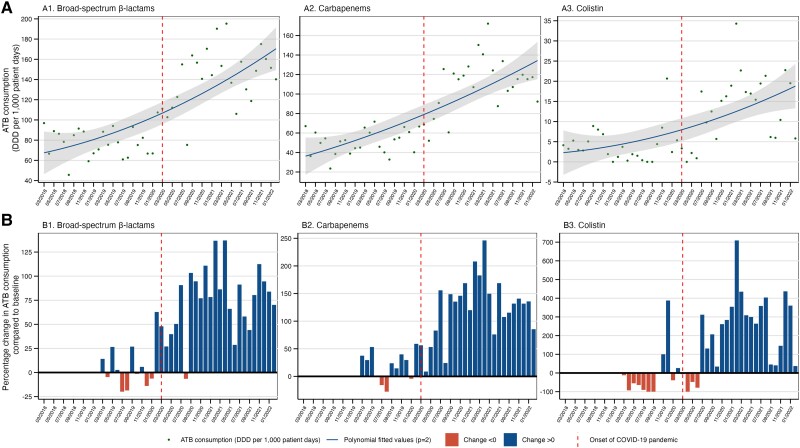
At a tertiary hospital in Santiago, Chile, between 2018 and 2022, subdivided into pre- (3/2018-2/2020) and post-COVID-19 onset (3/2020-2/2022), we evaluated intravenous AU and frequency of carbapenem-resistant Enterobacterales (CRE). We grouped monthly AU (defined daily doses [DDD]/1000 patient-days) into broad-spectrum β-lactams, carbapenems, and colistin and used interrupted time-series analysis to compare AU during pre- and post-pandemic onset. We studied the frequency of carbapenemase-producing (CP) CRE and performed whole-genome sequencing analyses of all carbapenem-resistant (CR) Klebsiella pneumoniae (CRKpn) isolates collected during the study period.
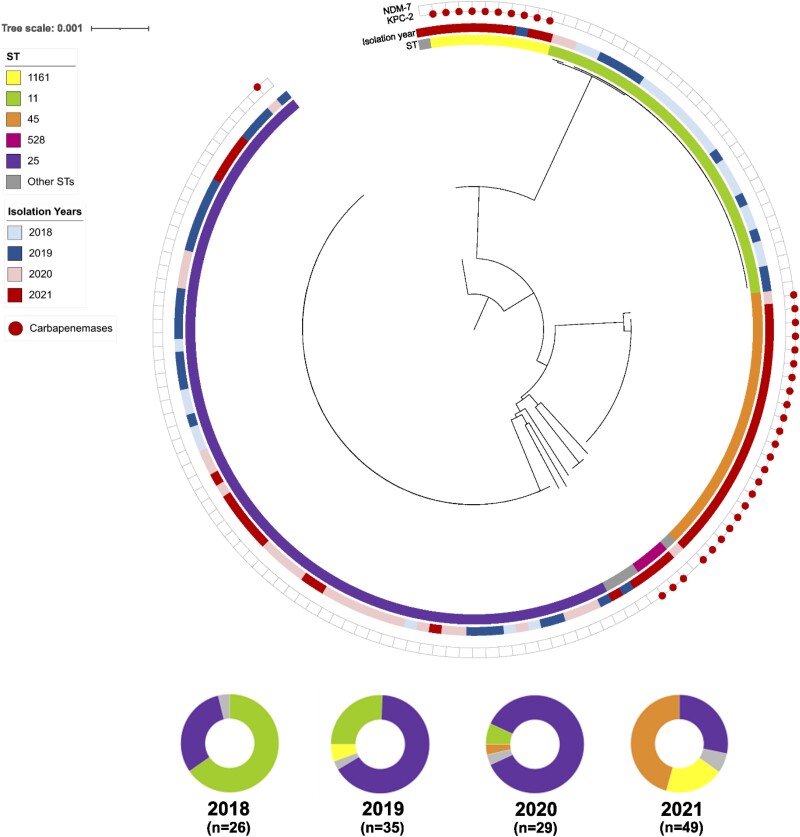
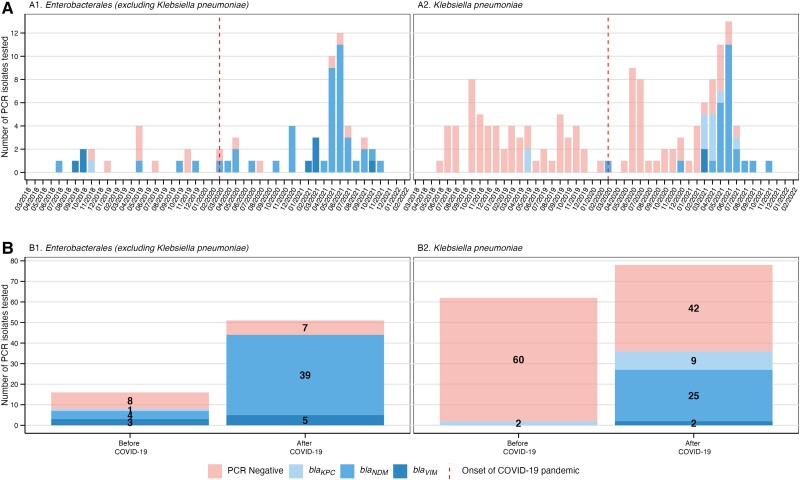
Compared with pre-pandemic, AU (DDD/1000 patient-days) significantly increased after the pandemic onset, from 78.1 to 142.5 (P < .001), 50.9 to 110.1 (P < .001), and 4.1 to 13.3 (P < .001) for broad-spectrum β-lactams, carbapenems, and colistin, respectively. The frequency of CP-CRE increased from 12.8% pre-COVID-19 to 51.9% after pandemic onset (P < .001). The most frequent CRE species in both periods was CRKpn (79.5% and 76.5%, respectively). The expansion of CP-CRE harboring blaNDM was particularly noticeable, increasing from 40% (n = 4/10) before to 73.6% (n = 39/53) after pandemic onset (P < .001). Our phylogenomic analyses revealed the emergence of two distinct genomic lineages of CP-CRKpn: ST45, harboring blaNDM, and ST1161, which carried blaKPC.
AU and the frequency of CP-CRE increased after COVID-19 onset. The increase in CP-CRKpn was driven by the emergence of novel genomic lineages. Our observations highlight the need to strengthen infection prevention and control and antimicrobial stewardship efforts.
新型冠状病毒病 2019(COVID-19)对南美洲抗菌药物使用(AU)和耐药性的影响尚未得到充分评估。这些数据对于制定国家政策和临床护理至关重要。
在智利圣地亚哥的一家三级医院,我们将 2018 年至 2022 年分为 COVID-19 发病前(2018 年 3 月至 2020 年 2 月)和 COVID-19 发病后(2020 年 3 月至 2022 年 2 月)两个阶段,评估了静脉 AU 和碳青霉烯类耐药肠杆菌科(CRE)的频率。我们将每月 AU(定义日剂量[DDD]/1000 患者-天)分为广谱β-内酰胺类、碳青霉烯类和黏菌素类,并使用中断时间序列分析比较发病前和发病后的 AU。我们研究了产碳青霉烯酶(CP)CRE 的频率,并对研究期间收集的所有碳青霉烯类耐药(CR)肺炎克雷伯菌(CRKpn)分离株进行了全基因组测序分析。
与发病前相比,发病后 AU(DDD/1000 患者-天)显著增加,分别从 78.1 增加到 142.5(P<0.001)、50.9 增加到 110.1(P<0.001)和 4.1 增加到 13.3(P<0.001),分别用于广谱β-内酰胺类、碳青霉烯类和黏菌素类。CP-CRE 的频率从 COVID-19 前的 12.8%增加到发病后的 51.9%(P<0.001)。在两个时期,最常见的 CRE 物种均为 CRKpn(分别为 79.5%和 76.5%)。携带 blaNDM 的 CP-CRE 的扩展尤其明显,从发病前的 40%(n=4/10)增加到发病后的 73.6%(n=39/53)(P<0.001)。我们的系统发育基因组学分析揭示了 CP-CRKpn 的两个不同的基因组谱系的出现:携带 blaNDM 的 ST45 和携带 blaKPC 的 ST1161。
COVID-19 发病后,AU 和 CP-CRE 的频率增加。CP-CRKpn 的增加是由新的基因组谱系的出现驱动的。我们的观察结果强调了加强感染预防和控制以及抗菌药物管理努力的必要性。