First Department of Pharmacology, Medical School, Aristotle University of Thessaloniki, 54124, Thessaloniki, Greece.
Second Department of Internal Medicine, 424 General Military Hospital, Thessaloniki, Greece.
Curr Obes Rep. 2023 Sep;12(3):191-206. doi: 10.1007/s13679-023-00519-y. Epub 2023 Jul 5.
To summarize experimental and clinical evidence on the association between tumor necrosis factor-α (TNF-α) and nonalcoholic fatty liver disease (NAFLD) and discuss potential treatment considerations.
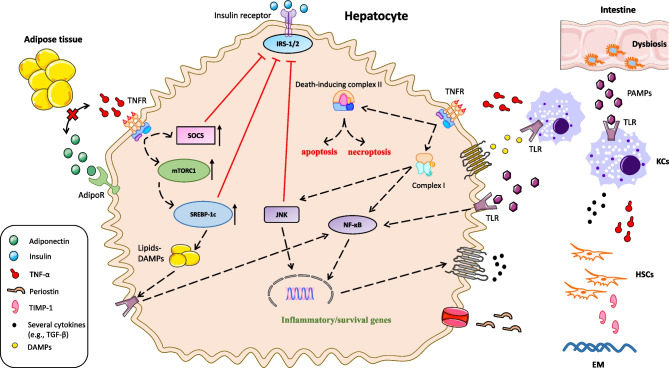
Experimental evidence suggests that TNF-α is a cytokine with a critical role in the pathogenesis of NAFLD. Although, the production of TNF-α may be an early event during the course of nonalcoholic fatty liver (NAFL), TNF-α may play a more substantial role in the pathogenesis of nonalcoholic steatohepatitis (NASH) and NAFLD-associated fibrosis. Moreover, TNF-α may potentiate hepatic insulin resistance, thus interconnecting inflammatory with metabolic signals and possibly contributing to the development of NAFLD-related comorbidities, including cardiovascular disease, hepatocellular carcinoma, and extra-hepatic malignancies. In clinical terms, TNF-α is probably associated with the severity of NAFLD; circulating TNF-α gradually increases from controls to patients with NAFL, and then, to patients with NASH. Given this potential association, various therapeutic interventions (obeticholic acid, peroxisome proliferator-activated receptors, sodium-glucose co-transporter 2 inhibitors, glucagon-like peptide-1 receptor agonists, probiotics, synbiotics, rifaximin, vitamin E, pentoxifylline, ursodeoxycholic acid, fibroblast growth factor-21, n-3 polyunsaturated fatty acids, statins, angiotensin receptor blockers) have been evaluated for their effect on TNF-α and NAFLD. Interestingly, anti-TNF biologics have shown favorable metabolic and hepatic effects, which may open a possible therapeutic window for the management of advanced NAFLD. The potential key pathogenic role of TNF-α in NAFLD warrants further investigation and may have important diagnostic and therapeutic implications.
总结肿瘤坏死因子-α(TNF-α)与非酒精性脂肪性肝病(NAFLD)之间关联的实验和临床证据,并讨论潜在的治疗注意事项。
实验证据表明,TNF-α是一种细胞因子,在 NAFLD 的发病机制中具有关键作用。尽管 TNF-α的产生可能是非酒精性脂肪肝(NAFL)过程中的早期事件,但 TNF-α可能在非酒精性脂肪性肝炎(NASH)和 NAFLD 相关纤维化的发病机制中发挥更重要的作用。此外,TNF-α可能增强肝胰岛素抵抗,从而将炎症与代谢信号相互关联,并可能导致 NAFLD 相关并发症的发生,包括心血管疾病、肝细胞癌和肝外恶性肿瘤。从临床角度来看,TNF-α可能与 NAFLD 的严重程度相关;循环 TNF-α从对照组逐渐增加到 NAFL 患者,然后增加到 NASH 患者。鉴于这种潜在的关联,各种治疗干预措施(奥贝胆酸、过氧化物酶体增殖物激活受体、钠-葡萄糖共转运蛋白 2 抑制剂、胰高血糖素样肽-1 受体激动剂、益生菌、合生菌、利福昔明、维生素 E、己酮可可碱、熊去氧胆酸、成纤维细胞生长因子-21、n-3 多不饱和脂肪酸、他汀类药物、血管紧张素受体阻滞剂)已被评估对 TNF-α和 NAFLD 的影响。有趣的是,抗 TNF 生物制剂已显示出良好的代谢和肝脏作用,这可能为治疗晚期 NAFLD 开辟了一个可能的治疗窗口。TNF-α在 NAFLD 中的潜在关键致病作用需要进一步研究,并可能具有重要的诊断和治疗意义。